Posts

Showing posts with the label wpaxos

FlexiRaft: Flexible Quorums with Raft

Image
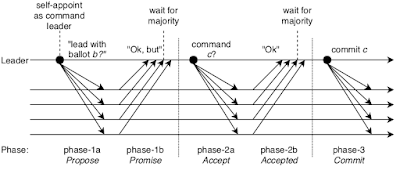
This paper appeared in CIDR23 and is from Meta (wow, this is the first time I used the new name without needing to mention it is in fact Facebook... wait.. goddammit). The paper talks about how they applied Raft to MySQL replication, and used the flexible quorums in the process. This is not a technically deep paper, but it was interesting to see a practical application of flexible quorums idea to Raft rather than Paxos. The most technically interesting part is the adoption of flexible quorums to Raft rather than Paxos. What is the difference? Flexible quorums idea was developed for Paxos's two phases. But, Raft needs to impose an extra requirement on quorums in order to guarantee Leader Completeness: "the new leader must already have all log entries replicated by a majority of nodes in the previous term." The paper does not call this explicitly. This is what the paper says: "For state machine safety, every data commit quorum needs to intersect with every leader elec...
Gryff: Unifying consensus and shared registers

Image
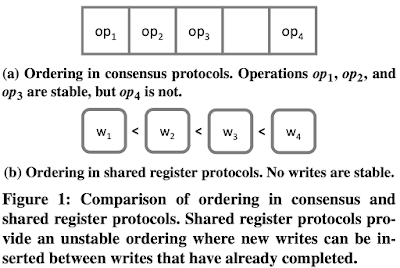
This paper is by Matthew Burke, Audrey Cheng, and Wyatt Lloyd, and appeared in NSDI'20. Here is a link to the paper, slides, and video presentation. Straight talk (from the middle of the book) The model of the paper is a great contribution. Stable versus Unstable ordering is a good framework to think in. Carstamps (consensus after registers) logical clock timestamping is a good way to realize this ordering. I think carstamps will see good adoption, as it is clear, concrete, and useful. Constructing a hybrid of EPaxos and ABD is a novel idea. The performance of Gryff is not good. A straightforward distributed key-value sharded implementation of Paxos would do a better job. I think Hermes is a better choice than Gryff with read-write and read-modify-write operations. Introduction Recently we see a lot of interest in unifying consensus and shared registers, the topic of the paper. I think this is because of the popularity of distributed key-value stores/systems. While con...

Dissecting performance bottlenecks of strongly-consistent replication protocols

Image
Dissecting performance bottlenecks of strongly-consistent replication protocols Ailidani Ailijiang, Aleksey Charapko, and Murat Demirbas. Hey, this is our paper! This appeared in Sigmod 2019 couple weeks back. This paper came out of the dissertation work of Ailidani Ailijiang . He has build the Paxi framework in Go, available on GitHub, to prototype any Paxos flavor quickly. His dissertation is called: "Strongly Consistent Coordination for Wide Area Networks".  Writing blog posts about one's own papers is harder than writing posts about others' papers. When you write a summary of your work, you want to include everything, and cannot detach yourself from specifics easily. I found that I neglected posting about many of our papers, even though it is important to provide brief and accessible summaries of these papers to enhance their reach. It is important to reach more people, because then we can see whether the paper can stand the test of time and push the state o...

Paper review. Sharding the Shards: Managing Datastore Locality at Scale with Akkio

Image
This paper by Facebook, which appeared in OSDI'18, describes the data locality management service, Akkio. Akkio has been in production use at Facebook since 2014. It manages over 100PB of data, and processes over 10 million data accesses per second. Why do we need to manage locality?  Replicating all data to all datacenters is difficult to justify economically (due to the extra storage and WAN networking costs) when acceptable durability and request serving latency could be achieved with 3 replicas. It looks like Facebook had been doing full replication (at least for ViewState and AccessState applications discussed in the evaluation) to all the 6 datacenters back-in-the-day, but as the operation and the number of datacenters grew, this became untenable. So, let's find suitable home-bases for data, instead of fully replicating it to all datacenters. But the problem is access locality is not static. What was a good location/configuration for the data ceases to become suita...

SDPaxos: Building efficient semi-decentralized geo-replicated state machines

Image
In the last decade, the Paxos protocol family grew with the addition of new categories. Rotating leader: Mencius Leaderless: EPaxos, Fast Paxos Paxos federations: Spanner , vertical Paxos  Dynamic key-leader: WPaxos   This paper, which appeared in SOCC 18, proposes SDPaxos which prescribes separating the control plane (single leader) from the replication plane (multiple leaders). SD in SDPaxos stands for "semi-decentralized". The motivation for this stems from the following observation. Single leader Paxos approach has a centralized leader and runs into performance bottleneck problems. On the other hand, the leaderless (or opportunistic multileader) approach is fully decentralized but suffers from the conflicting command problems. Taking a hybrid approach to capture the best of both worlds, SDPaxos makes the command-leaders to be decentralized (the closest replica can lead the command), but the ordering-leader (i.e., the sequencer) is still centralized/unique in t...

Popular posts from this blog

Hints for Distributed Systems Design

The Agentic Self: Parallels Between AI and Self-Improvement

Learning about distributed systems: where to start?

5 Lessons at 50

Foundational distributed systems papers

Building a Database on S3

Cloudspecs: Cloud Hardware Evolution Through the Looking Glass

Specula: Scaling formal specifications for autonomous model checking of system code

Aurora DSQL: Scalable, Multi-Region OLTP

What I'd do as a College Freshman in 2025