Posts

Showing posts with the label serializability

The Serial Safety Net: Efficient Concurrency Control on Modern Hardware

Image
This paper proposes a way to get serializability without completely destroying your system's performance. I quite like the paper, as it flips the script on how we think about database isolation levels.  The Idea In modern hardware setups (where we have massive multi-core processors, huge main memory, and I/O is no longer the main bottleneck), strict concurrency control schemes like Two-Phase Locking (2PL) choke the system due to contention on centralized structures. To keep things fast, most systems default to weaker schemes like Snapshot Isolation (SI) or Read Committed (RC) at the cost of allowing dependency cycles and data anomalies. Specifically, RC leaves your application vulnerable to unrepeatable reads as data shifts mid-flight, while SI famously opens the door to write skew, where two concurrent transactions update different halves of the same logical constraint. Can we have our cake and eat it too? The paper introduces the Serial Safety Net (SSN), as a certifier that sits...

Morty: Scaling Concurrency Control with Re-Execution

Image
This EuroSys '23 paper reads like an SOSP best paper. Maybe it helped that EuroSys 2023 was in Rome. Academic conferences are more enjoyable when the venue doubles as a vacation. The Problem Morty tackles a fundamental question: how can we improve concurrency under serializable isolation (SER), especially without giving up on interactive transactions? Unlike deterministic databases (e.g., Calvin ) that require transactions to declare read and write sets upfront, Morty supports transactions that issue dynamic reads and writes based on earlier results. Transactional systems, particularly in geo-replicated settings, struggle under contention. High WAN latency stretches transaction durations, increasing the window for conflicts. The traditional answer is blind exponential backoff, but that leads to low CPU utilization. TAPIR and Spanner replicas often idle below 17% under contention as Morty's evaluation experiments show. Morty's approach to tackle the problem is to start from...

Serializable Isolation for Snapshot Databases

Image
This paper (SIGMOD '08) proposes a lightweight runtime technique to make Snapshot Isolation (SI) serializable without falling back to locking. The key idea behind Serializable SI (SSI) is to detect potentially dangerous (write-skew) executions at runtime and abort one of the transactions to guarantee serializability (SER). The goal is to offer the strong guarantees of SER without sacrificing SI's high performance and non-blocking reads. But would it make sense to implement SER by layering on MVCC SI instead of implementing it directly? Do you think an SI-based implementation would be more performant than native 2PL-based SER implementations? What about compared to OCC-based SER? The evaluation section gives some answers. The problem and insight Let's back up. Write-skew is the canonical anomaly under SI. And the canonical example for write-skew is the "doctors on-call" scenario. Consider two doctors removing themselves from a duty roster. Each transaction checks ...

Fast Serializable Multi-Version Concurrency Control for Main-Memory Database Systems

Image
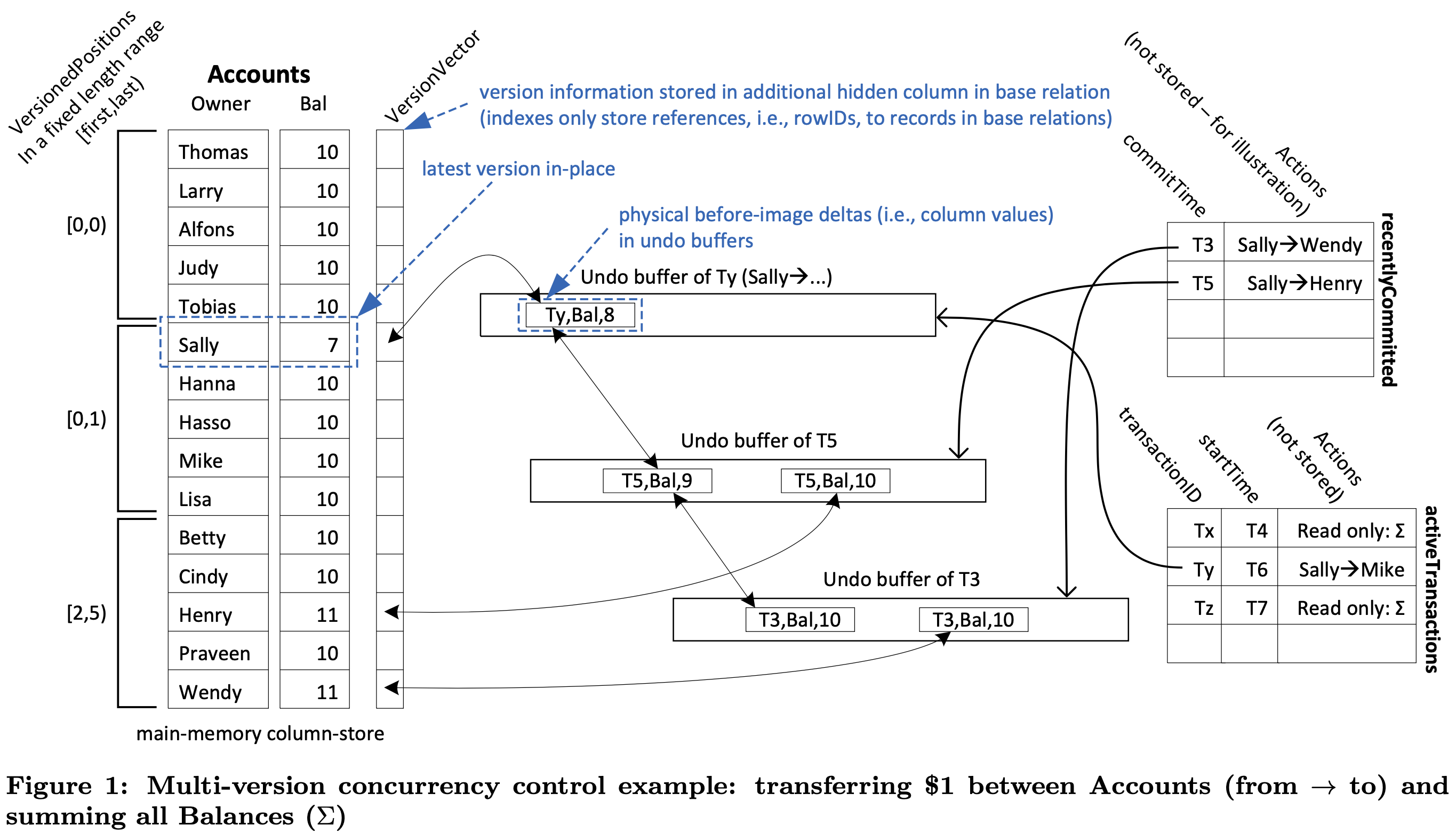
This paper from Sigmod 2015 describes the addition of Multi-Version Concurrency Control (MVCC) to the Hyper database, and discusses at length how they implement serializability efficiently with little overhead compared to snapshot isolation. Coming only two years later, this paper seems like a response/one-up-manship to the Hekaton paper . In the paper, you can see at many places statements like "in constrast to/ unlike/ as in/ Hekaton" phrase. In a way, that is the biggest compliment a paper can pay to another paper. Hyper is also an in-memory database as in Hekaton. The paper says that Hyper is like Hekaton in that, in order to preserve scan performance, new transactions are not allocated a separate place. The most uptodate version of the database is kept all in the same place. But, you can reach older versions of a record (that are still in use by active transactions) by working backwards from the record using the delta versions maintained. The biggest improvement in Hyp...

Popular posts from this blog

Hints for Distributed Systems Design

The Agentic Self: Parallels Between AI and Self-Improvement

Learning about distributed systems: where to start?

5 Lessons at 50

Foundational distributed systems papers

Building a Database on S3

Cloudspecs: Cloud Hardware Evolution Through the Looking Glass

TLA+ modeling tips

Supporting our AI overlords: Redesigning data systems to be Agent-first

Disaggregation: A New Architecture for Cloud Databases