Posts

Showing posts with the label serverless

CockroachDB Serverless: Sub-second Scaling from Zero with Multi-region Cluster Virtualization

Image
This paper describes the architecture behind CockroachDB Serverless. At first glance, the design can feel like cheating. Rather than introducing a new physically disaggregated architecture with log and page stores, CRDB retrofits its existing implementation through logical disaggregation: It splits the binary into separate SQL and KV processes and calls it serverless. But dismissing this as fake disaggregation would miss the point. I came to appreciate this design choice as I read the paper (a well written paper!). This logical disaggregation (the paper calls it cluster virtualization) provides a pragmatic evolution of the shared-nothing model. CRDB pushes the SQL–KV boundary (as in systems like TiDB and FoundationDB) to its logical extreme to provide the basis for a multi-tenant storage layer. From here on, they solve the sub-second cold starts problem and admission control problems with good engineering rather than an architectural overhaul. System Overview If you split the stack at...
Paper summary. Cloud programming simplified: A Berkeley view on Serverless Computing

Image
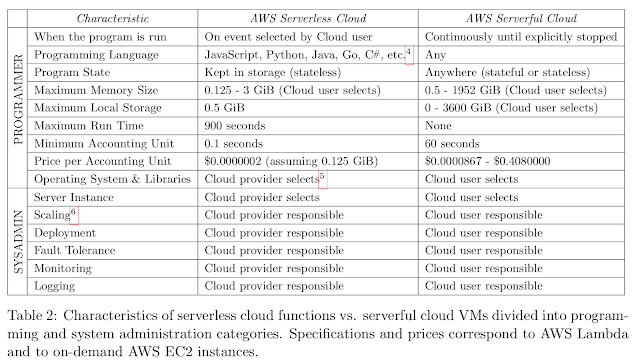
This position paper by UC Berkeley RISE lab is about serverless computing, its shortcomings, and its potential. It is easy reading, and is still useful even if you have a pretty good understanding about serverless computing due to some insights and forecasts in the paper. As you will read below, the paper provides a very strong endorsement for serverless computing. Instead of explaining the paper in my terms, I quote some of my highlights from the paper below, and at the end, in the MAD questions section, I discuss some of my thoughts on serverless computing. Introduction We believe the main reason for the success of low-level virtual machines was that in the early days of cloud computing users wanted to recreate the same computing environment in the cloud that they had on their local computers to simplify porting their workloads to the cloud. To set up your own environment in cloud (using virtual machines), you need to address these 8 issues. Redundancy for availability, ...

Popular posts from this blog

Hints for Distributed Systems Design

The Agentic Self: Parallels Between AI and Self-Improvement

Learning about distributed systems: where to start?

5 Lessons at 50

Foundational distributed systems papers

Building a Database on S3

Cloudspecs: Cloud Hardware Evolution Through the Looking Glass

Aurora DSQL: Scalable, Multi-Region OLTP

TLA+ modeling tips

Supporting our AI overlords: Redesigning data systems to be Agent-first