Posts

Showing posts with the label calm

DBSP: Automatic Incremental View Maintenance for Rich Query Languages

Image
Incremental computation represents a transformative (!) approach to data processing. Instead of recomputing everything when your input changes slightly, incremental computation aims to reuse the original output and efficiently update the results. Efficiently means performing work proportional only to input and output changes. This paper introduces DBSP, a programming language inspired by signal processing (hence the name DB-SP). DBSP is  simple, yet it offers extensive computational capabilities. With just four operators, it covers complex database queries, including entire relational algebra, set and multiset computations, nested relations, aggregations, recursive queries, and streaming computations. Basic DBSP operators  The language is designed to capture computation on streams. Streams are represented as infinite vectors indexed by consecutive time. Each stream can represent values of any type and incorporates basic mathematical operations like addition, subtraction, and ...

Transactional storage for geo-replicated systems

Image
This paper from SOSP 2011 describes a distributed storage system called Walter. Walter targets web applications that operate across multiple geographic sites, and it aims to balance consistency and latency in such systems by providing strong consistency within a site, and weaker consistency across sites. Parallel Snapshot Isolation (PSI) The paper introduces a new isolation property called Parallel Snapshot Isolation (PSI). PSI ensures consistent snapshots and transaction ordering within a site, causal ordering across sites, and prevention of write-write conflicts. PSI extends snapshot isolation (see Fig 3 for illustration of snapshot isolation, and here for an example of snapshot isolated database modeling ) by allowing different sites to have different commit orderings. For example, suppose site A executes transactions T1, T2 and site B executes transactions T3, T4. PSI allows site A to first incorporate just T1, T2 and later T3, T4, while site B first incorporates T3, T4 and later ...

Optimizing Distributed Protocols with Query Rewrites

Image
This paper (Sigmod 2024) formalizes scalability optimizations as rule-driven rewrites, inspired by SQL query optimizations. It focuses on two well-known and popular techniques: decoupling (distributing logic/code across nodes for introducing pipeline parallelism) and partitioning (distributing data across nodes--no new components, but instances of them-- for workload parallelism). Whittaker et al. (hi!) applied decoupling and partitioning optimizations to Paxos in the Compartmentalized Paxos work. That work deconstructed Paxos and showed how to reconstruct it using decoupling and partitioning to be more scalable by individually focusing on each component/role in Paxos. This is a simple but effective trick. Even after you learn the trick, you still keep getting surprised by how effective it is. The current paper aims to do this application via query rewrite rules more methodically rather than the traditional/ad-hoc way.  To this end, the paper utilizes Dedalus, a Datalog¬ dialect ...

New directions in cloud programming

Image
This paper appeared in CIDR'21 . This paper is also on operationalizing CALM theorem, and is a good companion to the CALM-CRDT paper we covered yesterday. The paper starts by pointing out the challenges of cloud programmability. It says that most developers find it hard to harness the enormous potential of the cloud, and that the cloud has yet to provide a programming environment that exposes the inherent power of the platform. The paper then lays out an agenda for providing a new generation of cloud programming environment to programmers in an evolutionary fashion. I would like to start by challenging the claim that the cloud about not yet providing a noteworthy programming environment. I think there are many examples of successful cloud programming paradigms and frameworks that have emerged in the past decade, such as MapReduce, Resilient Distributed Datasets, Hadoop environment, Spark environment, real time data processing and streaming systems, distributed machine learning syst...

Keep CALM and CRDT On

Image
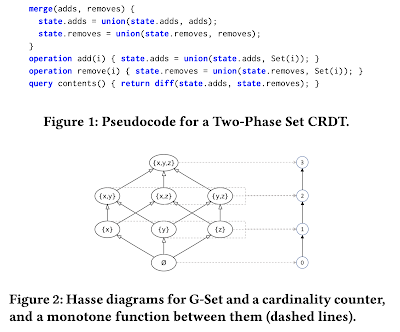
This paper is from VLDB'22. It focuses on the read/querying problem of conflict-free replicated data types (CRDTs). To solve this problem, it proposes extending CRDTs with a SQL API query model, applying the CALM theorem to identify which queries are safe to execute locally on any replica. The answer is of no surprise: monotonic queries can provide consistent observations without coordination. CRDTs To ensure replica consistency in distributed systems, a common method is to enforce strong consistency at the storage layer using traditional distributed coordination techniques such as consensus or transactions. However, for some applications this may create concerns about latency and availability (especially when a quorum is not readily available). Alternatively, developers can use weakly consistent storage models that don't require coordination, but they must ensure consistency at the application level. This is where CRDTs enter the picture, as they can provide a straightforward...

Popular posts from this blog

Hints for Distributed Systems Design

The Agentic Self: Parallels Between AI and Self-Improvement

Learning about distributed systems: where to start?

5 Lessons at 50

Foundational distributed systems papers

Building a Database on S3

Cloudspecs: Cloud Hardware Evolution Through the Looking Glass

TLA+ modeling tips

Supporting our AI overlords: Redesigning data systems to be Agent-first

Advice to the young