Posts

Showing posts with the label Azure

Going Beyond an Incident Report with TLA+

Image
This is a short article at usenix-login about the use of TLA+ to explain root cause for an Azure incident. It seems like this is part of a longer arxiv paper on the use of TLA+ for exploring/explaining data consistency in Cosmos DB. Markus Kuppe is an author here. Markus is heading the TLA+ model checker, TLC, development for more than a decade. If you've used the TLA+ model checker, you used Markus's work. If you are an intermediate/advanced user, it is very likely that you interacted with Markus, and got help from him at some point. The incident The Microsoft Azure incident is a 28-day outage. It looks like the incident got undetected/unreported for 26 days, because it was a partial outage. " A majority of requests did not fail -- rather, a specific type of request was disproportionately affected, such that global error rates did not reveal the outage despite a specific group of users being impacted. " For each request serviced by the work dispatcher, it would (1)...
Socrates: The New SQL Server in the Cloud (Sigmod 2019)

Image
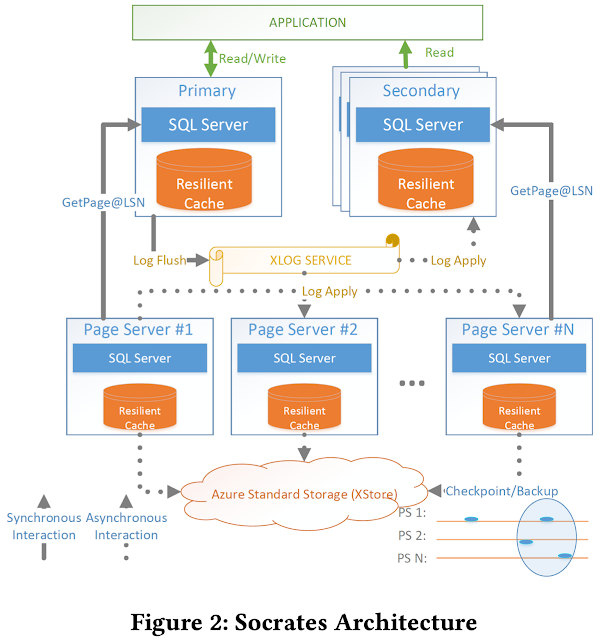
This paper (Sigmod 2019) presents Socrates, the database-as-a-service (DBaaS) architecture of the  Azure SQL DB Hyperscale. Deploying a DBaaS in the cloud requires an architecture that is cost-effective yet performant. An idea that works well is to decompose/disaggregate the functionality of a database into two as compute services (e.g., transaction processing) and storage services (e.g., checkpointing and recovery). The first commercial system that adopted this idea is Amazon Aurora. The Socrates design adopts the separation of compute from storage as it has been proven useful. In addition, Socrates separates database log from storage and treats the log as a first-class citizen. Separating the log and storage tiers disentangles durability (implemented by the log) and availability (implemented by the storage tier). This separation yields significant benefits: in contrast to availability, durability does not require copies in fast storage, in contrast to durability, availability do...

SOSP19 Day 1, Debugging session

Image
This session was the first session after lunch and had four papers on debugging in large scale systems. CrashTuner: Detecting Crash Recovery Bugs in Cloud Systems via Meta-info Analysis This paper is by Jie Lu (The Institute of Computing Technology of the Chinese Academy of Sciences), Chen Liu (The Institute of Computing Technology of the Chinese Academy of Sciences), Lian Li (The Institute of Computing Technology of the Chinese Academy of Sciences), Xiaobing Feng (The Institute of Computing Technology of the Chinese Academy of Sciences), Feng Tan (Alibaba Group), Jun Yang (Alibaba Group), Liang You (Alibaba Group) . Crash recovery code can be buggy and often result in catastrophic failure. Random fault injection is ineffective for detecting them as they are rarely exercised. Model checking at the code level is not feasible due to state space explosion problem. As a result, crash-recovery bugs are still widely prevalent. Note that the paper does not talk about "crush" b...

Azure Cosmos DB: Microsoft's Cloud-Born Globally Distributed Database

Image
It has been almost 9 months since I started my sabbatical work with the Microsoft Azure Cosmos DB team.  I knew what I signed up for then, and I knew it was overwhelming. It is hard not to get overwhelmed. Cosmos DB provides a global highly-available low-latency all-in-one database/storage/querying/analytics service to heavyweight demanding businesses. Cosmos DB is used ubiquitously within Microsoft systems/services, and is also one of the fastest-growing services used by Azure developers externally. It manages 100s of petabytes of indexed data, and serves 100s of trillions of requests every day from thousands of customers worldwide, and enables customers to build highly-responsive mission-critical applications. But I underestimated how much there is to learn about, and how long it would be to develop a good sense of the big picture. By "developing a good sense of the big picture", I mean learning/internalizing the territory myself, and, when looking at the terrain, bei...

Paper review. Sharding the Shards: Managing Datastore Locality at Scale with Akkio

Image
This paper by Facebook, which appeared in OSDI'18, describes the data locality management service, Akkio. Akkio has been in production use at Facebook since 2014. It manages over 100PB of data, and processes over 10 million data accesses per second. Why do we need to manage locality?  Replicating all data to all datacenters is difficult to justify economically (due to the extra storage and WAN networking costs) when acceptable durability and request serving latency could be achieved with 3 replicas. It looks like Facebook had been doing full replication (at least for ViewState and AccessState applications discussed in the evaluation) to all the 6 datacenters back-in-the-day, but as the operation and the number of datacenters grew, this became untenable. So, let's find suitable home-bases for data, instead of fully replicating it to all datacenters. But the problem is access locality is not static. What was a good location/configuration for the data ceases to become suita...

Paper review. Serverless computing: One step forward, two steps back

Serverless computing offers the potential to program the cloud in an autoscaling and pay-only-per-invocation manner. This paper from UC Berkeley (to appear at CIDR 19) discusses limitations in the first-generation serverless computing, and argues that its autoscaling potential is at odds with data-centric and distributed computing. I think the paper is written to ignite debate on the topic, so here I am writing some of my takes on these arguments. Overall, I think the paper could have been written in a more constructive tone. After you read the entire paper, you get a sense that the authors want to open constructive dialogue for improving the state of serverless rather than to crucify it. However, the overly-critical tone of the paper leads to some unfair claims,  not only about serverless, but also about cloud computing as well. This paragraph in the introduction is a good example. New computing platforms have typically fostered innovation in programming languages and environ...

Popular posts from this blog

Writing as a thinking tool

The Man from the Future: Why Johnny Can't Stop Abstracting

The Safest Job from AI may be Writing

The Two Abstractions of System Design: Hide or Reduce

In Search of a Compositional Theory of Self-Stabilization

The Agentic Self: Parallels Between AI and Self-Improvement

Learning about distributed systems: where to start?

Building a Database on S3

Foundational distributed systems papers

What I'd do as a College Freshman in 2025