Posts

Showing posts with the label OLTP

HPTS'24 Day 1, part 1

Image
Wow, what a week that was! The two days of HPTS (Monday and Tuesday this week) felt like a week to me. I learned a lot, and had a lot of good conversations, and even was able to squeeze in some beach walks in there.  HPTS has been operating since 1985, convenening mostly every two years. It has been described as Davos for database systems. Pat Helland has been running HPTS since 1989, and as usual he kicked it off with some short opening remarks 8:30am Monday morning.  Pat reminisced on the early HPTSs which discussed cutting edge work on scalable computing, punching past 100 txn on a mainframe! Then he quickly set the context of the workshop. This event is about meeting people. There are 130 people, with 20+ of them students. He said "your job is to meet everyone, HPTS is about the connections you make". The HPTS website also emphasizes this. "HPTS is about the breaks. The presentations punctuate the breaks! HPTS exists to promote community and relationships. This comm...

OLTP Through the Looking Glass, and What We Found There

Image
This paper appeared in Sigmod 2008.  The goal of the paper is to rethink the Online Transaction Processing (OLTP) database architecture (which remained largely unchanged from late 1970s) and to test out a streamlined/stripped-out in-memory database architecture. To this end, the paper dissects where time is spent inside of a single node OLTP database system, and carefully measures the performance of various stripped down variants of that system. Motivation OLTP databases were optimized for the computer technology of the 1970s-80s.  Multi-threaded execution was adopted to allow other transactions to make progress while one transaction waits for data to be fetched from the slow, rotating disk drive. Locking-based concurrency control was adopted since conflicts were inevitable in these disk-bound transactions, and since the small dataset sizes and the workloads of the time resulted in extremely "hot" keys. The computing world now is quite a different environment. Fast SSDs and a...

Tunable Consistency in MongoDB

Image
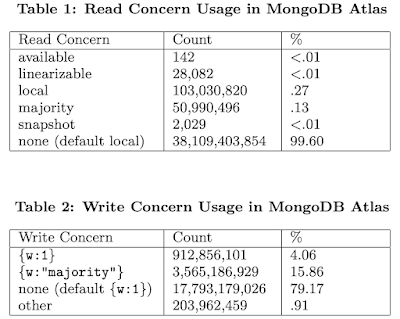
This paper appeared in VLDB 2019. It discusses the tunable consistency models in MongoDB and how MongoDB's speculative execution model and data rollback protocol enable this spectrum of consistency levels efficiently. Motivation Applications often tolerate short or infrequent periods of inconsistency, so it may not make sense for them to pay the high cost of ensuring strong consistency at all times. These types of trade-offs have been partially codified in the PACELC theorem . The Probabilistically Bounded Staleness work (and many followup work ) explored the trade-offs between operation latency and data consistency in distributed database replication and showcased their importance.  To provide users with a set of tunable consistency options, MongoDB exposes writeConcern and readConcern levels as parameters that can be set on each database operation. writeConcern specifies what durability guarantee a write must satisfy before being acknowledged to a client. Similarly, readConc...

Scalable OLTP in the Cloud: What’s the BIG DEAL?

Image
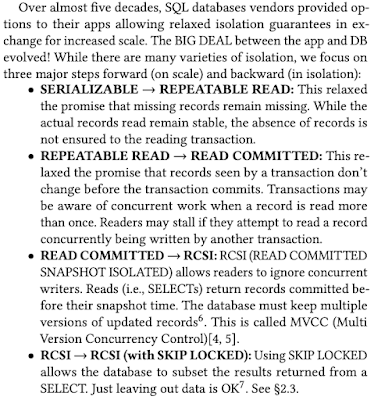
This paper is from Pat Helland, the apostate philosopher of database systems, overall a superb person, and a good friend of mine. The paper appeared this week at CIDR'24. (Check out the program for other interesting papers). The motivating question behind this work is: " What are the asymptotic limits to scale for cloud OLTP (OnLine Transaction Processing) systems? " Pat says that the CIDR 2023 paper "Is Scalable OLTP in the Cloud a Solved Problem?" prompted this question.  The answer to the question? Pat says that the answer lies in the joint responsibility of database and the application. If you know of Pat's work, which I have summarized several in this blog , you would know that Pat has been advocating along these lines before. But this paper provides a very crisp, specific, concrete answer. Read on for my summary of the paper. Disclaimer: This is a wisdom and technical information/detail packed 13-page paper, so I will try my best to summarize the sa...

Epoxy: ACID Transactions Across Diverse Data Stores

Image
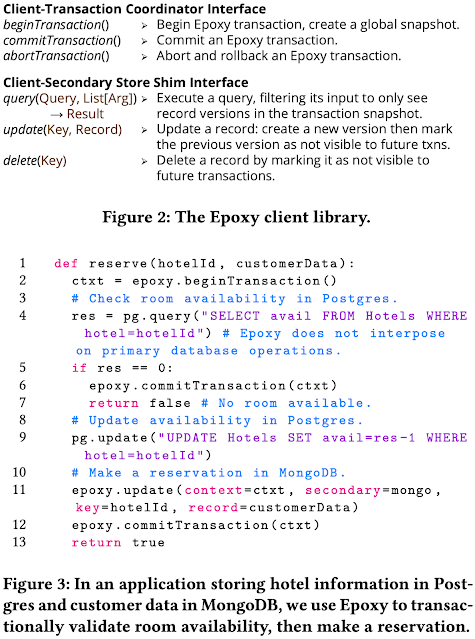
This VLDB'23 paper is a lovely and useful/practical piece of work. It is database in a can! It goes through all aspects of the protocol and implementation and solves a practical real problem. As with any systems (and especially distributed systems) problem, you initially think "oh how hard/complicated this could be", but as you delve in to the details, you realize there is a lot of things to consider and resolve. The paper does a great job presenting the challenges, and walking the reader through them. Ok, what is this Epoxy work about? Epoxy leverages Postgres transactional database as the primary/coordinator and  extends multiversion concurrency control (MVCC) for cross-data store isolation. It provides isolation as well as atomicity and durability through its optimistic concurrency control (OCC) plus two-phase commit (2PC) protocol. Epoxy was implemented as a bolt-on shim layer for five diverse data stores: Postgres, MySQL, Elasticsearch, MongoDB, and Google Cloud Sto...

Popular posts from this blog

Hints for Distributed Systems Design

The Agentic Self: Parallels Between AI and Self-Improvement

Learning about distributed systems: where to start?

5 Lessons at 50

Foundational distributed systems papers

Building a Database on S3

Cloudspecs: Cloud Hardware Evolution Through the Looking Glass

TLA+ modeling tips

Supporting our AI overlords: Redesigning data systems to be Agent-first

Disaggregation: A New Architecture for Cloud Databases