Posts

Showing posts with the label auditability

Paper summary. SnailTrail: Generalizing critical paths for online analysis of distributed dataflows

Image
Monitoring is very important for distributed systems, and I wish it would receive more attention in research conferences. There has been work on monitoring for predicate detection purposes and for performance problem detection purposes. As machine learning and big data processing frameworks are seeing more action, we have been seeing more work on the latter category. For example in ML there have been work on how to figure out what is the best configuration to run. And in the context of general big data processing framework there has been work on identifying performance bottlenecks. Collecting information and creating statistics about a framework to identify the bottleneck activities seems like an easy affair. However, the "making sense of performance" paper (2015) showed that this is not as simple as it seems, and sophisticated techniques such as blocked time analysis are needed to get a more accurate picture of performance bottlenecks. This paper (by ETH Zurich and due ...

Retroscope: Retrospective cut-monitoring of distributed systems (part 3)

Image
This post continues the discussion on monitoring distributed systems with Retroscope . Here we focus on cut monitoring approach Retroscope uses. (This post is jointly written with  Aleksey Charapko and Ailidani Ailijiang.) Retroscope is a monitoring system for exploring global/nonlocal state history of a distributed system. It differs from other monitoring tools due to the way it inspects the system state. While request tracers inspect the system by following the trace of a request (i.e. request r in the figure), Retroscope performs cut monitoring and examines the system at consistent global cuts, observing the state across many machines and requests. It moves along the system history and scans a progression of states one cut at a time, checking cut  Ts1 and then Ts2 and so on. Retroscope’s cut monitoring approach is complementary to the request tracing solutions, and brings a number of advantages. First, by exposing the nonlocal state, Retroscope enables users to examine...

Retroscope: Retrospective Monitoring of Distributed Systems (part 2)

Image
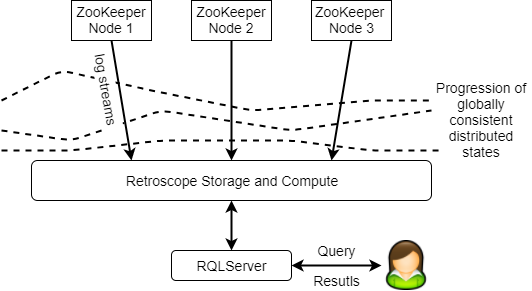
This post, part 2, focuses on monitoring distributed systems using Retroscope. This is a joint post with Aleksey Charapko . If you are unfamiliar with hybrid logical clocks and distributed snapshots, give part 1 a read first. Monitoring and debugging distributed applications is a grueling task. When you need to debug a distributed application, you will often be required to carefully examine the logs from different components of the application and try to figure out how these components interact with each other. Our monitoring solution, Retroscope, can help you with aligning/sorting these logs and searching/focusing on the interesting parts. In particular, Retroscope captures a progression of globally consistent distributed states of a system and allows you to examine these states and search for global predicates. Let’s say you are working on debugging ZooKeeper, a popular coordination service. Using Retroscope you can easily add instrumentation to the ZooKeeper nodes to log and ...

Retrospective Lightweight Distributed Snapshots Using Loosely Synchronized Clocks

Image
This is a summary of our recent work that appeared at ICDCS 2017 . The tool we developed, Retroscope (available on GitHub), enables unplanned retrospective consistent global snapshots for distributed systems. Many distributed systems would benefit from the ability to take unplanned snapshots of the past. Let's say Alice notices alarms going off for her distributed system deployment at 4:05pm. If she could roll-back to the state of the distributed system at 4:00pm, and roll forward step by step to figure out what caused the problems, she may be able to remedy the problem. The ability to take retrospective snapshots requires each node to maintain a log of state changes and then to collate/align these logs to construct a consistent cut at a given time. However, clock uncertainty/skew among nodes is dangerous and can lead to taking an inconsistent snapshot. For example, the cut at 4:00pm in this figure using NTP is inconsistent, because event F is included in the cut, but causally...

It is about time

A couple months ago, I had visitors from SpectraCom. They gifted me a GPS timeserver . I am now the guy with the most accurate time in the department. I have a GPS clock in my office. Syncs < 100 nanosecond of UTC. pic.twitter.com/9XkDFSMdKm — Murat Demirbas (@muratdemirbas) August 9, 2016 We met with these engineers for a couple hours discussing about time synchronization. It was a very enjoyable discussion and time flew by. We talked about how to achieve time synchronization at a box, how to distribute it, and its applications. I had taken some notes, and thought it would be useful to share them. Estimated reading time: 6 minutes. Suggested song to accompany (right-click and open link in new tab): Time from Pink Floyd Precise clocks in a box Atomic clocks often use Ribidium , which has a drift of only 1 microsecond a day. OCXO ovenized oscillators are the second best way to have precise clocks in a box. Temperature change has the most effect in crystal oscillation ...

Popular posts from this blog

Writing as a thinking tool

The Man from the Future: Why Johnny Can't Stop Abstracting

The Safest Job from AI may be Writing

The Two Abstractions of System Design: Hide or Reduce

In Search of a Compositional Theory of Self-Stabilization

The Agentic Self: Parallels Between AI and Self-Improvement

Learning about distributed systems: where to start?

Building a Database on S3

Foundational distributed systems papers

What I'd do as a College Freshman in 2025