Posts

Showing posts with the label failures

The checklist manifesto (Dr. Atul Gawande, 2009)

This book advocates for integrating checklists as potent safety and fault-tolerance tools across diverse domains. Atul Gawande, a prominent surgeon, enriches the narrative with numerous surgery cases to emphasize the effectiveness of checklists in handling intricate tasks. The surgery cases are graphic. The unemotional, matter-of-fact tone of the audiobook paradoxically intensified the emotional impact for me. Listening to those accounts gave me sweaty palms, and I instinctively clenched myself with pain. The graphic details effectively drive home the point. While listening, I couldn't help but lament that a simple checklist could have caught the mistake, averting all the blood and suffering. The book also delves into how the aviation industry has successfully embraced checklists to reduce errors and improve communication. Gawande argues that disciplined checklist use in aviation significantly enhances safety and reliability. He details how the aviation industry rigorously operati...
Metastable failures in the wild

Image
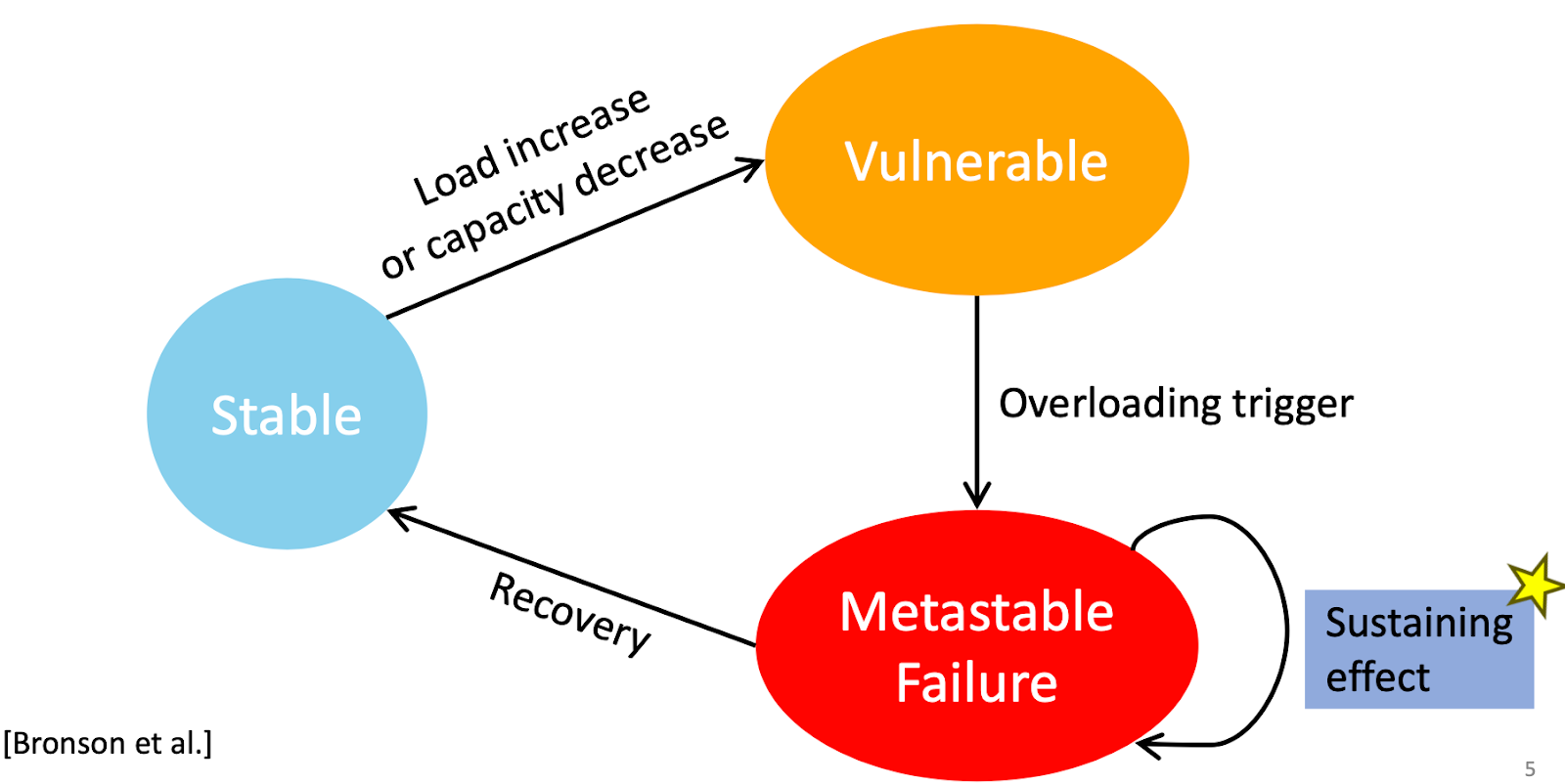
This paper appeared in OSDI'22. There is a great summary of the paper by Aleksey (one of the authors and my former PhD student, go Aleksey!). There is also a great conference presentation video from Lexiang. Below I will provide a brief overview of the paper followed by my discussion points. This topic is very interesting and important, so I hope you have fun learning about this. Metastability concept and categories Metastable failure is defined as permanent overload with low throughput even after the fault-trigger is removed. It is an emergent behavior of a system, and it naturally arises from the optimizations for the common case that lead to sustained work amplification. In this paper, the authors are able to capture/abstract the system behavior of interest in terms of two parameters, the load and capacity. If the load is above capacity, you have work piling up, right? Or if the capacity drops under the sustained load level, the same effect, right? Both of these create  a tem...

Stable and Consistent Membership at Scale with Rapid

Image
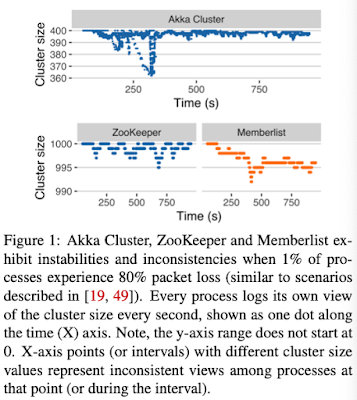
This paper is by Lalith Suresh, Dahlia Malkhi, Parikshit Gopalan, Ivan Porto Carreiro, and Zeeshan Lokhandwala , and it appeared in USENIX Annual Technical Conference 2018. In datacenters complex network conditions may arise, such as one-way reachability problems, firewall misconfigurations, flip-flops in reachability, and high packet loss (where some-but-not-all packets being dropped). Services became even more prone to these gray failures as processes are typically hosted in VM and container abstractions, and networks are governed more and more with software-defined-networking (SDN). Furthermore, everyday several cloud-side service upgrades happen, which create potential failure risks. Despite being able to cleanly detect crash faults, existing membership solutions struggle with these gray failure scenarios. When you introduce 80% packet-loss failures in 1% of nodes, the correct nodes start to accuse each other and the membership view becomes unstable. The experiments in the pap...

SOSP19 Lineage Stash: Fault Tolerance Off the Critical Path

Image
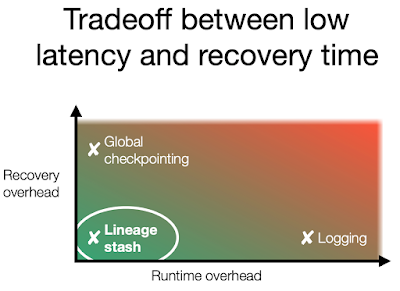
This paper is by Stephanie Wang (UC Berkeley), John Liagouris (ETH Zurich), Robert Nishihara (UC Berkeley), Philipp Moritz (UC Berkeley), Ujval Misra (UC Berkeley), Alexey Tumanov (UC Berkeley), Ion Stoica (UC Berkeley). I really liked this paper. It has a simple idea, which has a good chance of getting adopted by real world systems. The presentation was very well done and was very informative. You can watch the presentation video here. Low-latency processing is very important for data processing, stream processing, graph processing, and control systems. Recovering after failures is also important for them, because for systems composed of 100s of nodes, node failures are part of daily operation. It seems like there is a tradeoff between low latency and recovery time. The existing recovery methods either have low runtime overhead or low recovery overhead, but not both. Global checkpoint approach to recovery achieves a low runtime overhead, because a checkpoint/snapshot can be ta...

SOSP19 Verifying Concurrent, Crash-safe Systems with Perennial

Image
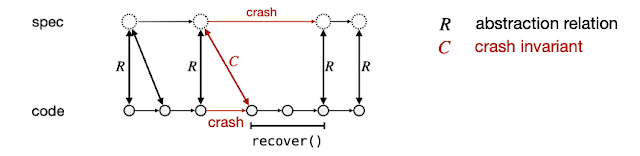
This paper is by Tej Chajed (MIT CSAIL), Joseph Tassarotti (MIT CSAIL), Frans Kaashoek (MIT CSAIL), Nickolai Zeldovich (MIT CSAIL). Replicated disk systems, such as file systems, databases, and key-value stores, need both concurrency (to provide high performance) and crash safety  (to keep your data safety). The replicated disk library is subtle, but the paper shows how to systematically reason about all possible executions using verification. (This work considers verification of a single computer storage system with multiple disk --not a distributed storage system.) Existing verification frameworks support either concurrency (CertiKOS [OSDI ’16], CSPEC [OSDI ’18], AtomFS [SOSP ’19]) or crash safety (FSCQ [SOSP ’15], Yggdrasil [OSDI ’16], DFSCQ [SOSP ’17]). Combining verified crash safety and concurrency is challenging because: Crash and recovery can interrupt a critical section, Crash can wipe in-memory state, and Recovery logically completes crashed threads' operations....

Paper review: Comprehensive and efficient runtime checking in system software through watchdogs

Image
This paper by Chang Lou, Peng Huang, and Scott Smith appeared in HotOS 2019.  The paper argues that system software needs intrinsic detectors that  monitor internally for subtle issues specific to a process. In particular, the paper advocates employing intrinsic watchdogs as detectors. Watchdogs (also known as grenade timers) have been widely used in embedded devices. Watchdogs use a decrementing timeout counter which resets the processor when it reaches zero. To prevent a reset, the software must keep restarting the watchdog counter after performing/clearing some sanity checks. Table 1 summarizes the comparison of crash failure detectors, intrinsic watchdogs, and error handlers. Failure detectors are too general, they just make "up-or-down" decisions. They are only good for achieving liveness, as they are too unreliable for making safety decisions. The disadvantage with error handlers, the paper argues, is  that liveness-related failures often do not have explicit e...

Do leases buy us anything?

Consider the atomic storage problem , which is a simpler problem than consensus. CAP theorem says that when there is a partition, you will need to sacrifice strong-consistency or high-availability. Using leases, it is possible to sacrifice availability for sometime (until lease expires), and reconfigure the storage system (often by shrinking the quorum) to keep providing availability. Consistency is preserved throughout, and availability is sacrificed only during lease expiration time. This is a good tradeoff. (I am going to bring up the question of whether this may help circumvent CAP at the end of the post.) But is this power unique to leases? Is there a way to explain this in an alternate way using only failure detectors instead of leases? This is the question I want to explore here. Many distributed systems implement leases with just countdown timers and without NTP timestamps. This is because in the short-term the rate of clocks at processes don't drift too much. So ma...

Teaching Paxi

Paxos family of protocols (which I refer to as Paxi) is immensely useful for building distributed systems due to their excellent fault-tolerance properties. Many cloud computing services and distributed databases employ Paxi for state machine replication (SMR). Paxi preserve the safety of consensus problem (no two nodes commit different values for the same slot) even to the face of a fully asynchronous execution, crash faults, message losses, and network partitions. Paxi satisfy liveness of consensus problem (some value is eventually committed for the slot) when the system moves outside the realm of the coordinated attack and FLP impossibility results. Paxi are perennially misunderstood and their sophistication underrated. While there has been a lot of work on Paxi, we have been able to explore only a fraction of the algorithm design space. A striking evidence of this arrived in 2016, where we had a flexible quorum breakthrough after 30 years, which no one had anticipated. There ...

Modeling an atomic version of Texel: an asynchronous consensus algorithm without rounds

Image
I had written about my preliminary impressions about Texel , an asynchronous consensus algorithm without rounds. Over the last couple of nights, I have modeled a shared memory version of the algorithm in TLA+, so that I can understand the algorithm better and learn more about the approach. I started with a very rough atomic version of the algorithm, where a node can atomically read the state of all other nodes and update its own state. This is not practical, but it is good for highlighting the essence of the Texel algorithm. In this post, I will talk about this atomic Texel model. After I got this model down, it was easy for me to refine the atomicity. In the refined model, a process can atomically read from one other process and update its state. That refined model is just one step removed from the message passing Texel algorithm presented in the paper , and demonstrates the tricky issues that arise when multiple nodes are concurrently trying to update their states. In that read-w...

Paper review. Gray Failure: The Achilles' Heel of Cloud-Scale Systems

Image
This paper (by Peng Huang, Chuanxiong Guo, Lidong Zhou, Jacob R. Lorch, Yingnong Dang, Murali Chintalapati, and Randolph Yao) occurred in HotOS 2017. The paper is an easy read at 5 pages, and considers the fault-tolerance problem of cloud scale systems. Although cloud provides redundancy for masking and replacing failed components, this becomes useful only if those failures can be detected. But some failures that are partial and suble failures remain undetected and these "gray failures" lead to major availability breakdowns and performance anomalies in cloud environments. Examples of gray failures are performance degradation, random packet loss, flaky I/O, memory thrashing/leaking, capacity pressure, and non-fatal exceptions. The paper identifies a key feature of gray failure as differential observability . Consider the setup in Figure 2. Within a system, an observer  gathers information about whether the system is failing or not. Based on the observations, a reactor t...

Is this consensus?

Image
The specification for consensus is as follows. The first two are safety properties, the last one a liveness property. Agreement : No two node can commit different decisions. Validity (Non-triviality) : If all initial values are same, nodes must commit that value. Termination : Nodes commit eventually. Below I talk about whether ABD or chain replication solve consensus, and whether it would be possible to implement state machine replication using them. Does ABD solve consensus? No, ABD does not solve consensus. I had written a summary of the ABD protocol in a 2012 post.  And I had talked about why ABD is not consensus in a 2015 post. Below is a short recap of that followed by a discussion of whether ABD can still be employed to solve the state machine replication problem. Consensus is prone to the FLP impossibility result, and it may lose progress under FLP conditions. In particular, for Paxos, if we can't determine whether the incumbent leader has failed in an asynch...

Popular posts from this blog

Writing as a thinking tool

The Man from the Future: Why Johnny Can't Stop Abstracting

The Safest Job from AI may be Writing

The Two Abstractions of System Design: Hide or Reduce

In Search of a Compositional Theory of Self-Stabilization

The Agentic Self: Parallels Between AI and Self-Improvement

Learning about distributed systems: where to start?

Building a Database on S3

Foundational distributed systems papers

What I'd do as a College Freshman in 2025