Posts

Showing posts matching the search for monotonicity

Hints for Distributed Systems Design

This is with apologies to Butler Lampson, who published the " Hints for computer system design " paper 40 years ago in SOSP'83. I don't claim to match that work of course. I just thought I could draft this post to organize my thinking about designing distributed systems and get feedback from others. I start with the same  disclaimer Lampson gave. These hints are not novel, not foolproof recipes, not laws of design, not precisely formulated, and not always appropriate. They are just hints.  They are context dependent, and some of them may be controversial. That being said, I have seen these hints successfully applied in distributed systems design throughout my 25 years in the field, starting from the theory of distributed systems (98-01), immersing into the practice of wireless sensor networks (01-11), and working on cloud computing systems both in the academia and industry ever since. These heuristic principles have been applied knowingly or unknowingly and has proven...
Consistency analysis in Bloom: a CALM and collected approach

This work from CIDR11 aims to provide theoretical foundations for correctness under eventual consistency, and identifies "order independence" (independence of program execution from temporal nondeterminism) as a sufficient condition for eventual consistency. CALM (consistency and logical monotonicity) principle states that monotonic programs guarantee order independence, and hence, eventual consistency. A monotonic program is one where any true statement remains to be true as new axioms arrive. In contrast, in a non-monotonic program, new input can cause the earlier output to be revoked. A monotonic program guarantees eventual consistency, whereas non-monotonicity requires the use of coordination logic. To simplify the task of identifying monotonic and nonmonotonic program segments, this work proposes using program analysis in a declarative language, Bloom. In Bloom, monotonicity of a program is examined via simple syntactic checks. Selection, join, and projection operators ...

Modeling Streamlet in TLA+

Image
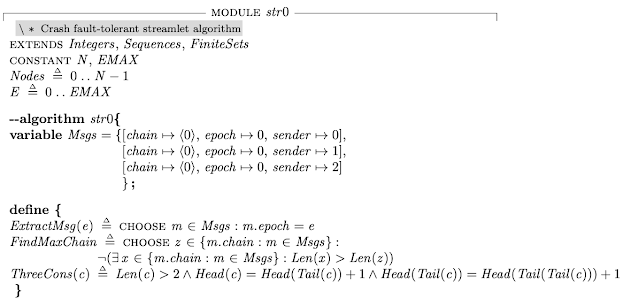
I had provided an overview of the Streamlet blockchain protocol in my last post , please read that before reading this post on modeling Streamlet in TLA+. Also if you want to get an idea about TLA+, this may be a good post to read. Here I model the crash fault-tolerant version of Streamlet provided in Appendix A of the paper. Modeling Byzantine nodes is very hard: How do you simulate arbitrary behavior of the nodes? How do you then hope to model check it? So I stick with the crash fault-tolerant version which is very similar to the Byzantine fault-tolerant version of the protocol. This version only considers crash faults and in turn it can tolerate up to a minority of node failures. The reason I started modeling was because I was suspicious how there was no need for using the epoch number knowledge in the protocol or the proof of safety in an asynchronous environment. The protocol employs only the longest chain rule. Longest chain does not necessarily mean the chain with the highest e...

Keep CALM and CRDT On

Image
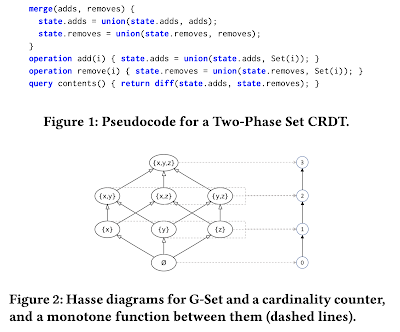
This paper is from VLDB'22. It focuses on the read/querying problem of conflict-free replicated data types (CRDTs). To solve this problem, it proposes extending CRDTs with a SQL API query model, applying the CALM theorem to identify which queries are safe to execute locally on any replica. The answer is of no surprise: monotonic queries can provide consistent observations without coordination. CRDTs To ensure replica consistency in distributed systems, a common method is to enforce strong consistency at the storage layer using traditional distributed coordination techniques such as consensus or transactions. However, for some applications this may create concerns about latency and availability (especially when a quorum is not readily available). Alternatively, developers can use weakly consistent storage models that don't require coordination, but they must ensure consistency at the application level. This is where CRDTs enter the picture, as they can provide a straightforward...

TLA+ mental models

Image
In the age of LLMs, syntax is no longer the bottleneck for writing, reading, or learning TLA+. People are even getting value by generating TLA+ models and counterexamples directly from Google Docs descriptions of the algorithms. The accidental complexity of TLA+ (its syntax and tooling) is going away. But the intrinsic complexity remains: knowing where to start a model, what to ignore, and how to choose the right abstractions. This is modeling judgment, and it is the hardest skill to teach. Engineers are trained to think in code, control flow, and local state. TLA+ forces you into a different mode: mathematical, declarative, and global. You specify what must hold, not how to achieve it. Once you get comfortable with this shift, it changes how you think about systems, even away from the keyboard. In a companion post , I described TLA+ as a design accelerator based on lessons from 8 industry projects. Here I want to go deeper and articulate the mental models behind effective TLA+ use. Th...

Transactional storage for geo-replicated systems

Image
This paper from SOSP 2011 describes a distributed storage system called Walter. Walter targets web applications that operate across multiple geographic sites, and it aims to balance consistency and latency in such systems by providing strong consistency within a site, and weaker consistency across sites. Parallel Snapshot Isolation (PSI) The paper introduces a new isolation property called Parallel Snapshot Isolation (PSI). PSI ensures consistent snapshots and transaction ordering within a site, causal ordering across sites, and prevention of write-write conflicts. PSI extends snapshot isolation (see Fig 3 for illustration of snapshot isolation, and here for an example of snapshot isolated database modeling ) by allowing different sites to have different commit orderings. For example, suppose site A executes transactions T1, T2 and site B executes transactions T3, T4. PSI allows site A to first incorporate just T1, T2 and later T3, T4, while site B first incorporates T3, T4 and later ...

Popular posts from this blog

The Safest Job from AI may be Writing

The Two Abstractions of System Design: Hide or Reduce

The Agentic Self: Parallels Between AI and Self-Improvement

In Search of a Compositional Theory of Self-Stabilization

Learning about distributed systems: where to start?

Hints for Distributed Systems Design

Foundational distributed systems papers

Building a Database on S3

Cloudspecs: Cloud Hardware Evolution Through the Looking Glass

Specula: Scaling formal specifications for autonomous model checking of system code