Posts

Showing posts matching the search for mahesh

SRDS Day 2

Image
Ok, continuing on the SRDS day 1 post , I bring you SRDS day 2. Here are my summaries from the keynote, and from the talks for which I took some notes.  Mahesh Balakrishnan's Keynote Mahesh 's keynote was titled "An Hourglass Architecture for Distributed Systems" . His talk focused on the evolution of his perspective on distributed systems research and the importance of abstraction in managing complexity. He began by reflecting on how in his PhD days, he believed the goal was to develop better protocols with nice properties. He said, he later realized that the true challenge in distributed systems research lies in creating new abstractions that simplify these complex systems. Complexity creeps into distributed systems through failures, asynchrony, and change. Mahesh also confessed that he didn't realize the extent to the importance of managing change until his days in industry.  While other fields in computer science have successfully built robust abstractions (su...

Foundational distributed systems papers

I talked about the importance of reading foundational papers last week. To followup, here is my compilation of foundational papers in the distributed systems area. (I focused on the core distributed systems area, and did not cover networking, security, distributed ledgers, verification work etc. I even left out distributed transactions, I hope to cover them at a later date.)  I classified the papers by subject, and listed them in chronological order. I also listed expository papers and blog posts at the end of each section. Time and State in Distributed Systems Time, Clocks, and the Ordering of Events in a Distributed System. Leslie Lamport, Commn. of the ACM,  1978. Distributed Snapshots: Determining Global States of a Distributed System. K. Mani Chandy Leslie Lamport, ACM Transactions on Computer Systems, 1985. Virtual Time and Global States of Distributed Systems.  Mattern, F. 1988. Practical uses of synchronized clocks in distributed systems. B. Liskov, 1991. Exp...

Log structured protocols in Delos (SOSP21)

Image
This paper picks up from where the "Virtual Consensus in Delos" paper finishes , and  talks about using Delos to build control plane databases at Facebook. These are my notes from Mahesh's excellent conference presentation. These control plane databases at Facebook were required to support multiple APIs: some SQL, some key-value pairs, and some ZooKeeper namespaces. Each such API typically requires a separate database to be built. But implementing and operating even a single zero dependency control plane system is difficult. To cut this dilemma, they observe that these databases have a similar structure: a consensus protocol at the bottom, and a replicated state machine on top. A lot of that state machine uses generic logic that can be reused across different APIs. This implies that there is an hourglass architecture at work here, where Delos platform is the narrow waist. This paper focuses on protocols which allow us to layer multiple apis on this common Delos platform....

WormSpace: A modular foundation for simple, verifiable distributed systems

Image
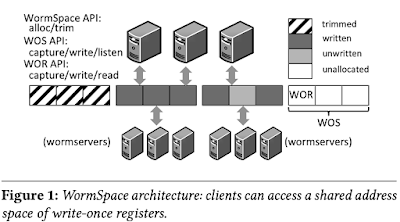
This paper is by Ji-Yong Shin, Jieung Kim, Wolf Honore, Hernán Vanzetto, Srihari Radhakrishnan, Mahesh Balakrishnan, Zhong Shao, and it appeared at SOCC'19.  The paper introduces the Write-Once Register (WOR) abstraction, and argues that the WOR should be a first-class system-building abstraction. By providing single-shot consensus via a simple data-centric API, the WOR acts as a building block for providing distributed systems durability, concurrency control, and failure atomicity. Each WOR is implemented via a Paxos instance , and leveraging this, WormSpace (Write-Once-Read-Many Address Space) organizes the address space into contiguous write-once segments (WOSes) and provides developers with a shared address space of durable, highly available, and strongly consistent WORs to build on. For example, a sequence of WORs can be used to impose a total order, and a set of WORs can keep decisions taken by participants in distributed transaction protocols such as 2PC. To demonstra...

SOSP'19 Day 0

Image
I attended SOSP this week. SOSP is the premier conference on systems where 500+ researchers follow 30+ paper presentations in a single-track event over three days. SOSP is held every two years --on odd years, alternating with OSDI which is held on the even years. This was my third SOSP. I had been to SOSP 2009 at Big Sky Montana and SOSP 2013 at Nemacolin Pennsylvania . It is always a treat to attend SOSP. I get to learn new ideas and meet with interesting people. SOSP never fails to impress me with the quality of papers and presentations. I attended almost all of the sessions on Monday and Tuesday and took a lot of notes. I will be releasing these notes over the next 4-5 posts as I find some free time to edit and post them. You can see the entire program here and download the papers freely as open access. Today, I will just talk about day 0 and the opening of day 1. Driving to SOSP Abutalib, a final year PhD student at CMU , had offered to give me a ride to the conference. ...

Taming Consensus in the Wild (with the Shared Log Abstraction)

Image
This paper recently appeared at ACM SIGOPS Operating Systems Review. It provides an overview of the shared log abstraction in distributed systems, particularly focusing on its application in State Machine Replication (SMR) and consensus protocols. The paper argues that this abstraction can simplify the design and implementation of distributed systems, and can make them more reliable and easier to maintain. What is the shared log abstraction? The shared log abstraction proposes to separate the system into two layers: the database layer (proposers/learners) and the log layer (acceptors). The shared log provides a simple API for appending entries, checking the tail, reading entries, and trimming the log. This separation allows the SMR layer to focus on higher-level concerns without dealing with the complexities of consensus protocols. This is a wisdom packed paper. It approaches the problem more from software engineering and systems/operations perspectives. ( Previous work, the Delos OSD...

HPTS 2026 (Day 1)

Image
Jim Gray started HPTS  42 years ago, and it still runs the same way at Asilomar with 0 proceedings, 1 track, 100 invited people, and ample discussion breaks. It's one of my favorite events, and I look forward to attending it every two years. This is my...umm...fifth HPTS. I have been attending all of them since 2015 , but I seem to have missed it in 2019 . Yep, my life is a blur, even for me. Here are my notes from day 1. I will put day 2 and day 3 in a second post. Keynote: Reality is the Final Verifier. Two Key Gaps in Agentic Software Engineering (Ion Stoica, UC Berkeley) Ion started with the promising parts. LLMs are able to solve difficult math problems, and provide proofs for conjectures that have been outstanding for many decades (Ok, maybe this is not as promising to mathematicians). LLMs also play scientist with AlphaEvolve, and OpenEvolve. In summer 2025 Berkeley ran a seminar where students applied agentic tools to research problems. They took a published state-of-the-a...

The FuzzyLog: A partially ordered shared log (OSDI'18)

Image
This paper appeared in OSDI 18, and is authored by Joshua Lockerman, Jose M. Faleiro, Juno Kim, Soham Sankaran, Daniel J. Abadi, James Aspnes, Siddhartha Sen, Mahesh Balakrishnan. The paper does not suggest many novel ideas or algorithms, but rather shows a nice amalgamation of existing ideas and algorithms for providing a more scalable version of a shared log across multiple datacenters. Having a shared log, and funneling all updates through a globally shared log  provides simplicity for building fault-tolerant consistent distributed systems. Tango paper from SOSP'13 , upon which they build here, argued for the simplicity benefits of such a system. Recently Jay Kreps wrote a nice and accessible explanation of the benefits of using globally shared logs for building distributed systems. Despite the simplicity it provides, maintaining a shared log with a system-wide total order is impractical, because it is expensive : At large scale, the single sequencer will be a bottleneck for the...

Paper summary. CORFU: A shared log design for flash clusters

Image
By: Mahesh Balakrishnan, Dahlia Malkhi, Vijayan Prabhakaran, Ted Wobber, Michael Wei, John D. Davis, Appeared in NSDI'2012 This paper applies VPaxos ideas (of using an auxiliary Paxos box for reconfiguration) and chain replication ideas in the context of Flash SSDs. The vision is that Corfu's novel client-centric design eliminates storage servers in favor of simple, efficient and inexpensive flash chips that attach directly to the network. The clients directly write to storage nodes, similar to what happens in Dynamo /Cassandra/ Voldemort replication, but linearizability is still guaranteed. Previously I had summarized the Tango paper, for maintaining distributed data structures over a shared log. Tango builds on the Corfu log abstraction. Corfu involves three main functions: A mapping function (maintained at the VPaxos box) from logical positions in the log to flash pages on the cluster of flash units A tail-finding mechanism (using a sequencer node) for finding t...

Popular posts from this blog

The Man from the Future: Why Johnny Can't Stop Abstracting

The Safest Job from AI may be Writing

The Two Abstractions of System Design: Hide or Reduce

The Agentic Self: Parallels Between AI and Self-Improvement

In Search of a Compositional Theory of Self-Stabilization

Learning about distributed systems: where to start?

Building a Database on S3

Foundational distributed systems papers

What I'd do as a College Freshman in 2025

Cloudspecs: Cloud Hardware Evolution Through the Looking Glass