Posts

Showing posts matching the search for hellerstein

MapReduce Online

I am running behind my blogging the seminar. Here are some short notes on the papers we have been discussing in the Data Center Computing seminar. The " MapReduce Online" paper by "Tyson Condie, Neil Conway, Peter Alvaro, Joseph M. Hellerstein, Khaled Elmeleegy and Russell Sears" was a reading assignment for the first week, but we didn't have the time to discuss it. This paper is written very simple and provides a clean discussion of Hadoop's inner workings that I felt I should write about the paper just for this reason. The paper presents a modified Hadoop mapreduce framework that allows data to be pipelined between operators, and supports online aggregation, which allows users to see "early returns" from a job as it is being computed. In Hadoop, a downstream worker is blocked until the previous worker process the entire data and make it available in entirety. In contrast, pipelining delivers data to downstream operators more promptly. Not only t...
Matchmaker Paxos: A Reconfigurable Consensus Protocol

Image
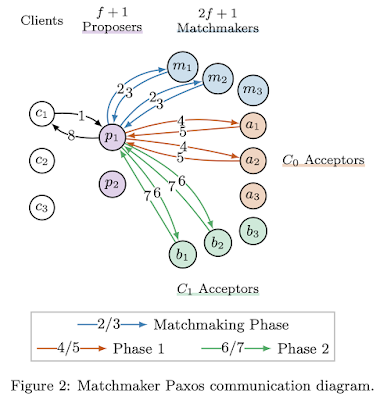
Michael Whittaker , Joe Hellerstein's PhD student at UC Berkeley, has recently defended his PhD thesis on Compartmentalized Paxos . The thesis deconstructs Paxos and shows ways to reconstruct it to be more scalable by individually focusing on each component/role in Paxos. It is a simple but effective trick. Even after you learn the trick, you still keep getting surprised by how effective it is. When I say Michael defended his thesis, I am speaking loosely. Michael was not defensive about anything. He didn't have to be, his work spoke for him. Just watch his PhD presentation and you will understand what I mean.  Michael has a great talent for explaining things simply. Unfortunately this is an underappreciated talent, especially in academia. This may make it look too easy and effortless, and like you didn't do sophisticated work. This dude did not even prepare presentation slides for his PhD thesis (the heresy!), and winged it on the fly by drawing his protocols on an iPad. H...

Onix: A Distributed Control Platform for Large-scale Production Networks

Image
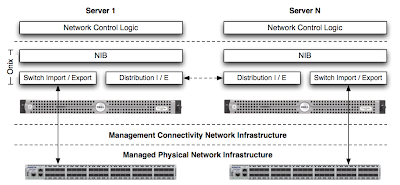
The Onix work (OSDI'10) builds on Nox. Essentially, Onix takes Nox and distributes over multiple servers. Let me start with a brief refresher on Nox. (Or you can r ead my previous post on Nox ) The main idea in Nox (and openflow) was to facilitate innovation by separating the control plane from the forwarding (data) plane. (In the current networking architecture, control and data planes are both implemented in the same place, the routers.) Nox introduced "software defined networking" (SDN): Nox uses a centralized controller to make the decisions (i.e., control plane); The routers implement only the data plane, and just follow directions from the controller while forwarding data. A drawback with Nox was that since it uses a single controller, it is prone to a single point of failure. Although the Nox work pointed out how this single controller can be distributed, it didn't pursue it further. Enter Onix. Onix investigates how to distribute that single controller. In On...

Paper summary. Blazes: Coordination analysis and placement for distributed programs

Image
This paper is by Peter Alvaro, Neil Conway, Joseph M. Hellerstein, and David Maier. It appears in October 2017 issue of ACM Transactions on Database Systems. A preliminary conference version appeared in ICDE 2014.  This paper builds a theory of dataflow/stream-processing programs, which cover the Spark , Storm, Heron , Tensorflow , Naiad, TimelyDataflow work. The paper introduces compositional operators of labels, and shows how to infer the coordination points in dataflow programs. When reading below, pay attention to the labeling section, the labels "CR, CW, OR, OW", and the section on reduction rules on labels. To figure out these coordination points, the Blazes framework relies on annotations of the dataflow programs to be supplied as an input. This is demonstrated in terms of a Twitter Storm application and a Bloom application. The paper has many gems.  It says at the conclusion section in passing that when designing systems, we should pay attention to coordinat...

Scalable distributed data structures for internet service construction

Image
I think this 2000 paper (by Gribble, Brewer, Hellerstein, and Culler) may as well be the original NoSQL paper. The paper starts off by identifying the problems with RDBMS that prohibit scalability. (This is how you would motivate a NoSQL key-value store system even today :-) RDBMSs have not been designed with Internet service workloads, service properties, and cluster environments in mind, and as a result they fail to provide the right scaling, consistency, or availability guarantees.  RDBMSs permit users to decouple the logical structure of their data from its physical layout, which is a good thing, but excessive data independence (isolation of application from modifying the layout of data definition and organization) can make parallelization and therefore scaling hard.  RDBMSs always choose consistency over availability. The paper then advocates a design sweet-point for achieving scalable and consistent data management for ...

Highly Available Transactions: Virtues and Limitations

Image
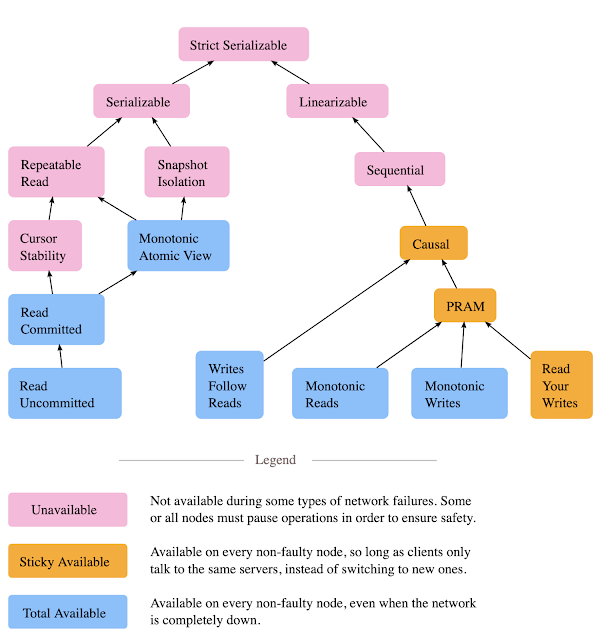
This is a VLDB 2014 paper from Peter Bailis, Aaron Davidson, Alan Fekete, Ali Ghodsi, Joseph M. Hellerstein, and Ion Stoica. This is a great paper, because it asked an important question that helped advanced our understanding of isolation properties with respect to high-availability. So here is the context. As part of his PhD, Peter Bailis started think about the benefits of relaxed consistency guarantees, and how can we leverage them. Peter's Probabilistic Bounded Staleness work is how things started. He also investigated eventual consistency limitations, and bolt-on causal consistency on that front. This paper brings that relaxed guarantees effort from the per-key consistency to the transaction isolation domain, and investigates Highly Available Transactions (HAT).  Remember this clickable chart from Jepsen I refer to often? The origin of that chart is the Figure 2 in this paper. This is what I meant when I said this paper advanced our understanding. This is a very subtle topic...

Looking Back at Postgres

Image
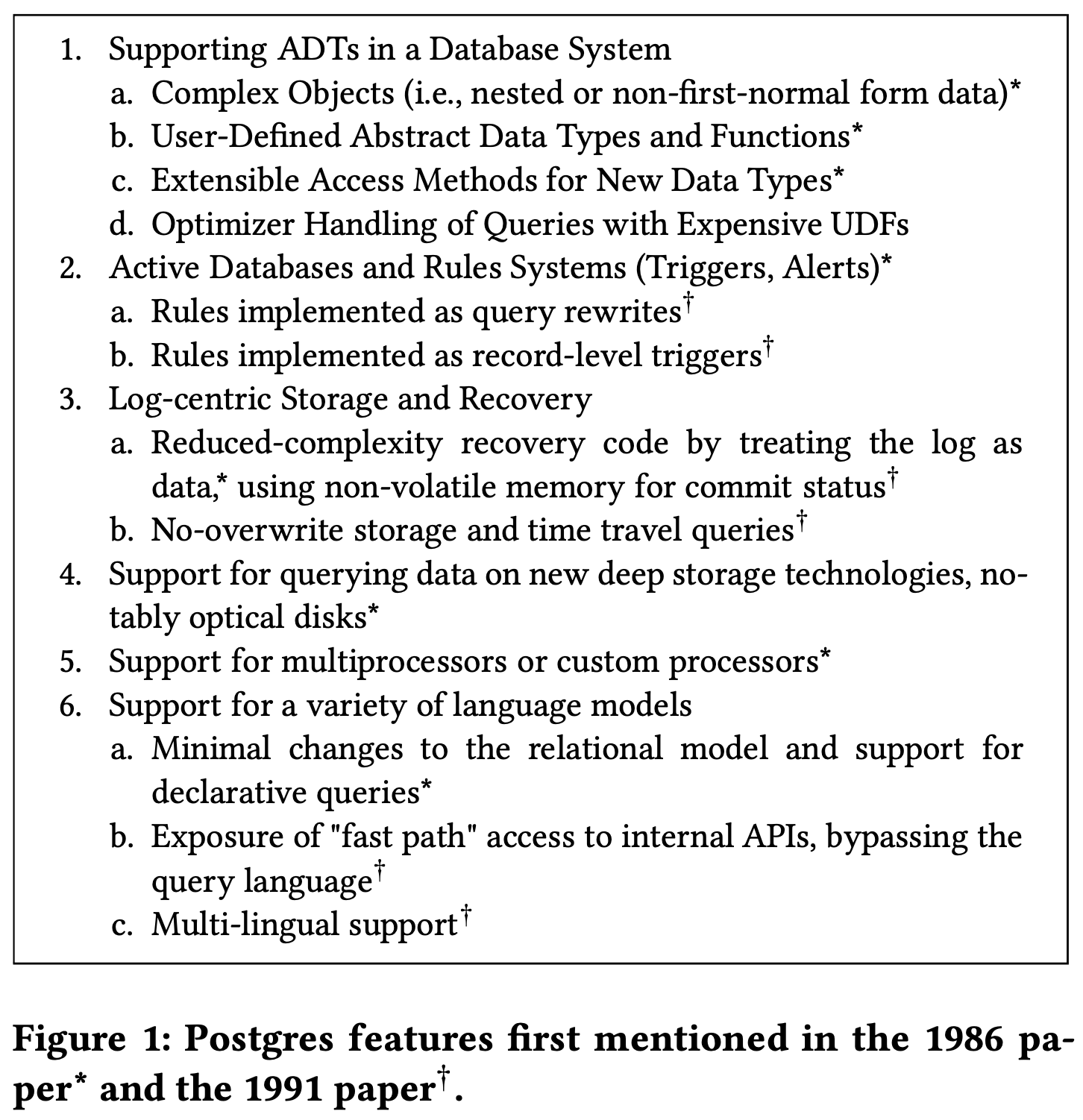
This is a 2019 article by Joe Hellerstein, the Jim Gray Professor of Computer Science at UC Berkeley. Last year at Sigmod, Joe was awarded the Ted Codd innovation award where he gave an awesome overview of his research agenda. This article, written to be included in Stonebraker’s Turing Award book, provides a retrospective on Postgres project, which Stonebraker led from the mid-1980’s to the mid-1990’s. I love this article a lot, because as I have written before, context is my crack : "The more context I know, the better I become able to locate something almost spatially, and the more I can make sense of it. Even reading the history and motivation for the subject can give my understanding a big boost." The entire paper is context, and it even has a section titled "Context", how cool is that? The footnotes on the article are also excellent! Very interesting gems there as well. Disclaimer: I use a lot of text from the article to summarize it. The features and the imp...

Take Out the TraChe: Maximizing (Tra)nsactional Ca(che) Hit Rate

Image
This paper appeared in OSDI 2023 in July, and is authored by Audrey Cheng, David Chu, Terrance Li, Jason Chan, Natacha Crooks, Joseph M. Hellerstein, and Ion Stoica, UC Berkeley; Xiangyao Yu, University of Wisconsin--Madison. The paper seems to break the acronym rule. It defines one acronym, TraChe, in the title, but uses another one, Detox, for the rest of the paper. I guess I agree, referring to your system as Trache is not very appealing.   I kid, because I love the authors. Looks like I cover almost any paper Audrey Cheng writes these days. Speaking of Audrey, she had written a brief summary of this paper here: https://audreyccheng.com/blog/transaction-caching . Hmm, she didn't use the word "TraChe" in her post even once. I wonder which one of the advisors on the paper coined the typo TraChe, and pushed it to the title. Ok, enough with the trache talk. The Problem           You have been doing caching wrong for your transactional workloads! That ...

New directions in cloud programming

Image
This paper appeared in CIDR'21 . This paper is also on operationalizing CALM theorem, and is a good companion to the CALM-CRDT paper we covered yesterday. The paper starts by pointing out the challenges of cloud programmability. It says that most developers find it hard to harness the enormous potential of the cloud, and that the cloud has yet to provide a programming environment that exposes the inherent power of the platform. The paper then lays out an agenda for providing a new generation of cloud programming environment to programmers in an evolutionary fashion. I would like to start by challenging the claim that the cloud about not yet providing a noteworthy programming environment. I think there are many examples of successful cloud programming paradigms and frameworks that have emerged in the past decade, such as MapReduce, Resilient Distributed Datasets, Hadoop environment, Spark environment, real time data processing and streaming systems, distributed machine learning syst...

Popular posts from this blog

Writing as a thinking tool

The Man from the Future: Why Johnny Can't Stop Abstracting

The Safest Job from AI may be Writing

The Two Abstractions of System Design: Hide or Reduce

The Agentic Self: Parallels Between AI and Self-Improvement

In Search of a Compositional Theory of Self-Stabilization

Learning about distributed systems: where to start?

Building a Database on S3

Foundational distributed systems papers

What I'd do as a College Freshman in 2025