Posts

Showing posts matching the search for benchmark

TPC-E vs. TPC-C: Characterizing the New TPC-E Benchmark via an I/O Comparison Study
Image
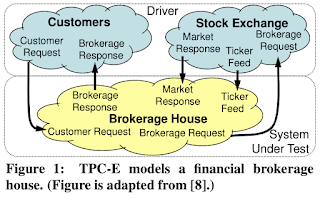
This paper is from Sigmod 2010, and compares the two standard TPC benchmarks for OLTP, TPC-C which came in 1992, and the TPC-E which dropped in 2007. TPC-E is designed to be a more realistic and sophisticated OLTP benchmark than TPC-C by incorporating realistic data skews and referential integrity constraints. However, because of its complexity, TPC-E is more difficult to implement, and hard to provide reproducability of the results by others. As a result adoption had been very slow and little. (I linked TPC-C to its TPC-C wikipedia page above, but poor TPC-E does not even have a Wikipedia page. Instead it has this 1990s style webpage .) A more cynical view on the immense popularity of TPC-C over TPC-E would be that TPC-C can be easily abused to show your database in the best possible light. TPC-C is very easily shardable on the  warehouse_id to hide any contention on concurrency control, so your database would be able to display high-scalability. We had recently reviewed the Oce...


SysMoBench: Evaluating AI on Formally Modeling Complex Real-World Systems

Image
This paper presents SysMoBench, a benchmark designed to evaluate generative AI's ability to formally model complex concurrent and distributed systems. Although the paper is published on January 2026, the AI landscape moves so fast that the models evaluated (like Claude-Sonnet-4 and GPT-5) already feel dated, after the release of heavy hitters like Claude 3.5 Opus or OpenAI's Codex.  The paper draws a distinction between algorithms/protocols and system modeling. As the paper (somewhat circularly) defines it, "system models enable verification of system code via comprehensive testing and model checking". The paper says: Modeling these systems requires the AI to deeply understand the system design, reason about safety and liveness under unexpected faults, and abstract system behavior into an executable program. This paper is a great paper to follow up my post yesterday on TLA+ Mental Models . It is instructive to see how the paper corroborates my claims in that post. My ...

SQLite: Past, Present, and Future

Image
SQLite is the most widely deployed database engine (or likely even software of any type) in existence. It is found in nearly every smartphone (iOS and Android), computer, web browser, television, and automobile. There are likely over one trillion SQLite databases in active use. (If you are on a Mac laptop, you can open a terminal, type "sqlite3", and start conversing with the SQLite database engine using SQL.) SQLite is a single node and (mostly) single threaded online transaction processing (OLTP) database. It has an in-process/embbedded design, and a standalone (no dependencies) codebase ...a single C library consisting of 150K lines of code.  With all features enabled, the compiled library size can be less than 750 KiB. Yet, SQLite can support tens of thousands of transactions per second. Due to its reliability, SQLite is used in mission-critical applications such as flight software. There are over 600 lines of test code for every line of code in SQLite. SQLite is truly t...

A Study of Database Performance Sensitivity to Experiment Settings

Image
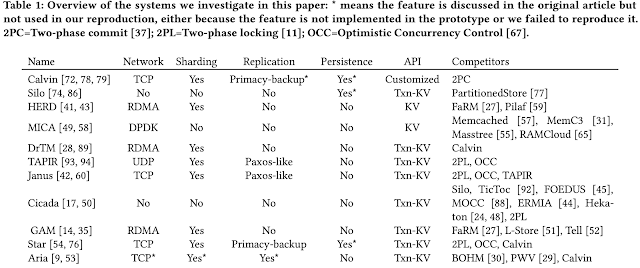
This paper appeared in VLDB2022 and is a good followup to our TPC-E vs TPC-C post . The paper investigates the following question: Many articles compare to prior works under certain settings, but how much of their conclusions hold under other settings? Their methodology is as follows. They used TPC-C and YCSB benchmarks as they are most widely used. They reproduced and evaluated 11 work (see Table 1). They then tuned benchmark parameters and system features to study effects on the performance of these work. They find that the evaluations of these work (and conclusions drawn from them) are sensitive to experiment settings. They make some recommendations as to how to proceed for evaluation of future systems work. The paper is well written and is an important contribution to systems work. In my summary below, I use many sentences from the paper verbatim. Analysis of TPC-C results TPC-C simulates the database of a wholesale company. It includes a number of warehouses, each maintaining sto...

Adapting TPC-C Benchmark to Measure Performance of Multi-Document Transactions in MongoDB

Image
This paper appeared in VLDB 2019 . Benchmarks are a necessary evil for database evaluation. Benchmarks often focus on narrow aspects and specific workloads, creating a misleading picture for broader real-world applications/workloads. However, for a quick comparative performance snapshot, they still remain a crucial tool. Popular benchmarks like YCSB, designed for simple key-value operations, fall short in capturing MongoDB's features, including secondary indexes, flexible queries, complex aggregations, and even multi-statement multi-document ACID transactions (since version 4.0). Standard RDBMS benchmarks haven’t been a good fit for MongoDB either, since they require normalized relational schema and SQL operations. Consider TPC-C, which simulates a commerce system with five types of transactions involving customers, orders, warehouses, districts, stock, and items represented with data in nine normalized tables. TPC-C requires specific relational schema and prescribed SQL statements...

An Evaluation of Distributed Concurrency Control

Image
This VLDB'17 paper investigates the effects of distributed concurrency control protocols on performance of distributed transactional databases. They evaluate six protocols: two-phase locking with NO_WAIT and WAIT_DIE flavors, timestamp ordering (TIMESTAMP), multi-version concurrency control (MVCC), optimistic concurrency control (OCC), and a deterministic protocol Calvin. For the evaluations, they use an in-memory distributed database evaluation framework called Deneva ( https://github.com/mitdbg/deneva ), providing an apples-to-apples comparison between each protocol. This is a delightful paper. After we covered several distributed databases in recent posts , this paper helps us consider the performance implications of concurrency control schemes they use and how they would fare under different workloads. The paper is very well written and easy to follow. In my summary I lifted a lot of the text from the paper with little editing. The six transaction protocols considered The pape...

Popular posts from this blog

The Safest Job from AI may be Writing

The Two Abstractions of System Design: Hide or Reduce

The Agentic Self: Parallels Between AI and Self-Improvement

In Search of a Compositional Theory of Self-Stabilization

Learning about distributed systems: where to start?

Hints for Distributed Systems Design

Foundational distributed systems papers

Building a Database on S3

Cloudspecs: Cloud Hardware Evolution Through the Looking Glass

Specula: Scaling formal specifications for autonomous model checking of system code