Posts

Modeling the Dining Philosophers Algorithm in TLA+
Image
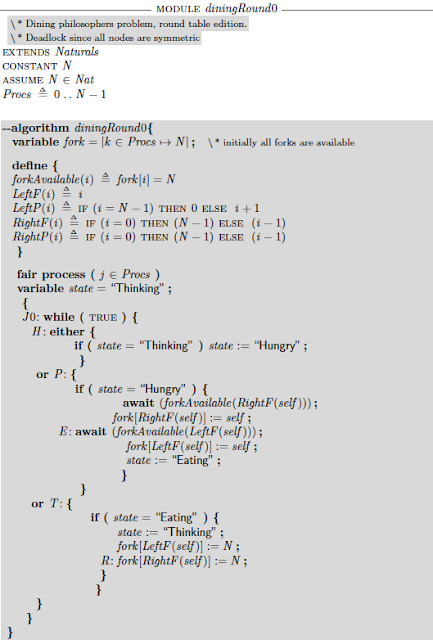
In this post I will provide a modeling of the dining philosophers algorithm in TLA+. If you have not heard about TLA+ before, take a look at my earlier posts on TLA+ to get some context.   Post1 and Post2 The dining philosophers problem is an instance/refinement of the mutual exclusion problem. The specification of the mutual exclusion problem dictates that when a node is in critical section, no other node in the system can be in the critical section. The dining philosopher relaxes this by taking into account the topology: When a node is in critical section, none of the neighbors of that node can be in critical section. Note that, this does not rule out two nodes to be in critical section simultaneously provided that they are not neighbors. In the original formulation of the dining philosophers problem by Dijkstra, there are 5 philosophers sitting around a table. Between each philosopher is a fork and, in order to eat a philosopher must hold both of the forks. (The spaghetti i...
It is about time

A couple months ago, I had visitors from SpectraCom. They gifted me a GPS timeserver . I am now the guy with the most accurate time in the department. I have a GPS clock in my office. Syncs < 100 nanosecond of UTC. pic.twitter.com/9XkDFSMdKm — Murat Demirbas (@muratdemirbas) August 9, 2016 We met with these engineers for a couple hours discussing about time synchronization. It was a very enjoyable discussion and time flew by. We talked about how to achieve time synchronization at a box, how to distribute it, and its applications. I had taken some notes, and thought it would be useful to share them. Estimated reading time: 6 minutes. Suggested song to accompany (right-click and open link in new tab): Time from Pink Floyd Precise clocks in a box Atomic clocks often use Ribidium , which has a drift of only 1 microsecond a day. OCXO ovenized oscillators are the second best way to have precise clocks in a box. Temperature change has the most effect in crystal oscillation ...

Book Review: Smarter Faster Better (2016)

I read this book in early September. My review comes after a month's lag, so I am not fresh on the details of the book, and can't totally recall my reactions while reading each chapter. However, sometimes it is better to write a review not afresh, but after some gestation period, so you can provide a more balanced review. Overall I liked the book. It is a fun read. Charles Duhigg is a great story teller. Maybe to a fault. In retrospect I think the stories diluted the focus of the book, and the real ideas/tips for becoming "smarter, faster, better" got shortchanged. After I briefly describe each chapter, I will revisit this point at the end of this post. The first chapter is "Motivation". What motivates us to work hard and get after it? There is a physiological component to motivation regulated by the "striatum" in the subcortical part of the forebrain, a critical component of the reward system. This chapter talks about the case of a very succes...

Sonification for monitoring and debugging distributed systems

Humans are top-grade pattern recognition machines. In his latest book , Ray Kurzweil, the Transcendent Man , theorizes that the human brain can be modeled as a hierarchy of pattern recognizers. Kurzweil says the neocortex contains 300 million very general pattern recognition circuits and argues that they are responsible for most aspects of human thought. (As a side note, here is an amusing little post I had written about some peculiar pattern recognition bug in our brains. ) I don't have theories or hard data to offer on human pattern recognition skills. All I can offer here are some anecdotes. Some time ago, I had read a story about rangers decrypting a secure radio transmission by just getting accustomed to it. (This was a fascinating story, and I lost track of where I read this story. If you have a pointer, let me know in the comments.) The secure radio transmission system had some peculiarities when encrypting, maybe the encryption was taking tad bit longer when encrypting ...

Kafka, Samza, and the Unix Philosophy of Distributed Data

Image
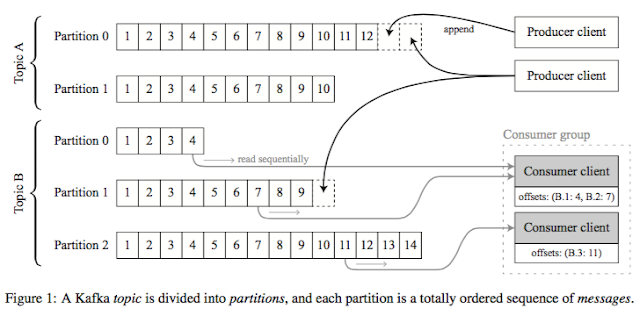
This paper is very related to the "Realtime Data Processing at Facebook" paper I reviewed in my previous post. As I mentioned there Kafka does basically the same thing as Facebook's Scribe, and Samza is a stream processing system on Kafka. This paper is very easy to read. It is delightful in its simplicity. It summarizes the design of Apache Kafka and Apache Samza and compares their design principles to the design philosophy of Unix, in particular, Unix pipes. Who says plumbing can't be sexy? (Seriously, don't Google this.) So without further ado, I present to you Mike Rowe of distributed systems. Motivation/Applications I had talked about the motivation and applications of stream processing in the Facebook post. The application domain is basically building web services that adapt to your behaviour and personalize on the fly, including Facebook, Quora, Linkedin, Twitter, Youtube, Amazon, etc. These webservices take in your most recent actions (likes, cli...

Realtime Data Processing at Facebook

Image
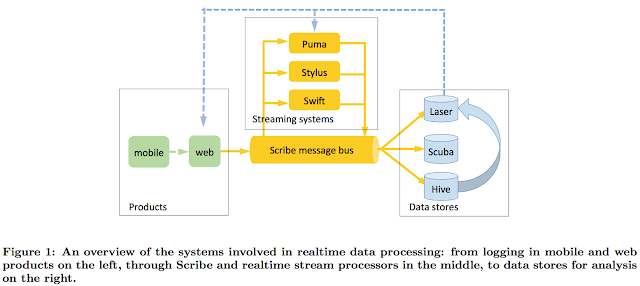
Recently there has been a lot of development in realtime data processing systems, including Twitter's Storm and Heron, Google's Millwheel, and LinkedIn's Samza. This paper presents Facebook's Realtime data processing system architecture and its Puma, Swift, and Stylus stream processing systems. The paper is titled "Realtime Data Processing at Facebook" and it appeared at Sigmod'16, June 26-July 1. Motivation and applications Facebook runs hundreds of realtime data pipelines in productions. As a motivation of the realtime data processing system the paper gives Chorus as an example. The Chorus data pipeline transforms a stream of individual Facebook posts into aggregated, anonymized, and annotated visual summaries. E.g., what are the top 5 topics being discussed for the election today? What are the demographic breakdowns (age, gender, country) of World Cup fans? Another big application is the mobile analytics pipelines that provide realtime feedback fo...

Efficient Replication of Large Data Objects

Image
This paper appeared in DISC 2003 , and describes an application of the ABD replicated atomic storage algorithm  for replication of large objects. When objects being replicated is much larger than the size of the metadata (such as tags or pointers), it is efficient to tradeoff performing cheaper operations on the metadata in order to avoid expensive operations on the data itself. The basic idea of the algorithm is to separately store copies of the data objects in replica servers , and information about where the most up-to-date copies are located in directory servers . This Layered Data Replication (LDR) approach adopts the ABD algorithm for atomic fault-tolerant replication of the metadata, and prescribes how the replication of the data objects in the replica servers can accompany replication of the metadata in directory servers in a concurrent and consistent fashion: In order to read the data, a client first reads the directories to find the set of up-to-date replicas, then r...

Replex: A Scalable, Highly Available Multi-Index Data Store

Image
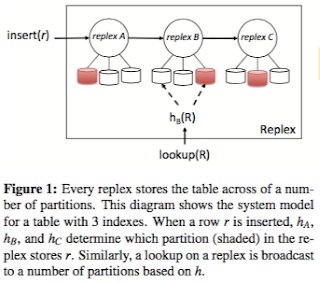
This paper received the best paper award at Usenix ATC'16 last week. It considers a timely important problem. With NoSQL databases, we got scalability, availability, and performance, but we lost secondary keys.  How do we put back the secondary indices, without compromising scalability, availability, and performance. The paper mentions that previous work on Hyperdex  did a good job of re-introducing secondary keys to NoSQL , but with overhead: Hyperdex generates and partitions an additional copy of the datastore for each key. This introduces overhead for both storage and performance: supporting just one secondary key doubles storage requirements and write latencies. Replex adds secondary keys to NoSQL databases without that overhead. The key insight of Replex is to combine the need to replicate for fault-tolerance and the need to replicate for index availability. After replication, Replex has both replicated and indexed a row, so there is no need for explicit indexing. ...

Modular Composition of Coordination Services

Image
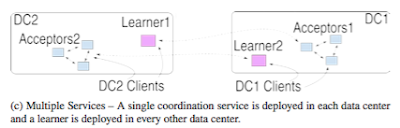
This paper appeared in Usenix ATC'16 last week.  The paper considers the problem of scaling ZooKeeper to WAN deployments. ( Check this earlier post for a brief review of ZooKeeper. ) The paper suggests a client-side only modification to ZooKeeper, and calls the resultant system ZooNet. ZooNet consists of a federation of ZooKeeper cluster at each datacenter/region. ZooNet assumes the workload is highly-partitionable, so  the data is partitioned among the ZooKeeper clusters, each accompanied by learners in the remote datacenter/regions. Each ZooKeeper cluster processes only updates for its own data partition and if applications in different regions need to access unrelated items they can also do so independently and in parallel at their own site. However, the problem with such a deployment is that it does not preserve ZooKeeper's sequential execution semantics. Consider the example in Figure 1. (It is not clear to me why the so-called "loosely-coupled" application...

How to package your ideas using the Winston star

Image
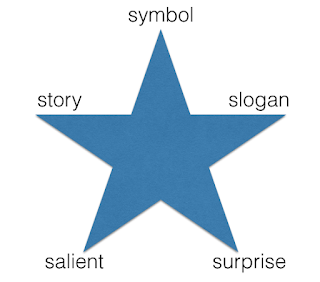
I came across this advice serendipitously by reading a random Hacker News comment. The advice shows up towards the last 10 minutes of an Artificial Intelligence lecture by Patrick Winston. Winston, a prominent professor at MIT , tells his class that he will disclose them important advice that may make or break their careers. It is about how to pack and present ideas. His advice is simple. Follow this 5-tip star to pack your ideas better. All the tips start with "S": Symbol: use a symbol to make your idea visual and memorable Slogan: find a catchy slogan for your idea Surprise: highlight the unconventional/counterintuitive/interesting part of your idea Salient: focus on the essential part of your idea, remember: less is more, fewer ideas is better Story: pack your idea with a story, human brains are hardwired for stories Here let me try to apply the  Winston's Star method on itself, to make this more concrete. Symbol: star is the symbol of the Winston...

Nobody wants to read your shit

Earlier I wrote about how much I liked the "The War of Art" by Steven Pressfield. This newly released book by Pressfield takes on where "The War of Art" has left. While the former focused on the psychological aspects of the writing process, this book focuses on the structural/mechanical aspects of writing. The book was freely distributed as pdf and ebook for a limited time for promotion purposes. (It looks like the promotion ended.)  I read it in one sitting and found it interesting. This book can benefit anyone who needs to communicate in writing. (Of course, if you are a novice writer, start with the Elements of Style .) The book gives a very interesting account of what Steven learned from a 50+ years career performing all forms of writing, including ad writing, Hollywood script-writing, novels, and nonfiction. The first chapter lays down the most important lesson Steven has learned: "Nobody wants to read your shit", and the rest of the book talks abou...

Progress by impossibility proofs

I recently listened to this TED talk by Google X director Astro Teller. The talk is about the Google X moonshot projects, and the process they use for managing them. Google X moonshot projects aim to address big, important, and challenging problems.  Teller tells (yay, pun!) that the process they manage a moonshot project is basically to try to find ways to kill the project. The team first tries to identify the bottleneck at a project by focusing on the most important/critical/risky part of the project. Then they try to either solve that hardest part or show that it is unsolvable (in a feasible manner) and kill the project. Teller claims that, at Google X, they actually incentivize people to kill the project by awarding bonuses, and celebrate when a project gets proved impossible and killed. And if a project still survives, that is a successful moonshot project that has potential for transformative change. Although, this approach looks counter intuitive at first, it is a...

TensorFlow: A system for large-scale machine learning

Image
This paper has been uploaded to arxiv.org on May 27 2016, so it is the most recent description of Google TensorFlow. ( Five months ago, I had commented on an earlier TensorFlow whitepaper , if you want to check that first.) Below I summarize the main points of this paper by using several sentences/paragraphs from the paper with some paraphrasing. I end the post with my wild speculations about TensorFlow. (This speculation thing is getting strangely addictive for me.) TensorFlow is built leveraging Google's experience with their first generation distributed machine learning system, DistBelief. The core idea of this paper is that TensorFlow's dataflow representation subsumes existing work on parameter server systems (including DistBelief), and offers a uniform programming model that allows users to harness large-scale heterogeneous systems, both for production tasks and for experimenting with new approaches. TensorFlow versus Parameter Server systems DistBelief was based o...

Popular posts from this blog

The Safest Job from AI may be Writing

The Two Abstractions of System Design: Hide or Reduce

The Agentic Self: Parallels Between AI and Self-Improvement

Learning about distributed systems: where to start?

Hints for Distributed Systems Design

Foundational distributed systems papers

Building a Database on S3

Cloudspecs: Cloud Hardware Evolution Through the Looking Glass

Specula: Scaling formal specifications for autonomous model checking of system code

What I'd do as a College Freshman in 2025