Posts

Showing posts matching the search for stabilization

About self-stabilization and blockchain consensus

This is a half-baked exploratory piece about how some self-stabilization ideas may relate with blockchain consensus in open/permissionless environments. I will write about some similarities and some major differences between the self-stabilizing distributed algorithms work and blockchain consensus deployments. Self-stabilization Let's start with a brief review self-stabilization . Stabilization is a type of fault-tolerance that handles faults in a principled unified manner instead of on a case-by-case basis. Instead of trying to figure out how much faults can disrupt the system's operation, stabilization assumes arbitrary state corruption, which covers all possible worst-case collusions of faults and program actions. Stabilization then advocates designing recovery actions that takes the program back to invariant states starting from any arbitrary state. This makes stabilization suitable for dealing with unanticipated faults. The most distinct property of self-stabilizat...

Cloud fault-tolerance

Image
I had submitted this paper to SSS'17. But it got rejected. So I made it a technical report and am sharing it here. While the paper is titled "Does the cloud need stabilizing?", it is relevant to the more general cloud fault-tolerance topic. I think we wrote the paper clearly. Maybe too clearly. Here is the link to our paper :  https://www.cse.buffalo.edu//tech-reports/2017-02.pdf (Ideally I would have liked to expand on Section 4. I think that is what we will work on now.) Below is an excerpt from the introduction of our paper, if you want to skim that before downloading the pdf. ------------------------------------------------------------------------- The last decade has witnessed rapid proliferation of cloud computing. Internet-scale webservices have been developed providing search services over billions of webpages (such as Google and Bing), and providing social network applications to billions of users (such as Facebook and Twitter). While even the smallest ...

Dijkstra's stabilizing token ring algorithm

Image
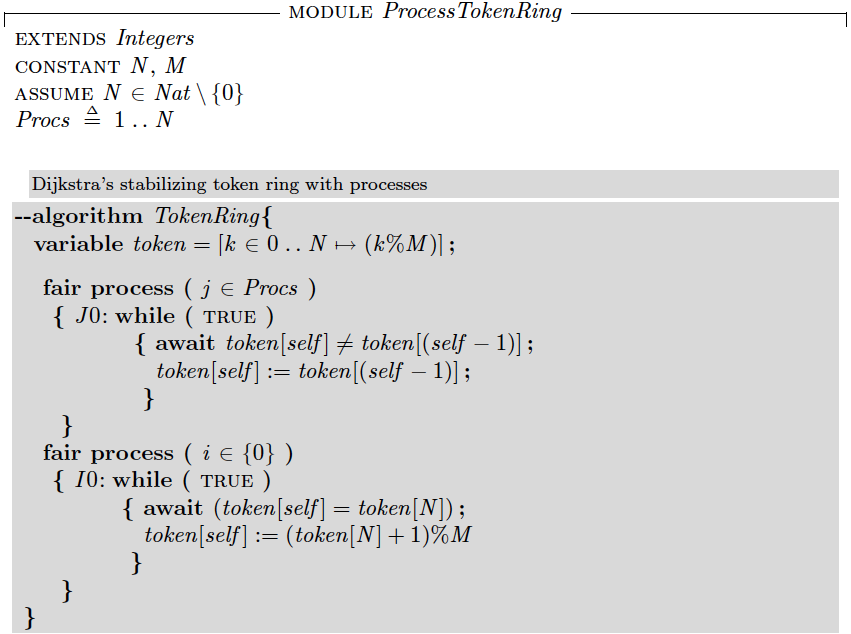
One of the classical algorithms I teach in my distributed systems class is Dijkstra's stabilizing token ring algorithm. This algorithm has started the self-stabilization field as a subfield of fault-tolerance. And, it still receives interest even after 40 years. There has been probably hundreds of self-stabilization papers that revisits Dijkstra's stabilizing token ring algorithm as part of a solution or as part of a case study. This algorithm never gets old for me as well. I still enjoy talking about this algorithm in class and thinking about it once in a while. I guess this is because it is a very elegant algorithm. Linked is Dijkstra's original paper introducing the algorithm. This paper also includes two variants of the stabilizing token ring algorithm, 3-state and 4-state token ring algorithms. Dijkstra would later do a followup writeup, titled, "A belated proof of self-stabilization" , where he gave a proof of stabilization for 3-state token ring progra...

Characterizing Metastable Faults and Failures

Image
Metastability has been studied in previous work as a self-sustaining degradation in goodput that persists even after the trigger is gone. The degraded state loiters on entirely due to the system's own internal feedback loops (retries, queues), and there is no simple reset button to press in distributed systems. So this is not a rare exotic problem. Since production systems would have already been hardened to handle the obvious failures, what remains is these hard-to-detect emergent failures. The "Metastable Failures in the Wild" paper (OSDI'22) reports 22 incidents across 11 organizations. Four of the 15 major AWS outages in a decade were metastable failures, with durations ranging from 1.5 to 73 hours.  This paper (June 2026) argues that the systems community has treated metastability phenomenologically, which led people to chase symptoms rather than causes. The paper sets out to give the first analytical causal account of these failures. This framing leads to two...

Metastable failures in the wild

Image
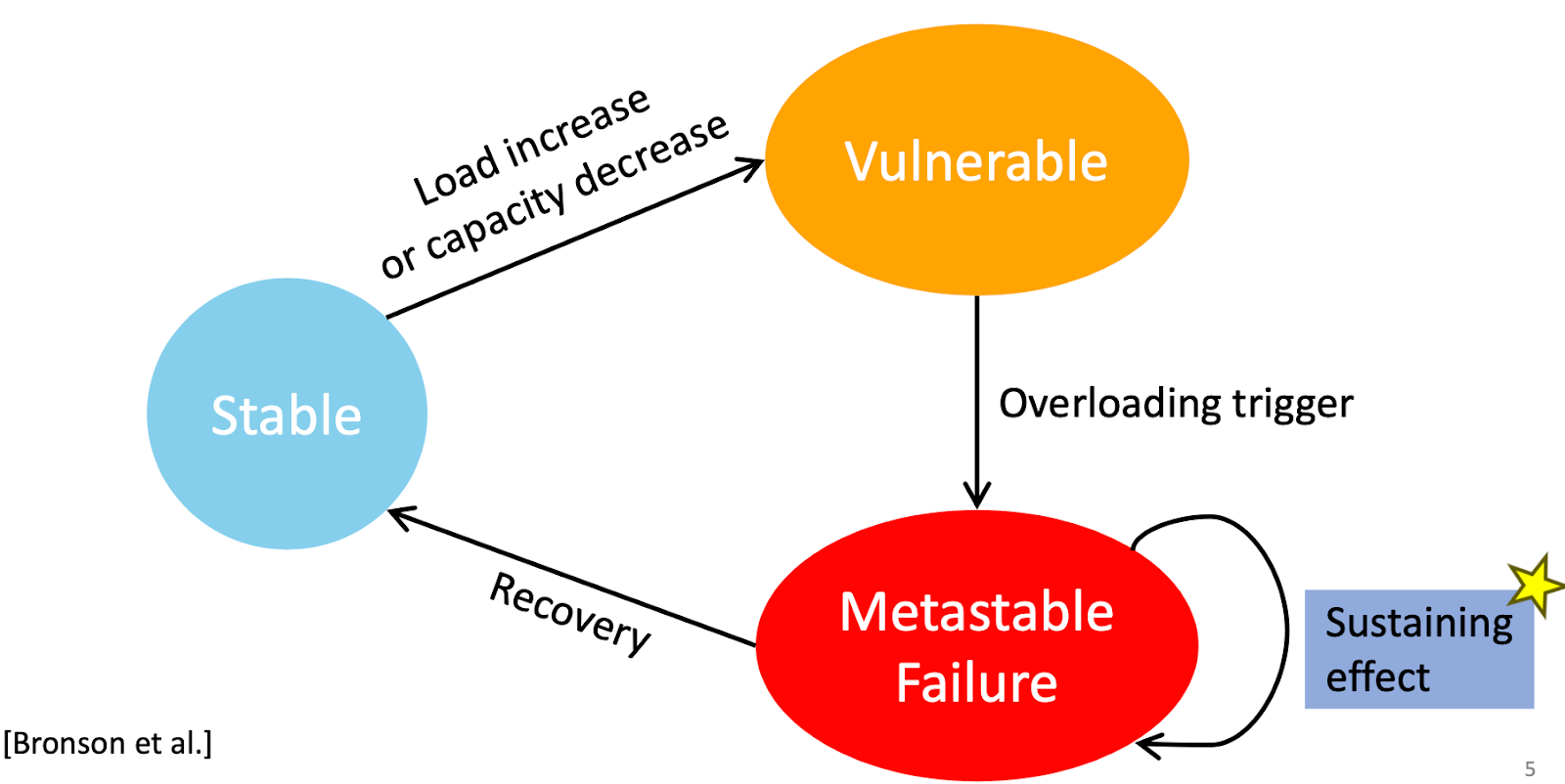
This paper appeared in OSDI'22. There is a great summary of the paper by Aleksey (one of the authors and my former PhD student, go Aleksey!). There is also a great conference presentation video from Lexiang. Below I will provide a brief overview of the paper followed by my discussion points. This topic is very interesting and important, so I hope you have fun learning about this. Metastability concept and categories Metastable failure is defined as permanent overload with low throughput even after the fault-trigger is removed. It is an emergent behavior of a system, and it naturally arises from the optimizations for the common case that lead to sustained work amplification. In this paper, the authors are able to capture/abstract the system behavior of interest in terms of two parameters, the load and capacity. If the load is above capacity, you have work piling up, right? Or if the capacity drops under the sustained load level, the same effect, right? Both of these create  a tem...

Checking statistical properties of protocols using TLA+

Image
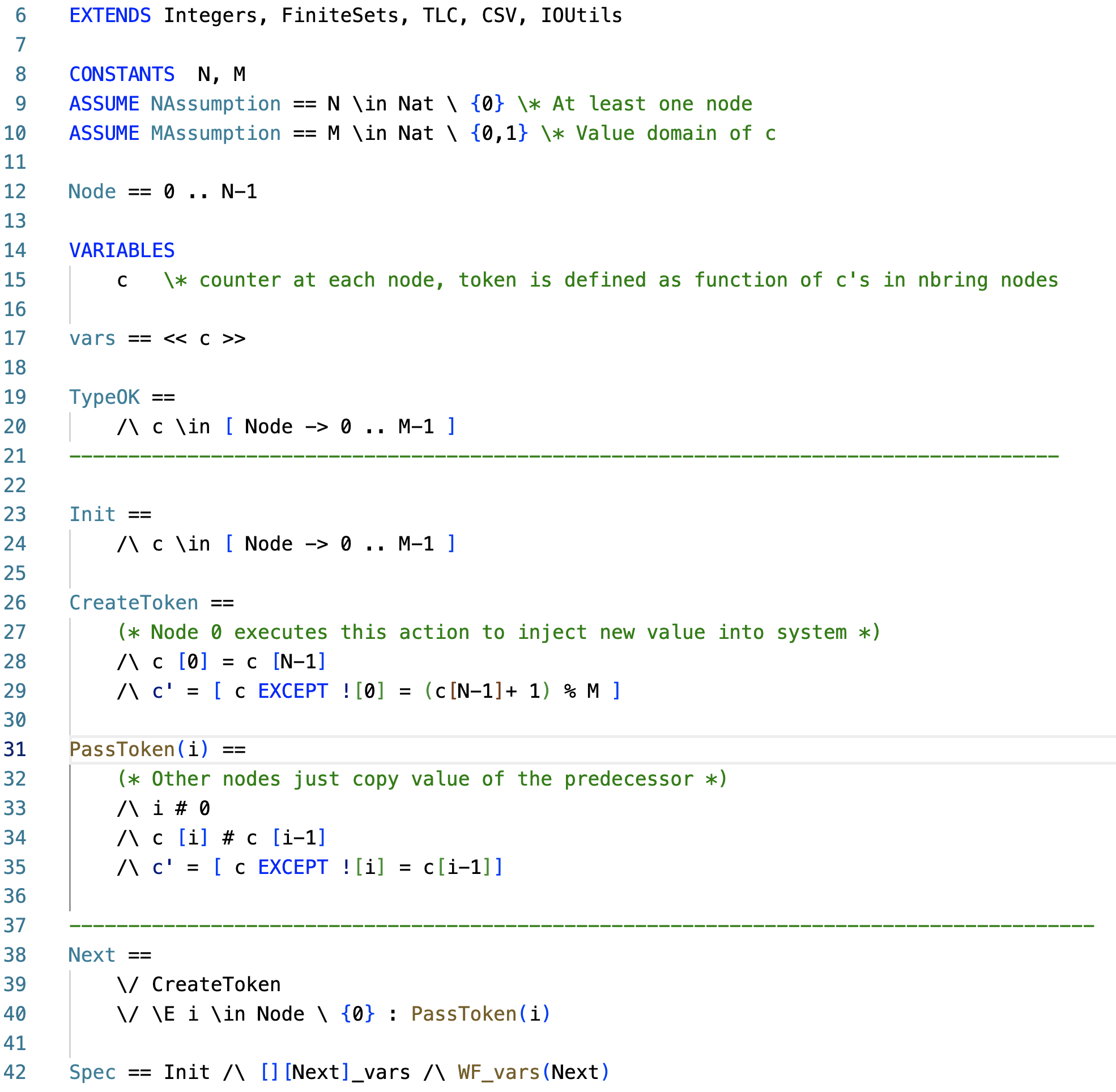
In my previous post, I mentioned how excited I was about Jack Vanlightly and Markus Kuppe's talk at TLA+ Conference. They showed a new mode (called "generate") added to the TLA+ checker to enable  obtaining statistical properties from the models. Here is how this works in a nutshell. Your TLA+ model/protocol produces a tree of runs, and, in the generate mode the TLA+ checker chooses these runs in a uniform manner. You also specify some state constraints, and when these are satisfied the TLA+ checker executes/evaluates your state constraint formula: you add the statistics logging as the side effect of this formula, and record information about the current run to a CSV file. This way, you can collect statistical hyper properties (abort rates, completion rounds, etc.) about the runs, in addition to checking it for correctness invariants. Later you can use Excel or Rscript to visualize the statistics collected and analyze the model behavior. Checking statistics is very usef...

Crash-only software, HOTOS'03

Here is the summary for the second paper we covered in the first class of our seminar. The paper has a provocative title, and in fact there is a wikipedia entry on this title : "Crash-only software refers to computer programs that handle failures by simply restarting, without attempting any sophisticated recovery. Correctly written components of crash-only software can microreboot to a known-good state without the help of a user. Since failure-handling and normal startup use the same methods, this can increase the chance that bugs in failure-handling code will be noticed..." (We had previously seen this observation in the last section of Ousterhout's "The role of distributed state" paper .) Motivation Since crashes are unavoidable, software must be at least as well prepared for a crash as it is for a clean shutdown. But then --in the spirit of Occam's Razor-- if software is crash-safe, why support additional, non-crash mechanisms for shutting down? A frequ...

SOSP19 Verifying Concurrent, Crash-safe Systems with Perennial

Image
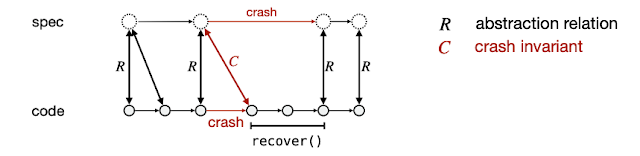
This paper is by Tej Chajed (MIT CSAIL), Joseph Tassarotti (MIT CSAIL), Frans Kaashoek (MIT CSAIL), Nickolai Zeldovich (MIT CSAIL). Replicated disk systems, such as file systems, databases, and key-value stores, need both concurrency (to provide high performance) and crash safety  (to keep your data safety). The replicated disk library is subtle, but the paper shows how to systematically reason about all possible executions using verification. (This work considers verification of a single computer storage system with multiple disk --not a distributed storage system.) Existing verification frameworks support either concurrency (CertiKOS [OSDI ’16], CSPEC [OSDI ’18], AtomFS [SOSP ’19]) or crash safety (FSCQ [SOSP ’15], Yggdrasil [OSDI ’16], DFSCQ [SOSP ’17]). Combining verified crash safety and concurrency is challenging because: Crash and recovery can interrupt a critical section, Crash can wipe in-memory state, and Recovery logically completes crashed threads' operations....

Popular posts from this blog

Hints for Distributed Systems Design

The Agentic Self: Parallels Between AI and Self-Improvement

Learning about distributed systems: where to start?

5 Lessons at 50

Foundational distributed systems papers

Building a Database on S3

Cloudspecs: Cloud Hardware Evolution Through the Looking Glass

Aurora DSQL: Scalable, Multi-Region OLTP

TLA+ modeling tips

Supporting our AI overlords: Redesigning data systems to be Agent-first