Posts

Showing posts matching the search for linearizability

Linearizability: A Correctness Condition for Concurrent Objects

Image
This paper is from Herlihy and Wing appeared in ACM Transactions on Programming Languages and Systems 1990. This is the canonical reference for the linearizability definition. I had not read this paper in detail before, so I thought it would be good to go to the source to see if there are additional delightful surprises in the original text. Hence, this post. I will dive into a technical analysis of the paper first, and then discuss some of my takes toward the end. I had written an accessible explanation of linearizability earlier; you may want to read that first. I will assume an understanding of linearizability to keep this review at reasonable length. Introduction I love how the old papers just barge in with the model, without bothered by pleasantries such as motivation of the problem. These are the first two sentences of the introduction. "A concurrent system consists of a collection of sequential processes that communicate through shared typed objects . This model encompass...

Paper review: Implementing Linearizability at Large Scale and Low Latency (SOSP'15)

Image
Motivation for the paper Remember the 2-phase commit problem?  The 2-phase commit blocks when the initiator crashes. Or, after a server crash the client/initiator may not be able to determine whether the transaction is completed. And transaction blocks. Because if we retry we may end up giving inconsistent result or redoing the transaction which messes up linearizability. You need to have 3-phase commit to fix this. The new-leader/recovery-agent comes and tries to recommit things. Unfortunately, 3-phase commit solutions are complicated, there are a lot of corner cases. Lamport and Gray recommended that the Paxos consensus box can be used to remember the initiator's abort commit decision to achieve consistency, or more precisely they recommended the Paxos box remembers each participants decision  for the sake of shaving off a message in critical latency path. What this paper recommends is an alternative approach. Don't use Paxos box to remember the decision, instead use ...

DDIA: Chp 9. Consistency and Consensus

Image
The chapter 9 of the Designing Data Intensive Applications (DDIA) book has the following 4 sections (which contain a total of 10 subsections).   Consistency guarantees Linearizability Ordering guarantees Distributed transactions and consensus TMI (Too much info) The chapter tries to do too much. Almost an entire semester of distributed systems content is force-jammed into this chapter. I don't think the discord reading group will be able to complete this chapter and make sense of what is going on. For a more manageable load, much of this chapter should be moved to other chapters. The chapter starts with explaining linearizability. It would have been better to explain this in Chapter 5, Replication. Linearizability sounds easy, but it takes time to internalize. I had discussed linearizability here , and later revisited it with this paper . And of course it was mentioned in many other posts. The chapter continues with CAP tradeoff, rightly calling it "the unhelpful CAP theorem...

Linearizability

Distributed/networked systems employ data replication to achieve availability and scalability. Consistency is concerned with the question of what should happen if a client modifies some data items and concurrently another client reads or modifies the same items possibly at a different replica. Linearizability is a strong form of consistency. (That is why it is also called as strong-consistency.) For a system to satisfy linearizability,  each operation must appear (from client perspective) to occur at an instantaneous point between its start time (when the client submits it) and finish time (when the client receives the response), and  execution at these instantaneous points should form a valid sequential execution (i.e., it should be as if operations are executed one at a time ---without concurrency, like they are being executed by a single node)  Let's simplify things further. In practice, consistency is often defined for systems that have two very specific operations: ...

Hermes: A fast fault-tolerant and linearizable replication protocol

Image
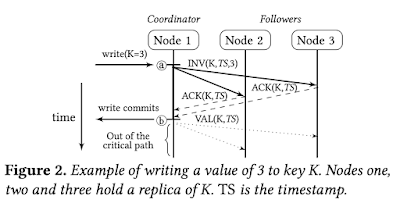
This paper (from ASPLOS'20 which was held remotely) is by Antonios Katsarakis, Vasilis Gavrielatos, M. R. Siavash Katebzadeh, Arpit Joshi, Aleksandar Dragojevic, Boris Grot, Vijay Nagarajan. The paper has its own website , where you can get to the video presentation, slides, and code. Introduction Hermes is a replication protocol that guarantees linearizability . It enables local reads: a client can execute a read locally on any of the replicas. Hermes enables any replica to coordinate a write to a key, and supports concurrent writes to different keys quickly. Too good to be true? You have to read the protocol section below to see how these are achieved. But if you are a distributed systems expert, here is my shortcut explanation of the protocol. Hermes is simply  chain replication (with CRAQ optimization)  deployed with the following "chain" topology: The head and tail node of the chain is colocated in one node, called the coordinator The intermediate nodes ...

Paper review: Measuring and Understanding Consistency at Facebook

Image
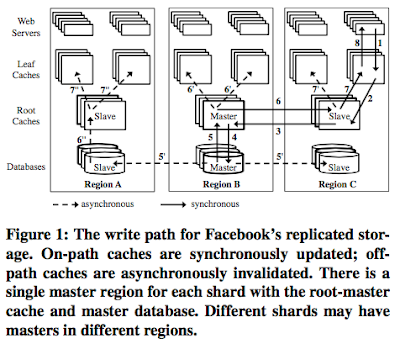
I have reviewed many Facebook papers in this blog before (see the links at the bottom for full list). Facebook papers are simple (in the good sense of the word) and interesting due to the huge scale of operation at Facebook. They are testaments of high scalability in practice. This one here is no different. This paper investigates the consistency of the Facebook TAO system. The TAO system is a replicated storage system for Facebook's social graph of billion vertices. In theory, TAO provides only eventual consistency. The interesting result in this paper is this: In practice, Facebook's TAO system is highly consistent, with only 5 inconsistency violations out of a million read requests! Facebook's TAO system TAO is basically 2-level memcached architecture backed by a database, as first discussed in NSDI'13 paper.  TAO architecture is given in Figure 1. As a prerequisite to TAO consistency discussion in the next section, it will be enough to review how TAO serves re...

Strict-serializability, but at what cost, for what purpose?

Image
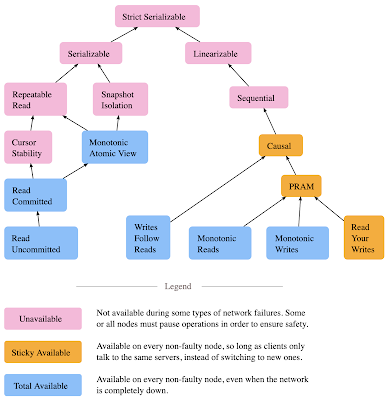
Strict-serializability guarantees that transactions appear to occur in an order consistent with the "real-time" ordering of those transactions: If transaction T1 commits before transaction T2 is invoked, then the commit timestamp of T1 precedes the commit timestamp of T2. This is, in fact, the real-time constraint from linearizability , but applied across transactions not just per-key. A strict-serializability system satisfies both serializability (transactions appear to occur as if they are executed one at a time in isolation) and linearizability per key (after all single-key reads/writes are transactions over one item). Below figure is from https://jepsen.io/consistency . However, this is a one-way implication, the other direction does not hold. You can satisfy both serializability per transactions and linearizability per key, but fail to satisfy strict-serializability. (Below I give an example accompanied with a TLA+ specification to check it.) This is because, in strict-...

PolarDB-SCC: A Cloud-Native Database Ensuring Low Latency for Strongly Consistent Reads

Image
This paper from Alibaba group appeared in VLDB'23 . It talks about how to perform low latency strongly-consistent reads from secondaries in PolarDB database deployments. PolarDB adopts the canonical primary secondary architecture of relational databases. The primary is a read-write (RW) node, and the secondaries are read-only (RO) nodes. Having RO nodes help for executing queries, and scaling out in terms of querying performance. This is essentially t he AWS Aurora architecture . Durability is satisfied through shared storage, so we can ignore that and orthogonally focus on the optimizations for improving RO node performance. The way to improve the RO node performance is by shipping the redo log (essentially WAL) to these RO nodes so they can  keep their buffers ready, and serve reads from the buffer quickly, rather than having to reach out to shared storage. PolarDB architecture follows the same ideas. On top of this, they are interested in being able to serve strong-consistency r...

Popular posts from this blog

The Safest Job from AI may be Writing

The Two Abstractions of System Design: Hide or Reduce

The Agentic Self: Parallels Between AI and Self-Improvement

In Search of a Compositional Theory of Self-Stabilization

Learning about distributed systems: where to start?

Hints for Distributed Systems Design

Foundational distributed systems papers

Building a Database on S3

Cloudspecs: Cloud Hardware Evolution Through the Looking Glass

Specula: Scaling formal specifications for autonomous model checking of system code