Posts

Showing posts matching the search for anish

Salute to Prof. Mohamed Gouda: Elegance in computing

Image
A couple months ago, I attended a special half-day workshop organized honoring Prof. Mohamed Gouda's contributions to computer science, and particularly the self-stabilizing systems community. Mohamed is the Mike A. Myers Centennial Professor at University of Texas at Austin . He has been at Austin Texas since 1980, for almost 40 years. His research contributions to the distributed systems has been phenomenal (borrowing a word Mohamed likes to use for things that excite him.) I am proud that Mohamed is my academic grandfather; he was the PhD advisor of my PhD advisor, Prof. Anish Arora. I wrote about "how to find your advisor" in my previous post, I hope elegance/rigor from Mohamed and Anish rubbed off on me a bit. At the workshop, there were about 10 talks technical in nature, but at the end of the talks, each speaker mentioned how their research and career has been enriched by Mohamed's contributions/help. I talked about my technical report on " Does t...

On becoming a researcher

I remember the first semester I joined THE Ohio State University as a graduate student, Spring 1998. I had taken Anish Arora's class on distributed systems, and I fell in love with distributed algorithms. The emergence of order out of chaotic (distributed/concurrent) execution was intellectually challenging and was very exciting to me. The way Anish taught was also very engaging, and I got drawn into trying the algorithms he mentioned in the class. He taught about the Dijkstra-Safra algorithm which performed termination detection in a ring with 3 rotations of the token. I thought it should be possible to improve on the 3 rounds required for completion, if we kept track of more information at the token. I mentioned this to Anish after the class, and he told me to give it a try. I started working on it. I was also taking English as A Second Language writing class that semester. So I wrote a technical report on this improved version of the Termination Detection algorithm. (We ended up...

How to present your work

Presentation is a very important skill. Determining how to present and communicate your results in an effective manner is  as important as doing the research and getting those results. From the same material you can get a killer job talk or a bummed dissertation talk. Presentation skills can make the difference. Presentation is not a soft skill despite the common misconception among many technical people. It takes a lot of brains, analyzing, and synthesizing to produce a good presentation. You have to understand and internalize your content very well in order to present it clearly in the most engaging and compelling way. So if you fail to present your work clearly, that reflects poorly on you and your work. The audience will think "the work doesn't look significant or promising", or even worse "the presenter doesn't truly understand/internalize his work". The most essential requirement for a successful presentation is practice. I observe that our graduat...

Foundational distributed systems papers

I talked about the importance of reading foundational papers last week. To followup, here is my compilation of foundational papers in the distributed systems area. (I focused on the core distributed systems area, and did not cover networking, security, distributed ledgers, verification work etc. I even left out distributed transactions, I hope to cover them at a later date.)  I classified the papers by subject, and listed them in chronological order. I also listed expository papers and blog posts at the end of each section. Time and State in Distributed Systems Time, Clocks, and the Ordering of Events in a Distributed System. Leslie Lamport, Commn. of the ACM,  1978. Distributed Snapshots: Determining Global States of a Distributed System. K. Mani Chandy Leslie Lamport, ACM Transactions on Computer Systems, 1985. Virtual Time and Global States of Distributed Systems.  Mattern, F. 1988. Practical uses of synchronized clocks in distributed systems. B. Liskov, 1991. Exp...

On the advisor-mentee relationship

I had previously given advice about how to find your advisor . But I realize I haven't talked about the advisor-mentee relationship directly before. The advisor is the window through which the student gets to perceive research and academia from. Advisors imprint the students with their approach to research, taste in research problems, perspective on solutions. Advisors also act as role models to the students in a more general sense. I see that the advisor's qualities often live on the student for a long time --at least through the assistant professorship period. For example, if the advisor is kind and generous to students, the mentee is nice to students, etc. This is a big responsibility for the advisors, and they should be aware of their roles in their interactions with their mentees. The advisor's main job is to ask questions and guide strategically where and when it matters. Acting as the leader, the advisor should provide purpose, give direction, and occasionally mo...

The Invisible Curriculum of Research

Image
Courses, textbooks, and papers provide the formal curriculum of research. But there is also an invisible curriculum. Unwritten rules and skills separate the best researchers from the rest. I did get an early education on this thanks to my advisor, Anish . He kept mentioning "taste", calling some of my observations and algorithms "cute", and encouring me to be more curious and creative and to develop my "taste".  Slowly, I realized that what really shapes a research career isn't written in any textbook or taught in any course. You learn it by osmosis from mentors, and through missteps: working on the wrong problem, asking shallow questions, botching a project, giving up too soon. But if you can absorb these lessons faster, you will find research more fulfilling. The visible curriculum teaches you how to build a car. The invisible curriculum teaches you where to go, who to ride with, and how to keep going when the road turns uphill. After 25 years of exp...

Mad questions

I am a very curious natured person. Every child starts asking lots of questions around 3-4, but according to my mom, I took that to another level constantly asking "but why?" and drove her crazy. On the other hand, I believe I owe my being curious to my mom. She was an elementary school teacher (a damn good one), and was instrumental in my development. She was (and still is) a very curious person, and she taught me how to ask more and better questions. For example, while traveling, she would notice different plants and would ask me why the landscape is different here? And we would make guesses. The Turkish education system was not big on asking questions (these days it is waaaay waaaaay worse). Since the lazy path is to memorize and regurgitate answers, that is what it demanded from the students. But I think my questioning skills mostly survived. Among my friends, I was famous for replying questions with questions of my own, and if not, my answer was often "I don't...

Dijkstra's stabilizing token ring algorithm

Image
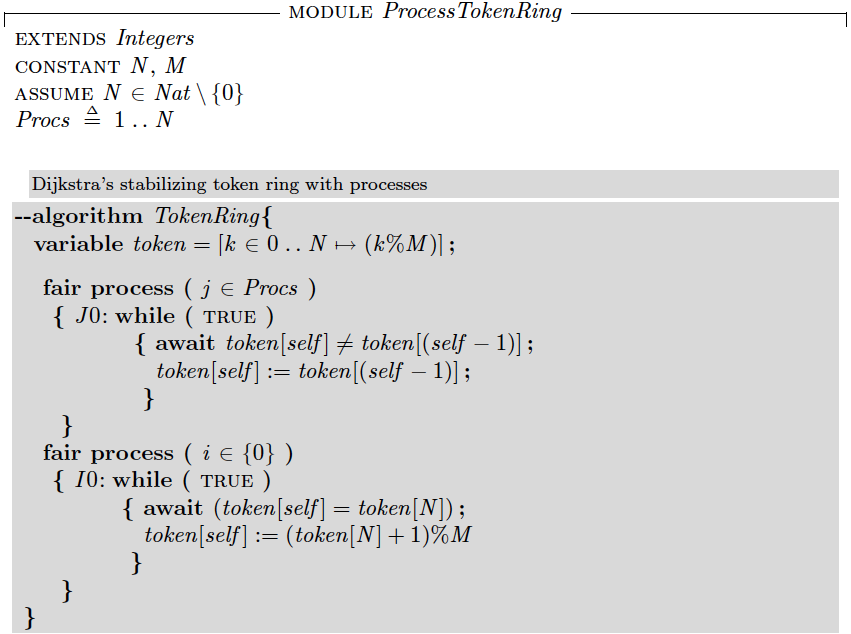
One of the classical algorithms I teach in my distributed systems class is Dijkstra's stabilizing token ring algorithm. This algorithm has started the self-stabilization field as a subfield of fault-tolerance. And, it still receives interest even after 40 years. There has been probably hundreds of self-stabilization papers that revisits Dijkstra's stabilizing token ring algorithm as part of a solution or as part of a case study. This algorithm never gets old for me as well. I still enjoy talking about this algorithm in class and thinking about it once in a while. I guess this is because it is a very elegant algorithm. Linked is Dijkstra's original paper introducing the algorithm. This paper also includes two variants of the stabilizing token ring algorithm, 3-state and 4-state token ring algorithms. Dijkstra would later do a followup writeup, titled, "A belated proof of self-stabilization" , where he gave a proof of stabilization for 3-state token ring progra...

Hints for Distributed Systems Design

This is with apologies to Butler Lampson, who published the " Hints for computer system design " paper 40 years ago in SOSP'83. I don't claim to match that work of course. I just thought I could draft this post to organize my thinking about designing distributed systems and get feedback from others. I start with the same  disclaimer Lampson gave. These hints are not novel, not foolproof recipes, not laws of design, not precisely formulated, and not always appropriate. They are just hints.  They are context dependent, and some of them may be controversial. That being said, I have seen these hints successfully applied in distributed systems design throughout my 25 years in the field, starting from the theory of distributed systems (98-01), immersing into the practice of wireless sensor networks (01-11), and working on cloud computing systems both in the academia and industry ever since. These heuristic principles have been applied knowingly or unknowingly and has proven...

Crash-only software, HOTOS'03

Here is the summary for the second paper we covered in the first class of our seminar. The paper has a provocative title, and in fact there is a wikipedia entry on this title : "Crash-only software refers to computer programs that handle failures by simply restarting, without attempting any sophisticated recovery. Correctly written components of crash-only software can microreboot to a known-good state without the help of a user. Since failure-handling and normal startup use the same methods, this can increase the chance that bugs in failure-handling code will be noticed..." (We had previously seen this observation in the last section of Ousterhout's "The role of distributed state" paper .) Motivation Since crashes are unavoidable, software must be at least as well prepared for a crash as it is for a clean shutdown. But then --in the spirit of Occam's Razor-- if software is crash-safe, why support additional, non-crash mechanisms for shutting down? A frequ...

How I read a research paper

I can't tell you how you should read a research paper.  Probably a different and customized style would work best for you.   But I can tell you how I read a research paper. And if you think some of the things below make sense, you can try them for yourself and see if they work for you as well. So, how do I read a paper? The first answer that pops to my mind is "I fight with it". I strive to completely understand and "Grok" the paper by arguing with it. I resist to believe the claims in the paper at face value, I try to poke holes at it. I believe that the paper has to earn my trust, and I only accept the parts that I am obliged to accept. My algorithm for reading a paper 0. Print the paper 1. Ask questions and argue with the paper 2. Write a review 3. Fight with the paper 4. Sleep on it and come back to it Print the paper I like to physically touch the paper and handwrite and doodle on the paper. I have highlighter and different color pens read...

Popular posts from this blog

Hints for Distributed Systems Design

Chess invariants

The Agentic Self: Parallels Between AI and Self-Improvement

Learning about distributed systems: where to start?

5 Lessons at 50

Foundational distributed systems papers

Building a Database on S3

Cloudspecs: Cloud Hardware Evolution Through the Looking Glass

TLA+ modeling tips

Supporting our AI overlords: Redesigning data systems to be Agent-first