Posts

Sudoku and research

I got addicted to Sudoku... again. When I have a chance to rest, I enjoy the challenge of solving Sudoku puzzles (*cough* at the expert level) on my iPhone. I think this practice gives my mind sharpness and clarity (my wife would roll her eyes so hard if she heard me say this :-). I was recently thinking of how the process of solving a Sudoku puzzle resembles doing research. 1) Sequencing is important. In Sudoku, you take things step by step. You fill out the obvious cells first. Having filled these, you now have more constraints/clues upon which you can fill in other blocks. You have to solve Sudoku step by step from most obvious to what is made obvious having finished that step. This is also the case in research. You can't rush things; you should start with the simple steps. First you have to attack/complete what you can do currently, so that more things can become available for you to see. You have to climb the stair step by step to see more and do more. 2) Writing is i...
Using TLA+ for teaching distributed systems

I am teaching CSE 4/586 Distributed Systems class  again this Fall (Fall 2014). This is the course I have most fun teaching. (I would like to think my students also feel that way :-) I teach the course with emphasis on reasoning about the correctness of distributed algorithms. Here are the topics I cover in sequence: Introduction, Syntax and semantics for distributed programs, predicate calculus Safety and progress properties Proof of program properties Time: logical clocks, State: distributed snapshots Mutual exclusion, Dining philosophers Consensus, Paxos Fault-tolerance, replication, rollback recovery, self-stabilization Programming support for distributed systems Data center computing and cloud computing  CAP theorem and NOSQL systems Distributed/WAN storage systems I put emphasis on reasoning about distributed algorithms because concurrency is very tricky; it truly humbles human brain. More than 3 actions in a distributed program and your intuitions will f...

Hybrid Logical Clocks

Image
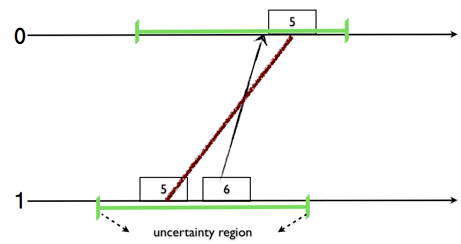
Here I will write about our recent work on Hybrid Logical Clocks, which provides a feasible alternative to Google's TrueTime. A brief history of time (in distributed systems) Logical Clocks (LC) was proposed in 1978 by Lamport for ordering events in an asynchronous distributed system. LC has several drawbacks for modern systems. Firstly, LC is divorced from physical time (PT), as a result we cannot query events in relation to real-time. Secondly, to capture happened-before relations, LC assumes that there are no backchannels and all communication occurs within the system. Physical Time (PT) leverages on physical clocks at nodes that are synchronized using the Network Time Protocol (NTP). PT also has several drawbacks. Firstly, in a geographically distributed system obtaining precise clock synchronization is very hard; there will unavoidably be uncertainty intervals. Secondly,   PT has several kinks such as leap seconds and non-monotonic updates.  And, when the uncertaint...

Distributed is not necessarily more scalable than centralized

Centralized is not necessarily unscalable!  Many people automatically associate centralized with unscalable, and distributed with scalable. And, this is getting ridiculous. In the Spring semester, in my seminar class, a PhD student was pitching me a project for distributed storage: syncing from phone to work/home computers and other phones. The pitch started with the sentence "Dropbox is unscalable, because it is centralized". I was flabbergasted, and I asked a couple of times "Really? Do you actually claim that Dropbox is unscalable?". The student persisted and kept repeating that "Dropbox has a bottleneck because it is a centralized storage solution, and the distributed solution doesn't have that bottleneck". I couldn't believe my ears. Dropbox already proved it is scalable: It serves files for more than 200 million users, who store 1 billion files every 24 hours. That it has a centralized architecture hosted in the cloud doesn't make i...

Management

Managing your resources (energy, time, and students) is a nontechnical topic, but nevertheless it is essential for your success in academia. There isn't much talk or guidance in these topics at the graduate school. You are expected to attain these skills on your own or maybe acquire them by osmosis from professors and colleagues. Here I will keep it short, and just post my summary slides of 3 great books I read on management. The first one is the seven habits book . This book is about managing yourself as an effective person. I first read this book around 18 and found it long, tedious, and boring. Reading it again at 38, I think the book has great advice. Link to my summary slides on the seven habits book. Getting Things Done (GTD)  is the best book on time and project management with low stress. This summer, do yourself a favor: Read the book, and adopt the GTD system ASAP. You will thank me later. Link to my summary slides on the GTD book. I am not aware of much work on...

Targeted crowdsourcing using app/interest categories of users

Image
Part of my research is on crowdsourcing. Basically, crowdsourcing means performing micro-collaborations with many people to complete a task. You divide the task into microtasks and outsource it to people. They provide solutions to your microtasks, and you aggregate those to obtain the solutions to the microtasks, and then ultimately to your task. Aggregating the responses from the crowd is a challenge of itself. If the questions are asked as open ended questions, the answers would come in a variety of types, and you would not be able to aggregate them automatically with a computer. (You may use human intelligence again to aggregate them, but how are you going to aggregate/validate these next level aggregators?) To simplify the aggregation process, we use multiple-choice question answering (MCQA). When the answers are provided in choices, a, b, c, or d, they become unambiguous and easier to aggregate with a computer. The simplest solution for aggregation of MCQA is the majority voti...

Writing versus Typing

Recently, there have been several high profile articles on how writing with pens is much better for the brain than typing. One article presented a study that found: If you write rather than type, you will learn and recall more of the lecture. For full disclosure, I am a fountain-pen fan and I enjoy the elegance and beauty of writing with the pen. I like writing so much that I have been thinking about converting to a tablet solution (MS Surface Pro 3). But, as I weigh my options, I cannot get myself to go for a tablet solution or a dual (laptop+tablet) solution. Typing simply knocks the socks off writing when it comes to productivity. Writing with a fountain-pen has many drawbacks. First of all it is not digital. It can not be easily stored and archived. It is not searchable, and so is not available easily. Most importantly, the writing produced by the fountain-pen is not easily editable. So, this forces you to be extra careful for writing, and self-censor, and this kills creati...

How to write your research paper

The legend of Köroğlu I will start with a story of oppression and an uprising, involving a mythical horse in the process. Way to start a post about writing research papers, huh? In 16th century Anatolia, there was a corrupt and oppressor mayor in the Bolu state. The mayor one day decided that he should find and gift the best horse in the world to the Sultan. He contacted a very skilled horse breeder. The breeder said the horse that is deserving of the Sultan should be very special, and said none of his horses is worthy of this. He went on a quest for this horse himself. One day he saw some street kids abusing a feeble and awkward-looking foal. He immediately recognized the potential in this foal and bought the foal, and headed for the mayor's palace. The mayor got outraged, being the ignorant oppressor he is, he thought the breeder is mocking him by offering this weak awkward foal. The mayor immediately ordered the breeder to be blinded. The breeder had a young son, who beca...

Dapper, a Large-Scale Distributed Systems Tracing Infrastructure

Image
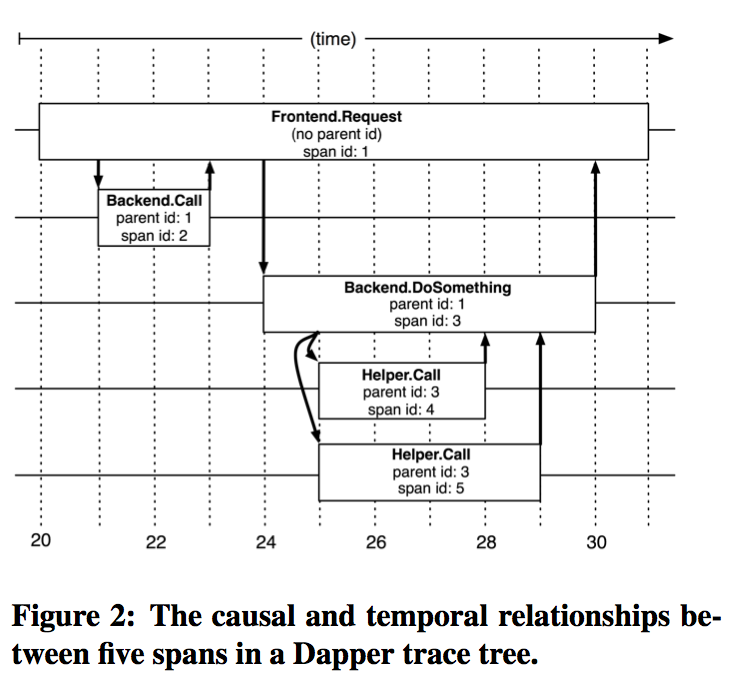
This paper is from Google. This is a refreshingly honest and humble paper. The paper is not pretending to be sophisticated and it doesn't have the "we have it all, we know it all" attitude. The paper presents the Dapper tool which is trying to solve a real problem, and it honestly represents how this simple straightforward solution fares and where it can be improved. This is the attitude of genuine researchers and seekers of truth. It is sad to see that this paper did not get published in any conferences and is still listed as a Google Technical Report since April 2010. What was the problem? Not enough novelty? Not enough graphs? Use case: Performance monitoring tail at scale Dapper is Google's production distributed systems tracing infrastructure. The primary application for Dapper is performance monitoring to identify the sources of latency tails at scale. A front-end service may distribute a web query to many hundreds of query servers. An engineer looking on...

Naiad: A timely dataflow system

Image
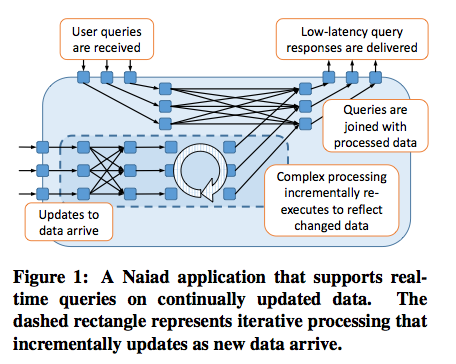
What is in a name? Naiad is from Microsoft Research.  Dryad , a general purpose runtime for execution of data parallel applications, was also from Microsoft Research. An application written for Dryad is modeled as a directed acyclic graph (DAG) and Dryad is the " tree nymph " in Greek mythology. Naiad is a stream processing platform and Naiad is the " stream nymph " in Greek mythology. Naiad is an opensource project that has been receiving a lot of attention recently. I expect we will hear more about Naiad, because it is very useful for low-latency real-time querying and high-throughput incremental-processing of streaming big data. What is not to like? Naiad is useful especially in incremental processing of graphs. As has been observed before, MapReduce is inappropriate for graph processing because of the large number of iterations needed in graph applications. MapReduce is a functional language, so using MapReduce requires passing the entire state of the grap...

Energy approach to life, the universe, and everything

I recently read Scott Adams new book titled: " How to fail at almost everything and still win big ". I enjoyed reading the book a lot; Scott discusses a lot of intriguing ideas as usual. The main idea in the book was that you need systems instead of goals. Motivation is ephemeral, but systems/processes are persistent. As Jeff Bezos says " Good intentions don't work, good systems work! " Another main idea in the book is the importance of monitoring and managing your energy for being successful. The book advises you to "watch what you eat, exercise, match mental states to activity and attack tasks when you have the appropriate energy level". I think this energy approach to personal productivity and life is promising. So I wanted to collect my thoughts on this and see what I can add on this topic. Things that increase energy and decrease energy It isn't the mountains ahead to climb that wears you down. It is the pebble in your shoe. – Mu...

Consistency-Based Service Level Agreements for Cloud Storage

Image
This paper is from Microsoft Research and appeared in SOSP'13 . This paper is more of a position and vision paper. The paper introduces a consistency-based SLA concept, which can provide a win-win arrangement for cloud providers and developers. Problem  For performing reads from key-value stores, currently you have two options. You can do strongly-consistent reads by increasing the size of your read replica quorum, but this will increase latency of the responses, and you don't get the flexibility to revert to a quick dirty (eventually-consistent) read if a strong-consistent read would take a long time to respond. Or you go with best effort reads (which are eventually-consistent) from the key value store because you insist on low-latency answers. (Actually there is another option: You can use a strongly consistent multiversion data store like BigTable or Spanner, and relax it by reading slightly stale data and get flexibility. I will revisit this option in the discussion....

The scalable commutativity rule: Designing scalable software for multicore processors

Image
This paper was one of the best paper's at SOSP 13 . The paper is open access since SOSP paid for the open access fees for each paper that appeared in the conference. The scalable commutativity rule says that "Whenever interface operations commute, they can be implemented in a way that scales" . In other words, whenever several operations commute at the interface-level (i.e., there's no way to distinguish their execution order using the interface), for those operations we can have implementations whose memory accesses are conflict-free. (Scalable commutativity sounds like a misnomer, shouldn't the theorem be called "commutative scalability" theorem? The end goal is scalability, and commutativity is a tool for it. Thus "commutative" should qualify "scalability", not the other way around.) I found several nice generalizable insights in the paper. The first one is using commutativity as a detectable/measurable and controllable wi...

Black sheep

" Publish or Perish " has become a motto for academics, but it is hard not to get depressed about this rat race in academia. I see researchers who have published an implausible amount of papers in good venues, but they still remain obscure. With all those papers, they haven't even made a splash in their field of study. I then ask myself what chance I stand for making a big enough contribution to be useful. Then, I proceed to have my semi-annual existential crisis, and question the point of publishing and my career in academia. I recover in a couple days generally, because I like working on problems and I am curious about stuff. But, these questions loom: Am I wasting my time? Am I irrelevant with my publications? How should I allocate/manage my time to be useful? Publish less?  It is simplistic to say " It is the quality that counts. If you publish less you will publish better quality work and get recognition ". Experience refutes this. If you strive to publ...

Popular posts from this blog

The Safest Job from AI may be Writing

The Two Abstractions of System Design: Hide or Reduce

The Agentic Self: Parallels Between AI and Self-Improvement

In Search of a Compositional Theory of Self-Stabilization

Learning about distributed systems: where to start?

Hints for Distributed Systems Design

Foundational distributed systems papers

Building a Database on S3

Cloudspecs: Cloud Hardware Evolution Through the Looking Glass

Specula: Scaling formal specifications for autonomous model checking of system code