Posts

Showing posts matching the search for winston

How to package your ideas using the Winston star
Image
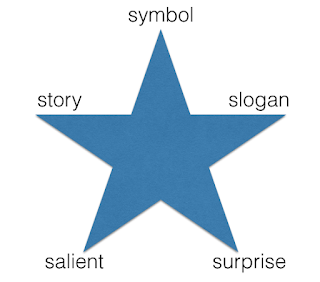
I came across this advice serendipitously by reading a random Hacker News comment. The advice shows up towards the last 10 minutes of an Artificial Intelligence lecture by Patrick Winston. Winston, a prominent professor at MIT , tells his class that he will disclose them important advice that may make or break their careers. It is about how to pack and present ideas. His advice is simple. Follow this 5-tip star to pack your ideas better. All the tips start with "S": Symbol: use a symbol to make your idea visual and memorable Slogan: find a catchy slogan for your idea Surprise: highlight the unconventional/counterintuitive/interesting part of your idea Salient: focus on the essential part of your idea, remember: less is more, fewer ideas is better Story: pack your idea with a story, human brains are hardwired for stories Here let me try to apply the  Winston's Star method on itself, to make this more concrete. Symbol: star is the symbol of the Winston...

How to speak (by Patrick Winston)

Image
On New Year's morning, I watched the above lecture by Patrick Winston, the late MIT professor, on "How To Speak". (Patrick Winston passed away in July 2019. May he rest in peace.)   I had previously covered the Winston star idea by him ; this talk provides a more general and comprehensive treatment on how to speak and present. Patrick's talk contained several new gems for me. And I thought I already know a lot about presenting. Start with an empowerment promise. Nobody cares about your talk, they care about what useful things they can learn from your talk. So make this about the audience, look at this from their perspective, and start by telling them what useful thing they will get out of this talk. Differentiate between presentations that aim to expose (a job talk or a conference talk) versus that aim to inform (a lecture). For an exposition talk, you need to get across your message in the first five minutes. You should explain the problem you solve and...

Book Review. Made to stick: why some ideas survive and others die

This book from 2007 was an easy and fun book to read. The book gives tactics for making ideas/concept stick in peoples minds. This is not just useful for marketing purposes, but also for teaching, presenting, and research exposition. The book gives the following formula for stickiness: tell Simple, Unexpected, Concrete, Credible, and Emotional Stories. SUCCESS! Acronyms help for stickiness. Notice how close the advice in the "Talk like TED" book mirrors the advice here. For me this is what stuck from the book. (Note that this follows the SUCCESS formula.) Nora Ephron is a screenwriter whose scripts for Silkwood, When Harry Met Sally, and Sleepless in Seattle have all been nominated for Academy Awards. Ephron started her career as a journalist for the New York Post and Esquire. She became a journalist because of her high school journalism teacher.  Ephron still remembers the first day of her journalism class. Although the students had no journalism experience, th...

How to write papers so they get accepted

Image
This is a very bold and *valuable* talk: The craft of writing effectively . It introduces a no-bullshit approach to academic publishing that will change/upgrade your perspective to writing. This talk may offend you, you may want to reject these ideas initially, but you will eventually realize that this is the reality we live in and you must come to terms with it. Since you are a researcher, and deal with complicated topics, you need to use your writing for thinking. Writing and thinking feed off of each other, and you need to write to help your thinking. But ultimately writing is not about you or your thinking, it is about the *reader*. After your initial drafts are done, you should reframe your writing to be reader-centric . The reader doesn't care about your work, he cares about what useful things he can learn from it. ( In marketing, they have a good saying about this: The customer doesn't want a power drill, he wants a hole in the wall to hang a photo. ) Provide val...

Year in Review: Best of Metadata in 2020

What a decade this year has been! Here are some highlights among my 2020 posts. Distributed systems My Distributed Systems Seminar's reading list for Fall 2020  Learning about distributed systems: where to start?  Millions of tiny databases Compositional Programming and Testing of Dynamic Distributed Systems  Ocean Vista: Gossip-Based Visibility Control for Speedy Geo-Distributed Transactions  Zoom Distributed Systems Reading Group  Distributed coordination PigPaxos: Devouring the communication bottlenecks in distributed consensus  WormSpace: A modular foundation for simple, verifiable distributed systems  Hermes: A fast fault-tolerant and linearizable replication protocol  Scalog: Seamless Reconfiguration and Total Order in a Scalable Shared Log State-Machine Replication for Planet-Scale Systems Streamlet: textbook streamlined blockchains  Modeling Streamlet in TLA+ Book reviews Book review. Tiny Habits Vincent Van Gogh, Lust for Life  ...

How to present your work

Presentation is a very important skill. Determining how to present and communicate your results in an effective manner is  as important as doing the research and getting those results. From the same material you can get a killer job talk or a bummed dissertation talk. Presentation skills can make the difference. Presentation is not a soft skill despite the common misconception among many technical people. It takes a lot of brains, analyzing, and synthesizing to produce a good presentation. You have to understand and internalize your content very well in order to present it clearly in the most engaging and compelling way. So if you fail to present your work clearly, that reflects poorly on you and your work. The audience will think "the work doesn't look significant or promising", or even worse "the presenter doesn't truly understand/internalize his work". The most essential requirement for a successful presentation is practice. I observe that our graduat...

Book review Draft No. 4 by John McPhee

This book is a collection/compilation of many essays McPhee wrote over his career as a prominent writer for the New Yorker. Here is one of those essays, which forms the basis for one of the chapters in the book and gives the book its title. The book is about the craft of writing, with its many aspects. But the book is stamped with McPhee's unmistakable take on writing, which puts a big emphasis on the structure/composition of the piece: You can build a strong, sound, and artful structure. You can build a structure in such a way that it causes people to want to keep turning pages. A compelling structure in nonfiction can have an attracting effect analogous to a story line in fiction.  I thoroughly enjoyed reading the book. To tell the truth, I was prejudiced going into this. I imagined McPhee would be a boring high-brow NewYorker writer, who would use fancy words I don't understand. Quite the contrary, he is a very colorful figure, a great observer, and insightful and sinc...

Popular posts from this blog

The Safest Job from AI may be Writing

The Two Abstractions of System Design: Hide or Reduce

The Agentic Self: Parallels Between AI and Self-Improvement

In Search of a Compositional Theory of Self-Stabilization

Learning about distributed systems: where to start?

Hints for Distributed Systems Design

Foundational distributed systems papers

Building a Database on S3

Cloudspecs: Cloud Hardware Evolution Through the Looking Glass

Specula: Scaling formal specifications for autonomous model checking of system code