Posts

Paper summary: Bitcoin-NG -- A scalable Blockchain Protocol
Image
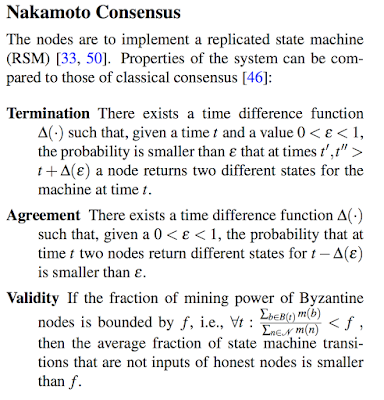
This week in our seminar , we discussed the Bitcoin-NG paper. The paper appeared in NSDI 16, and is authored by Ittay Eyal, Adem Efe Gencer, Emin Gün Sirer, and Robbert van Renesse at the Cornell University. The model section of this paper is very well formalized and written. This is like a Rosetta Stone find for classical distributed systems researchers that want to enter blockchain research. So in this summary, I will start by covering as much of that as I can. The Nakamoto Consensus Problem  The blockchain system is comprised of a set of nodes N connected by a reliable peer-to-peer network. Nodes can generate public-private key-pairs for themselves. The system employs a cryptopuzzle system, defined by a cryptographic hash function H. The solution to a puzzle defined by the string y is a string x such that H(y|x) --the hash of the concatenation of the two-- is smaller than some target (i.e., the hash has k number of leading zeros). Each node i has a limited amount of comput...

Paper review. IPFS: Content addressed, versioned, P2P file system

This week we discussed  the IPFS whitepaper  by Juan Benet  in my Distributed Systems Seminar. Remember peer-to-peer systems? IPFS is "peer-to-peer systems reloaded" with improved features. IPFS is a content-addressed distributed file system that combines Kademlia + BitTorrent + Git ideas. IPFS also offers better privacy/security features: it provides cryptographic hash content addressing, file integrity and versioning, and filesystem-level encryption and signing support. The question is will it stick? I think it won't stick, but this work will still be very useful because we will transfer the best bits of IPFS to our datacenter computing as we did with other peer-to-peer systems technology. The reason I think it won't stick has nothing to do with the IPFS development/technology, but has everything to do with the advantages of centralized coordination and the problems surrounding decentralization.  I rant more about this later in this post. Read on for the more...

Paper summary. SnailTrail: Generalizing critical paths for online analysis of distributed dataflows

Image
Monitoring is very important for distributed systems, and I wish it would receive more attention in research conferences. There has been work on monitoring for predicate detection purposes and for performance problem detection purposes. As machine learning and big data processing frameworks are seeing more action, we have been seeing more work on the latter category. For example in ML there have been work on how to figure out what is the best configuration to run. And in the context of general big data processing framework there has been work on identifying performance bottlenecks. Collecting information and creating statistics about a framework to identify the bottleneck activities seems like an easy affair. However, the "making sense of performance" paper (2015) showed that this is not as simple as it seems, and sophisticated techniques such as blocked time analysis are needed to get a more accurate picture of performance bottlenecks. This paper (by ETH Zurich and due ...

Think before you code

Image
I have been reading Flash boys by Michael Lewis . It is a fascinating book about Wall Street and high-frequency traders . I will write a review about the book later but I can't refrain from an overview comment. Apart from the greediness, malice, and sneakiness of Wall Street people, another thing that stood out about them was the pervasive cluelessness and ineptness. It turns out nobody knew what they were doing, including the people that are supposed to be regulating things, even sometimes the people that are gaming the system. This brought to my mind Steve Jobs' quote from his 1994 interview: "Everything in this world... was created by people no smarter than you." Anyways, today I will talk about something completely different in the book that caught my eye. It is about thinking before coding. On Page 132 of the book: Russians had a reputation for being the best programmers on Wall Street, and Serge thought he knew why: They had been forced to learn to progr...

Paper review. Blockchains from a distributed computing perspective

Image
Our distributed systems seminar met the first time this Monday. I went through the syllabus, explained how we will run the seminar , and introduced the papers we will discuss . In the second hour, to give students an overview of the blockchains technology, I went through this paper:  "Blockchains from a distributed computing perspective" . I liked this paper a lot. It is from a respected distributed systems expert, Maurice Herlihy . It is written to be accessible and expository. The paper gives several examples (with increasing sophistication) to explain the blockchain concepts concretely. Finally, the paper is a perfect fit with our seminar's theme of looking at blockchains from a distributed systems perspective . Herlihy states that the paper is "colored by the perspective that much of the blockchain world is a disguised, sometimes distorted, mirror-image of the distributed computing world." For a data processing perspective on blockchains, see this other ...

Paxos derived

Lamport's fault-intolerant state machine replication algorithm In 1978, Lamport published his classic "Time, Clocks, and the Ordering of Events in a Distributed System". As an application of logical clocks, he presented a distributed replicated state machine algorithm (and then he instantiated that algorithm to solve mutual exclusion as an example). Lamport complains that no one seemed to be aware of the distributed replicated state machine algorithm introduced in the paper: "This is my most often cited paper. Many computer scientists claim to have read it. But I have rarely encountered anyone who was aware that the paper said anything about state machines. People seem to think that it is about either the causality relation on events in a distributed system, or the distributed mutual exclusion problem. People have insisted that there is nothing about state machines in the paper. I’ve even had to go back and reread it to convince myself that I really did remember...

Modeling the DAO attack in PlusCal

Image
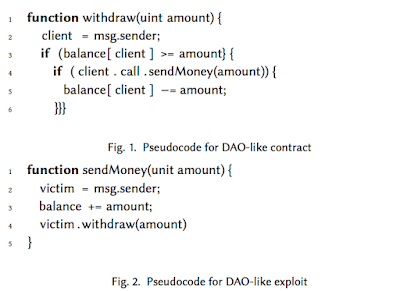
Maurice Herlihy's paper: "Blockchains from a distributed computing perspective" explains the DAO attack as follows: "Figure 1 shows a fragment of a DAO-like contract, illustrating a function that allows an investor to withdraw funds. First, the function extracts the client's address (Line 2), then checks whether the client has enough funds to cover the withdrawal (Line 3). If so, the funds are sent to the client through an external function call (Line 4), and if the transfer is successful, the client’s balance is decremented (Line 5).  This code is fatally  flawed. In June 2016, someone exploited this function to steal about $50 million funds from the DAO. As noted, the expression in Line 3 is a call to a function in the client's contract. Figure 2 shows the client's code. The client's contract immediately calls withdraw() again (Line 4). This re-entrant call again tests whether the client has enough funds to cover the withdrawal (Line 3), and b...

Spring 18 Distributed Systems Seminar

I considered doing a blast from the past edition of the seminar focusing only on classical papers published before 2000 . But, nah, I decided, I am doing a blockchain seminar instead. There has been many interesting papers on blockchains and this will be a good chance to catch up with those and look at the distributed systems, concurrency and coordination issues there. Here is the list. I thank Adem Efe Gencer for suggesting several interesting papers for this list. Blockchain papers: Blockchains from a Distributed Computing Perspective   Blockstack: A Global Naming and Storage System Secured by Blockchains  IPFS   Bitcoin-NG: A Scalable Blockchain Protocol   A Secure Sharding Protocol For Open Blockchains Enhancing Bitcoin Security and Performance with Strong Consistency via Collective Signing   Service-Oriented Sharding for Blockchains The stellar consensus protocol: A federated model for internet-level consensus Smart contracts papers: Step ...

Erasable pens for editing papers

Image
I recently discovered the Pilot Frixion pens and I like them a lot. (I am not getting any advertisement money from them I swear :-) The pens have erasable ink, so they are great for marking your comments/edits on a paper while reading. They erase via heat. Each pen comes with a plastic nub, and if you apply friction to the page with the plastic nub at the top, and it erases the writing --mostly clean. A word of caution though, this means if you leave your writing in a hot car, you will find it erased, which you can remedy by putting it in a freezer. I am not kidding. So, don't use it for writing you want to keep permanently, but it is great for writing comments and marking on a paper when you are reading. I print the research paper I am reading and I do a lot of marking on paper. If I use a regular pen, I cross over some of my guesswork, nonsensical questions, or misinformed comments, and it messes up the paper. But using Frixion pens, I erase and modify my comments without ...

Remember peer-to-peer systems?

Image
Traditionally computer systems use client server model. This is more of a centralized approach; server sits there and responds to clients requests. If one server is not enough for computation/analysis, a "hierarchical" organization of servers model is adopted in datacenter and cloud computing. One node becomes the master, other nodes act as workers. This is called the master-worker model. This simple model make sense if you have an infrastructure. Centralized control architecture is simple, so you can keep the coordination simple and efficient. Peer-to-peer model is on the other end of the spectrum: it calls for a fully decentralized system model. There is no distinguished master. Each node acts as both server and client, each node is a peer. This model does not require stable infrastructure and it can self-organize with what is presently available. As such, they are great for circumventing laws, bans, and censorship. In 2000s, peer-to-peer systems were all the craze...

Paper summary. A Berkeley view of systems challenges for AI

Image
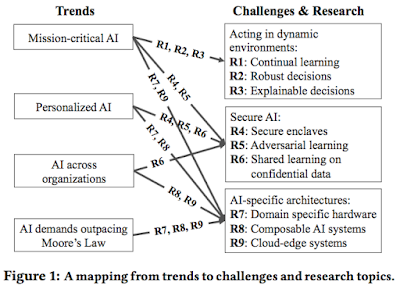
This position paper from Berkeley identifies an agenda for systems research in AI for the next 10 years. The paper also serves to publicize/showcase their research, and steer interest towards these directions, which is why you really write position papers. The paper motivates the systems agenda by discussing how systems research/development played a crucial role in fueling AI’s recent success. It says that the remarkable progress in AI has been made possible by a "perfect storm" emerging over the past two decades, bringing together: (1) massive amounts of data, (2) scalable computer and software systems, and (3) the broad accessibility of these technologies. The rest of the paper talks about the trends in AI and how those map to their systems research agenda for AI. Trends and challenges The paper identifies 4 basic trends in the AI area: Mission-critical AI: Design AI systems that learn continually by interacting with a dynamic environment in a timely, robust, and...

Popular posts from this blog

Hints for Distributed Systems Design

The Agentic Self: Parallels Between AI and Self-Improvement

Learning about distributed systems: where to start?

5 Lessons at 50

Foundational distributed systems papers

Building a Database on S3

Cloudspecs: Cloud Hardware Evolution Through the Looking Glass

Aurora DSQL: Scalable, Multi-Region OLTP

TLA+ modeling tips

Supporting our AI overlords: Redesigning data systems to be Agent-first