Posts

Showing posts with the label timeDB

Tiga: Accelerating Geo-Distributed Transactions with Synchronized Clocks

Image
This paper (to appear at SOSP'25) is one of the latest efforts exploring the dream of a one-round commit for geo-replicated databases. TAPIR tried to fuse concurrency control and consensus into one layer. Tempo and Detock went further using dependency graphs.  Aleksey and I did our usual thing. We recorded our first blind read of the paper. I also annotated a copy while reading, which you can access here . We liked the paper overall. This is a thoughtful piece of engineering, not a conceptual breakthrough. It uses  future timestamps to align replicas  in a slightly new way, and the results are solid. But the presentation needs refinement and stronger formalization. (See our livereading video about how these problems manifested themselves.)  Another study to add to my survey , showing how, with modern clocks, time itself is becoming a coordination primitive. The Big Idea Tiga claims to do strictly serializable one-shot (multi-shot ok with reconnaissance queries t...

GaussDB-Global: A Geographically Distributed Database System

Image
This paper , presented in the industry track of ICDE 2024 , introduces GaussDB-Global (GlobalDB) , Huawei's geographically distributed database system. GlobalDB replaces the centralized transaction management (GTM) of GaussDB with a decentralized system based on synchronized global clocks (GClock) . This approach mirrors Google Spanner's TrueTime approach and its commit-wait technique, which provides externally serializable transactions by waiting out the uncertainty interval. However, GlobalDB claims compatibility with commodity hardware, avoiding the need for specialized networking infrastructure for synchronized clock distribution. The GClock system uses GPS receivers and atomic clocks as the global time source device at each regional cluster. Each node synchronizes its clock with the global time source over TCP every 1 millisecond. Clock deviation is kept low because synchronization is achieved within 60 microseconds as a TCP round trip, and the CPU’s clock drift is bound...

Use of Time in Distributed Databases (part 5): Lessons learned

Image
This concludes our series on the use of time in distributed databases , where we explored how use of time in distributed systems evolved from a simple ordering mechanism to a sophisticated tool for coordination and performance optimization. A key takeaway is that time serves as a shared reference frame that enables nodes to make consistent decisions without constant communication. While the AI community grapples with alignment challenges, in distributed systems we have long confronted our own fundamental alignment problem. When nodes operate independently, they essentially exist in their own temporal universes. Synchronized time provides the global reference frame that bridges these isolated worlds, allowing nodes to align their events and states coherently. At its core, synchronized time serves as an alignment mechanism in distributed systems. As explored in Part 1, synchronized clocks enable nodes to establish "common knowledge" through a shared time reference, which is pow...

Use of Time in Distributed Databases (part 4): Synchronized clocks in production databases

Image
This is part 4 of our "Use of Time in Distributed Databases" series . In this post, we explore how synchronized physical clocks enhance production database systems. Spanner Google's Spanner (OSDI'12) implemented a novel approach to handling time in distributed database systems through its TrueTime API. TrueTime API provides time as an interval that is guaranteed to contain the actual time, maintained within about 6ms (this is 2012 published number which improved significantly since then) of uncertainty using GPS receivers and atomic clocks. This explicit handling of time uncertainty allows Spanner to provide strong consistency guarantees while operating at a global scale. Spanner uses multi-version concurrency control (MVCC) and achieves external consistency (linearizability) for current transactions through techniques like "commit wait," where transactions wait out the uncertainty in their commit timestamps before making their writes visible. Spanner uses ...

I Can’t Believe It’s Not Causal! Scalable Causal Consistency with No Slowdown Cascades

Image
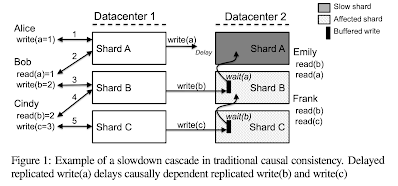
I recently came across the Occult paper (NSDI'17) during my series on "The Use of Time in Distributed Databases." I had high expectations, but my in-depth reading surfaced significant concerns about its contributions and claims. Let me share my analysis, as there are still many valuable lessons to learn from Occult about causality maintenance and distributed systems design. The Core Value Proposition Occult (Observable Causal Consistency Using Lossy Timestamps) positions itself as a breakthrough in handling causal consistency at scale. The paper's key claim is that it's "the first scalable, geo-replicated data store that provides causal consistency without slowdown cascades." The problem they address is illustrated in Figure 1, where a slow/failed shard A (with delayed replication from master to secondary) can create cascading delays across other shards (B and C) due to dependency-waiting during write replication. This is what the paper means by "...

Use of Time in Distributed Databases (part 3): Synchronized clocks in databases

Image
This is part 3 of our "Use of Time in Distributed Databases" series . In this post, we explore how synchronized physical clocks enhance database systems, focusing on research and prototype databases. Discussion of time's role in production databases will follow in our next post. To begin, let's revisit the utility of synchronized clocks in distributed systems. As highlighted in Part 1 , synchronized clocks provide a shared time reference across distributed nodes and partitions. For simple, single-key replication tasks, such precision is often unnecessary and leader-based approaches such as MultiPaxos or Raft is much more appropriate. Even WPaxos might be considered if you need a WAN deployment. Of course, if you want to go very fancy by using a leaderless designs, such as those in the EPaxos family/Tempo/Accord,  then dependency graphs and time synchronization re-enter the picture. The true value of synchronized clocks becomes apparent in distributed multi-key operat...

Use of Time in Distributed Databases (part 2): Use of logical clocks in databases

Image
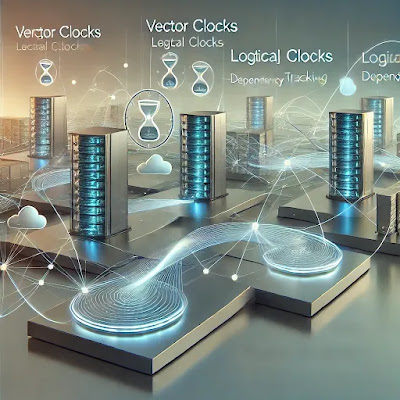
This is part 2 of our "Use of Time in Distributed Databases" series . We talk about the use of logical clocks in databases in this post. We consider three different approaches: vector clocks dependency graph maintenance epoch service  In the upcoming posts we will allow in physical clocks for timestamping, so there is no (almost no) physical clocks involved in the systems in part 2.    1. Vector clocks Dynamo: Amazon's highly available key-value store (SOSP'07) Dynamo employs sloppy quorums and hinted hand-off and uses version vector (a special case of vector clocks) to track causal dependencies within the replication group of each key. A version vector contains one entry for each replica (thus the size of clocks grows linearly with the number of replicas). The purpose of this metadata is to detect conflicting updates and to be used in the conflict reconciliation function. Dynamo provides eventual consistency thanks to this reconciliation function and conflict detect...

Popular posts from this blog

Hints for Distributed Systems Design

The Agentic Self: Parallels Between AI and Self-Improvement

Learning about distributed systems: where to start?

5 Lessons at 50

Foundational distributed systems papers

Building a Database on S3

Cloudspecs: Cloud Hardware Evolution Through the Looking Glass

Aurora DSQL: Scalable, Multi-Region OLTP

TLA+ modeling tips

Supporting our AI overlords: Redesigning data systems to be Agent-first