Posts

Showing posts with the label consistency

Asymmetric Linearizable Local Reads

Image
People want data fast. They also want it consistent. Those two wants pull in opposite directions. This VLDB'25 paper does another take on this conundrum. Rather than assuming a symmetric network environment where all replicas face similar latencies, the paper emphasizes that in practice, some replicas are closer to the leader, where others are stranded halfway across the globe. By embracing this asymmetry, the authors propose two new algorithms: Pairwise-Leader (PL) and Pairwise-All (PA). Both cut read latency compared to the prior approaches. PL could even achieve 50x latency improvements in some cases. Aleksey and I did our usual thing. We recorded our first blind read of the paper . I also annotated a copy while reading which you can access here. We liked the ideas, even though the protocols themselves didn't thrill us particularly. I particularly liked finding another good example of the use of synchronized time in distributed database systems. Another study to add to my s...

DDIA: Chp 5. Replication (Part 1)

Image
Chapter 5 of the Designing Data Intensive Applications (DDIA) book discusses strategies and challenges in replicating data across distributed systems. Replication is critical for ensuring data availability, fault tolerance, and scalability. One of the key challenges in replication is maintaining consistency across multiple replicas. Leader-based replication, the most common method, involves a single leader node accepting all writes, while follower nodes replicate the leader's changes. While single leader replication does not guarantee consistency readily (due to leader failover cornercases), it gives us a fighting chance. One primary advantage of leader-based replication is its simplicity: all write requests are serialized through the leader, ensuring a consistent order of operations. Followers receive a stream of changes (i.e., the replication log) from the leader and apply them in sequence, ensuring eventual consistency. However, replication lag, the delay between when a write i...

Linearizability: A Correctness Condition for Concurrent Objects

Image
This paper is from Herlihy and Wing appeared in ACM Transactions on Programming Languages and Systems 1990. This is the canonical reference for the linearizability definition. I had not read this paper in detail before, so I thought it would be good to go to the source to see if there are additional delightful surprises in the original text. Hence, this post. I will dive into a technical analysis of the paper first, and then discuss some of my takes toward the end. I had written an accessible explanation of linearizability earlier; you may want to read that first. I will assume an understanding of linearizability to keep this review at reasonable length. Introduction I love how the old papers just barge in with the model, without bothered by pleasantries such as motivation of the problem. These are the first two sentences of the introduction. "A concurrent system consists of a collection of sequential processes that communicate through shared typed objects . This model encompass...

Implementation of Cluster-wide Logical Clock and Causal Consistency in MongoDB

Image
This paper (SIGMOD 2019) discusses the design of causal consistency and cluster-wide logical clock for MongoDB.  Causal consistency preserves Lamport's happened-before (transitive and partial) order of events in a distributed system. If an event A causes another event B, causal consistency ensures that every process in the system observes A before observing B. Causal consistency guarantees read-your-writes, write-follows-reads, monotonic reads, and monotonic writes. Causal consistency is the strictest consistency level where the system can still make progress (always-available one-way convergence) in the presence of partitions as discussed in  the "Consistency, Availability, and Convergence" paper . This makes causal-consistency a very attractive model for modern distributed applications. https://jepsen.io/consistency The paper provides a simple and balanced design for causal-consistency in MongoDB. The ideas are simple, yet the implementation and operationalizing (backw...

Checking Causal Consistency of MongoDB

Image
This paper  declares the Jepsen testing of MongoDB for causal consistency a bit lacking in rigor, and goes on to test MongoDB against three variants of causal consistency (CC, CCv, and CM) under node failures, data movement, and network partitions. They also add TLA+ specifications of causal consistency and their checking algorithms, and verify them using the TLC model checker, and discuss how TLA+ specification can be related to Jepsen testing. This is a journal paper, so it is long. The writing could have been better. But it is apparent that a lot of effort went into the paper. One thing I didn't like in the paper was the wall-of-formalism around defining causal consistency in Section 2:Preliminaries. This was hard to follow. And I was upset about the use of operational definitions such as "bad patterns" for testing. Why couldn't they define this in a state-centric manner, as in the client-centric database isolation paper ? It turns out that Section 2 did not intr...

Tunable Consistency in MongoDB

Image
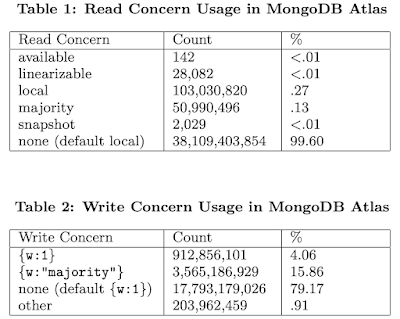
This paper appeared in VLDB 2019. It discusses the tunable consistency models in MongoDB and how MongoDB's speculative execution model and data rollback protocol enable this spectrum of consistency levels efficiently. Motivation Applications often tolerate short or infrequent periods of inconsistency, so it may not make sense for them to pay the high cost of ensuring strong consistency at all times. These types of trade-offs have been partially codified in the PACELC theorem . The Probabilistically Bounded Staleness work (and many followup work ) explored the trade-offs between operation latency and data consistency in distributed database replication and showcased their importance.  To provide users with a set of tunable consistency options, MongoDB exposes writeConcern and readConcern levels as parameters that can be set on each database operation. writeConcern specifies what durability guarantee a write must satisfy before being acknowledged to a client. Similarly, readConc...

Fault-Tolerant Replication with Pull-Based Consensus in MongoDB

Image
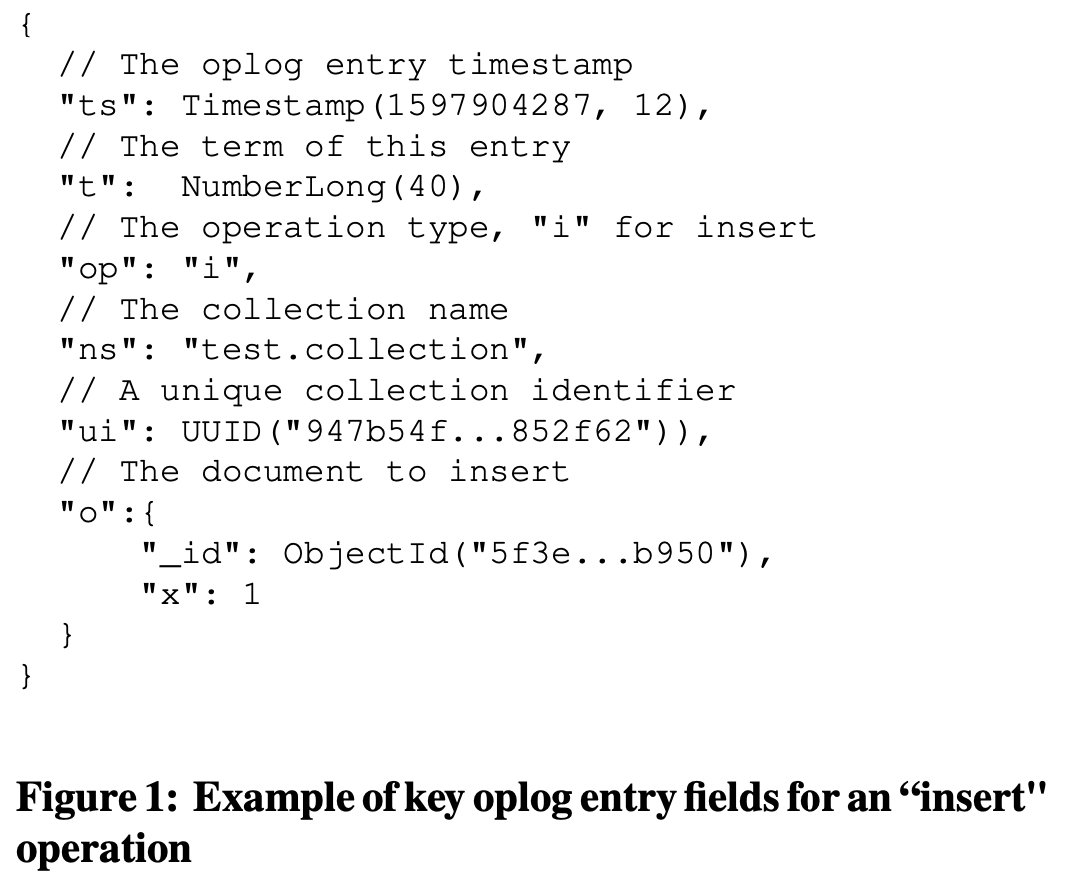
This paper, from NSDI 2021, presents the design and implementation of strongly consistent replication in MongoDB using a consensus protocol derived from Raft. Raft provides fault-tolerant state-machine-replication (SMR) over asynchronous networks. Raft (like most SMR protocols) uses push-based replication. But MongoDB uses pull-based replication scheme, so when integrating/invigorating MongoDB's SMR with Raft, this caused challenges. The paper focuses on examining and solving these challenges, and explaining the resulting MongoSMR protocol (my term, not the paper's).  The paper restricts itself to the strongest consistency level, linearizability, but it also talks about how serving weaker models interact/shape decisions made in MongoDB's replication protocol. The paper talks about extensions/optimizations of MongoDB SMR protocol, but I skip those for brevity. I also skip the evaluation section, and just focus on the core of the SMR protocol. Design Background Unlike conve...

Popular posts from this blog

Hints for Distributed Systems Design

The Agentic Self: Parallels Between AI and Self-Improvement

Learning about distributed systems: where to start?

5 Lessons at 50

Foundational distributed systems papers

Building a Database on S3

Cloudspecs: Cloud Hardware Evolution Through the Looking Glass

Aurora DSQL: Scalable, Multi-Region OLTP

TLA+ modeling tips

Supporting our AI overlords: Redesigning data systems to be Agent-first