Posts

Showing posts with the label time

Claude Code experiment: Visualizing Hybrid Logical Clocks

Image
Yesterday morning I downloaded Claude Code, and wanted to see what this bad boy can do. What better way to learn how this works than coding up a toy example with it. The first thing that occurred to me was to build a visualizer for Hybrid Logical Clocks (HLC). HLC is a simple idea we proposed in 2014 : combine physical time with a logical counter to get timestamps that are close to real time but still safe under clock skew. With HLC, you get the best of both worlds: real-time affinity augmented with causality when you need it. Since then HLC has been adopted by many distributed databases, including MongoDB, CockroachDB, Amazon Aurora DSQL, YugabyteDB, etc. This felt well scoped for a first project with Claude Code. Choosing Javascript enabled me to host this on Github (Git Pages) for free. Easy peezy way of sharing something small yet useful with people.  Claude Code is a clever idea. It is essentially an agent wrapped around the Claude LLM. Chat works well for general Q/A, but it ...

The Sauna Algorithm: Surviving Asynchrony Without a Clock

Image
While sweating it out in my gym's sauna recently, I found a neat way to illustrate the happened-before relationship in distributed systems. Imagine I suffer from a medical condition called dyschronometria , which makes me unable to perceive time reliably, such that 10 seconds and 10 minutes feel exactly the same to me. In this scenario, the sauna lacks a visible clock. I'm flying blind here, yet I want to leave after a healthy session. If I stay too short, I get no health benefits. If I stay too long, I risk passing out on the floor. The question becomes: How do I, a distributed node with no local clock, ensure operating within a safety window in an asynchronous environment? Thankfully, the sauna has a uniform arrival of people. Every couple of minutes, a new person walks in. These people don't suffer from dyschronometria and they stay for a healthy session, roughly 10 minutes. My solution is simple: I identify the first person to enter after me, and I leave when he leaves....

LeaseGuard: Raft Leases Done Right!

Image
Many distributed systems have a leader-based consensus protocol at their heart. The protocol elects one server as the "leader" who receives all writes. The other servers are "followers", hot standbys who replicate the leader’s data changes. Paxos and Raft are the most famous leader-based consensus protocols. These protocols ensure consistent state machine replication , but reads are still tricky. Imagine a new leader L1 is elected, while the previous leader L0 thinks it's still in charge. A client might write to L1, then read stale data from L0, violating Read Your Writes . How can we prevent stale reads? The original Raft paper recommended that the leader communicate with a majority of followers before each read, to confirm it's the real leader. This guarantees Read Your Writes but it's slow and expensive. A leader lease is an agreement among a majority of servers that one server will be the only leader for a certain time. This means the leader can run...

Chapter 4: Non-Locking Schedulers (Concurrency Control Book)

Image
Chapter 4 of the Concurrency Control and Recovery in Database Systems book (1987) opens with a sentence that doesn't quite pass the grammar test: "In this chapter we will examine two scheduling techniques that do not use locks, timestamp ordering (TO) and serialization graph testing (SGT)."  That comma is trying to do the job of a colon and failing at it. Precision matters, more so in technical writing. The writing is otherwise clear and careful. And as par the book, it is ahead of its time. The chapter presents a spectrum of non-locking schedulers, starting from Basic TO, expanding into certifiers (which basically stands for optimistic concurrency control), and ending with modular, composable scheduler designs that separate synchronization concerns cleanly between read-write and write-write synchronization.  Let's dig into the details. Timestamp Ordering (TO) Timestamp Ordering (TO) uses transaction start timestamps to impose a serial order on conflicting operations...

Use of Time in Distributed Databases (part 5): Lessons learned

Image
This concludes our series on the use of time in distributed databases , where we explored how use of time in distributed systems evolved from a simple ordering mechanism to a sophisticated tool for coordination and performance optimization. A key takeaway is that time serves as a shared reference frame that enables nodes to make consistent decisions without constant communication. While the AI community grapples with alignment challenges, in distributed systems we have long confronted our own fundamental alignment problem. When nodes operate independently, they essentially exist in their own temporal universes. Synchronized time provides the global reference frame that bridges these isolated worlds, allowing nodes to align their events and states coherently. At its core, synchronized time serves as an alignment mechanism in distributed systems. As explored in Part 1, synchronized clocks enable nodes to establish "common knowledge" through a shared time reference, which is pow...

Use of Time in Distributed Databases (part 4): Synchronized clocks in production databases

Image
This is part 4 of our "Use of Time in Distributed Databases" series . In this post, we explore how synchronized physical clocks enhance production database systems. Spanner Google's Spanner (OSDI'12) implemented a novel approach to handling time in distributed database systems through its TrueTime API. TrueTime API provides time as an interval that is guaranteed to contain the actual time, maintained within about 6ms (this is 2012 published number which improved significantly since then) of uncertainty using GPS receivers and atomic clocks. This explicit handling of time uncertainty allows Spanner to provide strong consistency guarantees while operating at a global scale. Spanner uses multi-version concurrency control (MVCC) and achieves external consistency (linearizability) for current transactions through techniques like "commit wait," where transactions wait out the uncertainty in their commit timestamps before making their writes visible. Spanner uses ...

I Can’t Believe It’s Not Causal! Scalable Causal Consistency with No Slowdown Cascades

Image
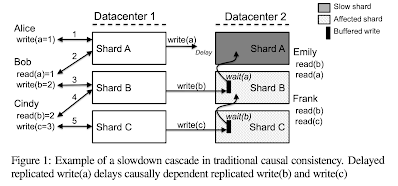
I recently came across the Occult paper (NSDI'17) during my series on "The Use of Time in Distributed Databases." I had high expectations, but my in-depth reading surfaced significant concerns about its contributions and claims. Let me share my analysis, as there are still many valuable lessons to learn from Occult about causality maintenance and distributed systems design. The Core Value Proposition Occult (Observable Causal Consistency Using Lossy Timestamps) positions itself as a breakthrough in handling causal consistency at scale. The paper's key claim is that it's "the first scalable, geo-replicated data store that provides causal consistency without slowdown cascades." The problem they address is illustrated in Figure 1, where a slow/failed shard A (with delayed replication from master to secondary) can create cascading delays across other shards (B and C) due to dependency-waiting during write replication. This is what the paper means by "...

Use of Time in Distributed Databases (part 3): Synchronized clocks in databases

Image
This is part 3 of our "Use of Time in Distributed Databases" series . In this post, we explore how synchronized physical clocks enhance database systems, focusing on research and prototype databases. Discussion of time's role in production databases will follow in our next post. To begin, let's revisit the utility of synchronized clocks in distributed systems. As highlighted in Part 1 , synchronized clocks provide a shared time reference across distributed nodes and partitions. For simple, single-key replication tasks, such precision is often unnecessary and leader-based approaches such as MultiPaxos or Raft is much more appropriate. Even WPaxos might be considered if you need a WAN deployment. Of course, if you want to go very fancy by using a leaderless designs, such as those in the EPaxos family/Tempo/Accord,  then dependency graphs and time synchronization re-enter the picture. The true value of synchronized clocks becomes apparent in distributed multi-key operat...

Popular posts from this blog

Hints for Distributed Systems Design

The Agentic Self: Parallels Between AI and Self-Improvement

Learning about distributed systems: where to start?

5 Lessons at 50

Foundational distributed systems papers

Building a Database on S3

Cloudspecs: Cloud Hardware Evolution Through the Looking Glass

Aurora DSQL: Scalable, Multi-Region OLTP

TLA+ modeling tips

Supporting our AI overlords: Redesigning data systems to be Agent-first