Posts

Showing posts with the label htap

HPTS day 2, part 2

Image
Continuing with our HPTS series . This is now the afternoon of second day. The first session was on HTAP and streaming, and the second one on caching.  Session 7: HTAP and Streaming  Who cares about HTAP? - Tianyu Li (MIT) Tianyu argued that while Hybrid Transactional/Analytical Processing (HTAP) showed great promise in 2014, it has failed to make a significant impact in the decade since. Instead, he proposed that the real disruption in the database world is coming from the migration of workloads to the cloud, with companies like Snowflake and Databricks leading the charge. The trend is moving towards virtualization and cloud-native architectures. The trend has been for composing specialized data engines connected by pipelines and streams, rather than relying on monolithic HTAP systems. He highlighted the MITDBG projects on developing modern abstractions and architectures for cloud-native data processing. Amazon Zero-ETL - Gopal Paliwal and Gokul Soundararajan (AWS) This tal...
TiDB: A Raft-based HTAP Database

Image
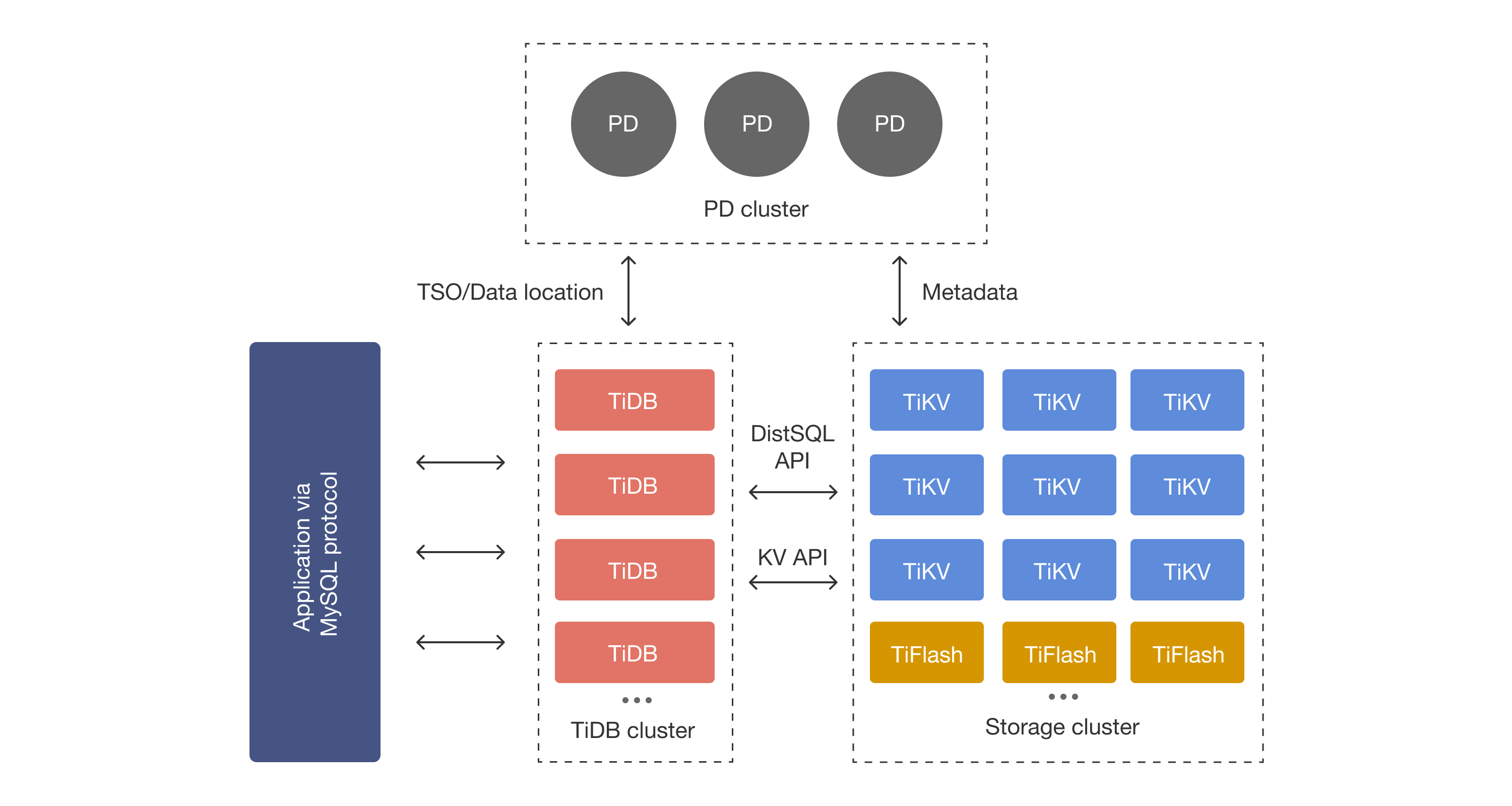
This paper is from VLDB 2020. TiDB is an opensource Hybrid Transactional and Analytical Processing (HTAP) database, developed by PingCap. The TiDB server, written in Go, is the query/transaction processing component; it is stateless, in the sense that  it does not store data and it is for computing only. The underlying key-value store, TiKV, is written in Rust, and it uses RocksDB as the storage engine. They add a columnar store called TiFlash, which gets most of the coverage in this paper. In this figure PD stands for Placement Driver (PD), which is responsible for managing Raft ranges, and automatically moving ranges to balance workloads. PD also hosts the timestamp oracle (TSO), which provides strictly increasing and globally unique timestamps to serve as transaction IDs. Each timestamp includes the physical time and logical time. The physical time refers to the current time with millisecond accuracy, and the logical time takes 18 bits. If you know about CockroachDB/CRDB ( he...

Fast Serializable Multi-Version Concurrency Control for Main-Memory Database Systems

Image
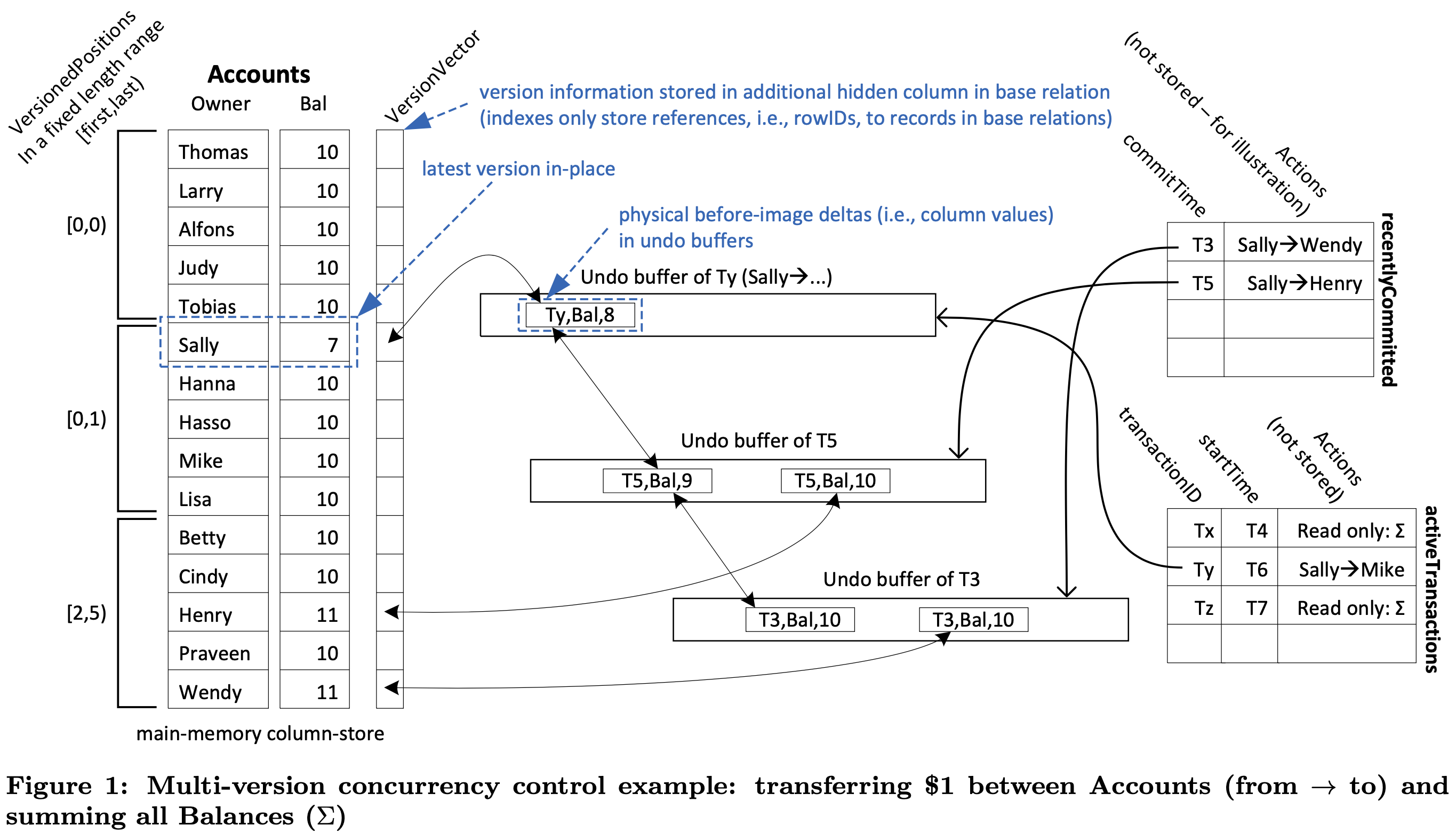
This paper from Sigmod 2015 describes the addition of Multi-Version Concurrency Control (MVCC) to the Hyper database, and discusses at length how they implement serializability efficiently with little overhead compared to snapshot isolation. Coming only two years later, this paper seems like a response/one-up-manship to the Hekaton paper . In the paper, you can see at many places statements like "in constrast to/ unlike/ as in/ Hekaton" phrase. In a way, that is the biggest compliment a paper can pay to another paper. Hyper is also an in-memory database as in Hekaton. The paper says that Hyper is like Hekaton in that, in order to preserve scan performance, new transactions are not allocated a separate place. The most uptodate version of the database is kept all in the same place. But, you can reach older versions of a record (that are still in use by active transactions) by working backwards from the record using the delta versions maintained. The biggest improvement in Hyp...

Popular posts from this blog

Hints for Distributed Systems Design

The Agentic Self: Parallels Between AI and Self-Improvement

Learning about distributed systems: where to start?

5 Lessons at 50

Foundational distributed systems papers

Building a Database on S3

Cloudspecs: Cloud Hardware Evolution Through the Looking Glass

Aurora DSQL: Scalable, Multi-Region OLTP

TLA+ modeling tips

Supporting our AI overlords: Redesigning data systems to be Agent-first