Posts

Showing posts with the label SQL

Looking Back at Postgres
Image
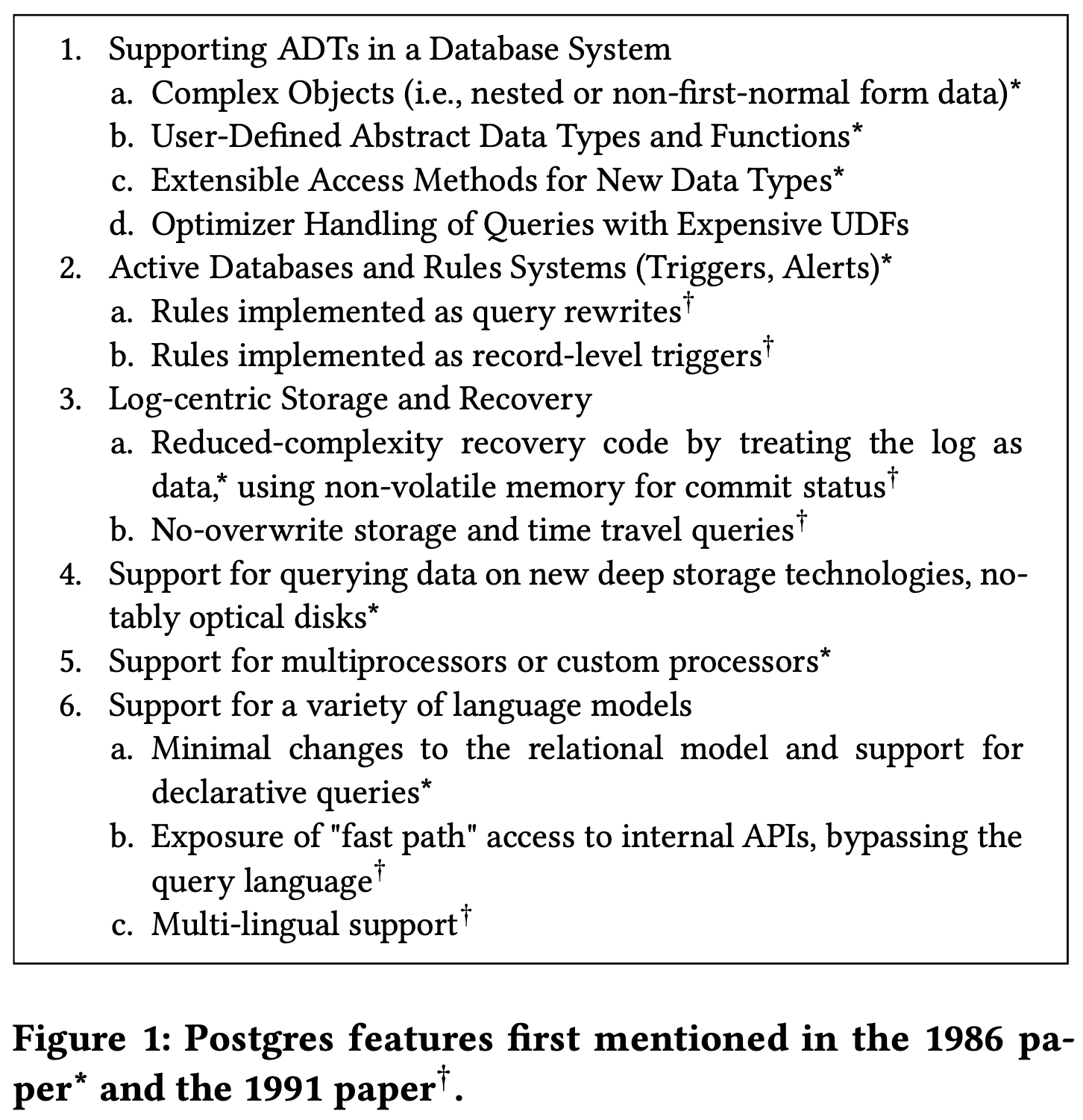
This is a 2019 article by Joe Hellerstein, the Jim Gray Professor of Computer Science at UC Berkeley. Last year at Sigmod, Joe was awarded the Ted Codd innovation award where he gave an awesome overview of his research agenda. This article, written to be included in Stonebraker’s Turing Award book, provides a retrospective on Postgres project, which Stonebraker led from the mid-1980’s to the mid-1990’s. I love this article a lot, because as I have written before, context is my crack : "The more context I know, the better I become able to locate something almost spatially, and the more I can make sense of it. Even reading the history and motivation for the subject can give my understanding a big boost." The entire paper is context, and it even has a section titled "Context", how cool is that? The footnotes on the article are also excellent! Very interesting gems there as well. Disclaimer: I use a lot of text from the article to summarize it. The features and the imp...
Scalable OLTP in the Cloud: What’s the BIG DEAL?

Image
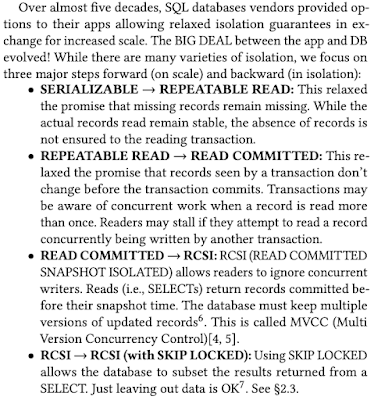
This paper is from Pat Helland, the apostate philosopher of database systems, overall a superb person, and a good friend of mine. The paper appeared this week at CIDR'24. (Check out the program for other interesting papers). The motivating question behind this work is: " What are the asymptotic limits to scale for cloud OLTP (OnLine Transaction Processing) systems? " Pat says that the CIDR 2023 paper "Is Scalable OLTP in the Cloud a Solved Problem?" prompted this question.  The answer to the question? Pat says that the answer lies in the joint responsibility of database and the application. If you know of Pat's work, which I have summarized several in this blog , you would know that Pat has been advocating along these lines before. But this paper provides a very crisp, specific, concrete answer. Read on for my summary of the paper. Disclaimer: This is a wisdom and technical information/detail packed 13-page paper, so I will try my best to summarize the sa...

Spanner: Becoming a SQL system

Image
This is a VDLB 2017 paper. Last week we reviewed the F1 paper from 2012. It seems like F1 was an experiment and sort of a preview towards adding serious SQL support in Spanner. The original Spanner paper was published in 2012 had little discussion/support for SQL. It was mostly a "transactional NoSQL core". In the intervening years, though, Spanner has evolved into a relational database system, and many of the SQL features in F1 got incorporated directly in Spanner. Spanner got a strongly-typed schema system and a SQL query processor, among other features. This paper describes Spanner's evolution to a full featured SQL system. It focuses mostly on the distributed query execution (in the presence of resharding of the underlying Spanner record space), query restarts upon transient failures, range extraction (which drives query routing and index seeks), and the improved blockwise-columnar storage format. I wish there was discussion on the evolution of data manipulation/modi...

Noria: dynamic, partially-stateful dataflow for high-performance web applications

Image
This paper, which appeared in OSDI 2018 , considers the question of how to design a read-optimized RDBMS database with built-in support for caching and fast lookup answers to complex queries. The resulting system, Noria is implemented in Rust, and is available as opensource at https://github.com/mit-pdos/noria . There are already two good summaries written of the paper (from Adrian Colyer and Micah Lerner ), so my job today will be simpler. Artwork created by Stable Diffusion Motivation and overview Databases (mostly relational databases) are overwhelmingly used with read-heavy workloads due to all those SQL querying they serve, but they fail to take advantage of this and improve their designs to optimize for read-heavy workloads. Some crutch solutions was added to address this: memcached, read-only replicas etc., but these have shortcomings. Many deployments employ an in-memory key-value cache (like Redis, memcached, or TAO) to speed up common-case read queries. Such a cache avoids r...

NoSQL: The Hangover of Dropping ACID

Image
Created by Stable Diffusion The 70s were a time of excess and rebellion, a carefree era where people embraced their wildest impulses and let their hair down. But as the years went by, people realized that the true freedom lies not in the absence of rules, but in the discipline to follow them. And so, they put away their acid-washed jeans and neon-colored hair, and embraced a more structured, disciplined way of life. As we hit 2010, the 70s spirit of rebellion spawned a new breed of databases known as "NoSQL". The rise of NoSQL databases was a rebellion against the strict rules and constraints of SQL databases. NoSQL databases promised to free users from the rigid, structured world of SQL, with their strict schemas and complex query languages. Instead, NoSQL databases offered a simple, flexible approach to data storage and retrieval, allowing users to store and access data in whatever way they saw fit. In contrast to SQL databases, which provide strong consistency guarantees t...

Hekaton: SQL Server’s Memory-Optimized OLTP Engine

Image
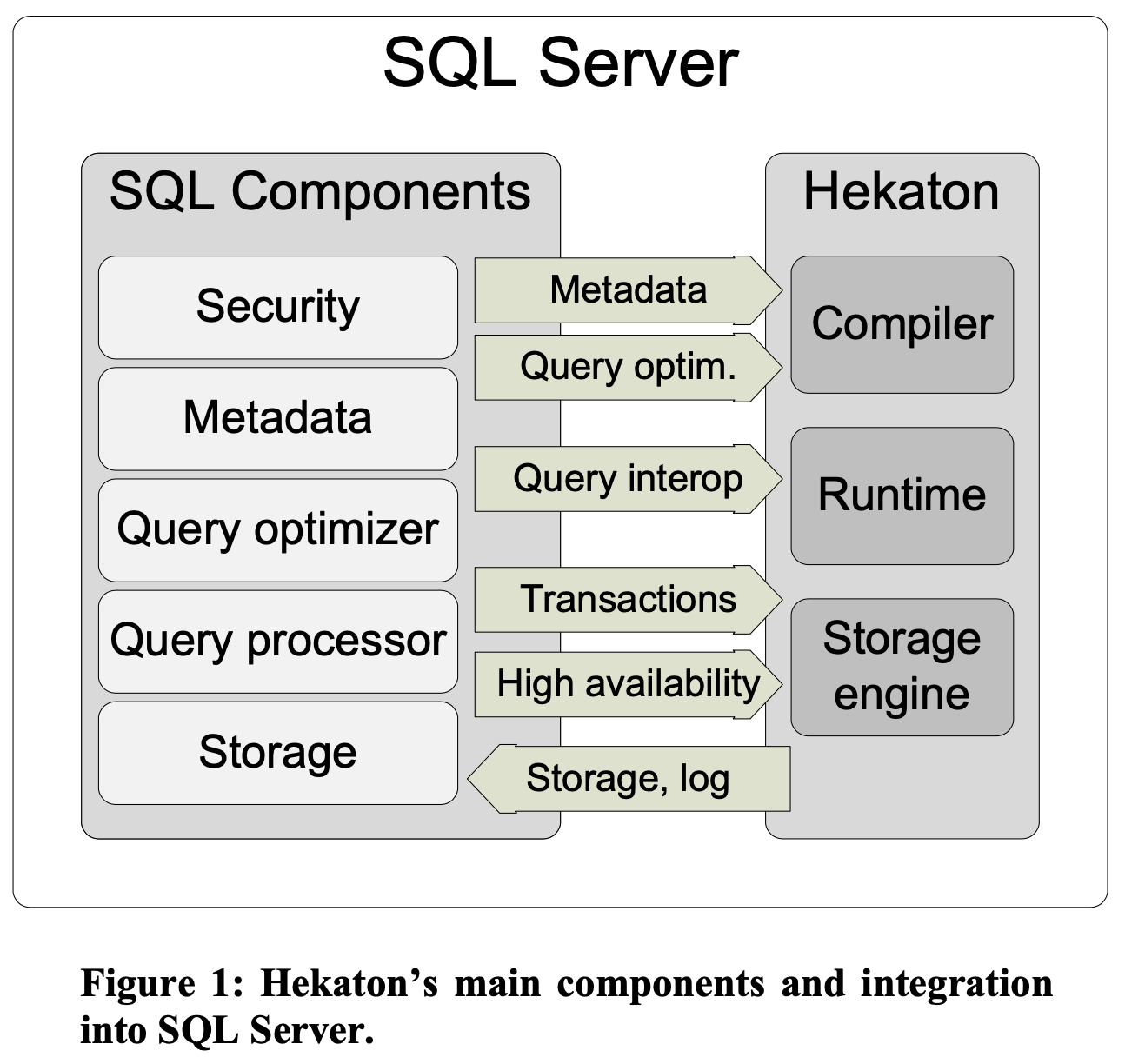
This paper (Sigmod 2013) gives an overview of the design of the Hekaton engine which is optimized for memory resident data and OLTP workloads and is fully integrated into Microsoft SQL Server. The paper starts with a strongly opinionated paragraph: SQL Server and other major database management systems were designed assuming that main memory is expensive and data resides on disk. This assumption is no longer valid; over the last 30 years memory prices have dropped by a factor of 10 every 5 years. Today, one can buy a server with 32 cores and 1TB of memory for about $50K and both core counts and memory sizes are still increasing. The majority of OLTP databases fit entirely in 1TB and even the largest OLTP databases can keep the active working set in memory. I really like this paper. The paper is self-contained and is easy to follow. It is very well written. It has the old-school touch: it is succinct and opinionated, it explains principles/tenets behind design, and it does not oversell...

Popular posts from this blog