Posts

Paper review. GraphLab: A new Framework for Parallel Machine Learning

Image
This GraphLab paper is from 2010. It is written elegantly and it does a good job of explaining the GraphLab abstraction and foundations. A later VLDB 2012 paper presents how to extend this basic GraphLab abstraction to a distributed GraphLab implementation. It seems like GraphLab has since took off big time. There are workshops and conferences about GraphLab. And GraphLab is now developed by the company Dato (formerly GraphLab inc.). Dato Inc. raised 6.75M$ from Madrona and New Enterprise Associates in A round, and 18.5M$ in B round from Vulcan Capital and Opus Capital, as well as Madrona and New Enterprise Associates. Introduction The motivation for GraphLab was to hit the sweetspot in development of machine learning solutions. "(Then in 2010) Existing high-level parallel abstractions like MapReduce are insufficiently expressive, while low-level tools like MPI and Pthreads leave machine learning (ML) experts repeatedly solving the same design challenges." GraphLab a...
Book review: The War Of Art by Steven Pressfield

I read this book recently and liked it a lot. The book is written by Steven Pressfield. He is also the writer of "The Legend of Bagger Vance" and "Gates of Fire" (arguably the best book about Spartans, and is being used as recommended reading in Army academies). Pressfield definitely knows and respects his craft. This book is a call for all people, and creative people and writers in particular, to wake up and realize their calling. The book says: "Most of us have two lives. The life we live, and the unlived life within us." Yeah... About that... I know "self-help" books, and books that use "new-agey" language rub many people the wrong way. I am a pragmatic about that. The way I see it, if I can learn some good paradigms, tips, strategy to become more productive, effective, I can look past some of the turn-offs. The book is organized in 3 parts. The first part talks about resistance, the enemy of creating anything meaningful and wort...

Consensus in the Cloud: Paxos Systems Demystified

Image
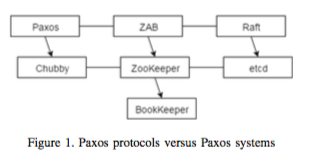
This our most recent paper, still under submission. It is available as a technical report here. We felt we had to write this paper because we have seen misuses/abuses of Paxos-based coordination services. Glad this is off our chests. Here is the short pitch for the paper. I hope you like it and find it helpful. Coordination and consensus play an important role in datacenter and cloud computing. Examples are leader election, group membership, cluster management, service discovery, resource/access management, and consistent replication of the master nodes in services. Paxos protocols and systems provide a fault-tolerant solution to the distributed consensus problem and have attracted significant attention but they also  generated substantial confusion. Zab, Multi-Paxos, Raft are examples of Paxos protocols.  ZooKeeper, Chubby, etcd are examples of Paxos systems. Paxos systems and Paxos protocols reside in different planes, but even that doesn't prevent these two concepts...

Paper Review. Petuum: A new platform for distributed machine learning on big data

Image
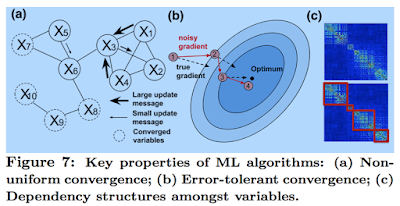
First there was big data. Industry saw that big data was good. Industry made big data storage systems, NoSQL datastores, to store and access the big data. Industry saw they were good. Industry made big data processing systems, Map Reduce, Spark, etc., to analyze and extract information and insights (CRM, business logistics, etc.) from big data. Industry saw they were good and popular, so machine learning libraries are added to these big data processing systems to provide support for machine learning algorithms and techniques. And here is where this paper makes a case for a redesign for machine learning systems. The big data processing systems produced by the industry are general analytic systems, and are not specifically designed for machine learning from the start. Those are data analytics frameworks first, with some machine learning libraries as add on to tackle machine learning tasks. This paper considers the problem of a clean slate system design for a big data machine learning s...

Paper review: Building Consistent Transactions with Inconsistent Replication (SOSP'15)

Image
This paper investigates an interesting and promising research problem: how can we implement distributed transactions more efficiently by performing a cross-layer design of the transaction protocal/layer with the underlying distributed storage protocol/layer? This idea is motivated by the observation that there is wasted/duplicated work done both at the transaction layer and at the storage layer. The transaction layer already provides ordering (i.e., linearizability), and, if you look at the distributed storage layer, it also provides strongly consistent replication which orders/linearizes updates often with Paxos. The paper argues that this is overlapping functionality, and leads to higher latency and lower throughput. Ok, at this point, we have to take a step back and realize that we cannot avoid all coordination between the two layers. The distributed storage layer needs to be consistent with the order of updates at the transaction layer, because it serves reads and you like it to...

Paper review: Measuring and Understanding Consistency at Facebook

Image
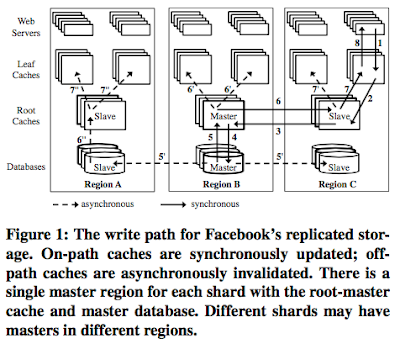
I have reviewed many Facebook papers in this blog before (see the links at the bottom for full list). Facebook papers are simple (in the good sense of the word) and interesting due to the huge scale of operation at Facebook. They are testaments of high scalability in practice. This one here is no different. This paper investigates the consistency of the Facebook TAO system. The TAO system is a replicated storage system for Facebook's social graph of billion vertices. In theory, TAO provides only eventual consistency. The interesting result in this paper is this: In practice, Facebook's TAO system is highly consistent, with only 5 inconsistency violations out of a million read requests! Facebook's TAO system TAO is basically 2-level memcached architecture backed by a database, as first discussed in NSDI'13 paper.  TAO architecture is given in Figure 1. As a prerequisite to TAO consistency discussion in the next section, it will be enough to review how TAO serves re...

Paper review: Implementing Linearizability at Large Scale and Low Latency (SOSP'15)

Image
Motivation for the paper Remember the 2-phase commit problem?  The 2-phase commit blocks when the initiator crashes. Or, after a server crash the client/initiator may not be able to determine whether the transaction is completed. And transaction blocks. Because if we retry we may end up giving inconsistent result or redoing the transaction which messes up linearizability. You need to have 3-phase commit to fix this. The new-leader/recovery-agent comes and tries to recommit things. Unfortunately, 3-phase commit solutions are complicated, there are a lot of corner cases. Lamport and Gray recommended that the Paxos consensus box can be used to remember the initiator's abort commit decision to achieve consistency, or more precisely they recommended the Paxos box remembers each participants decision  for the sake of shaving off a message in critical latency path. What this paper recommends is an alternative approach. Don't use Paxos box to remember the decision, instead use ...

Holistic Configuration Management at Facebook

Image
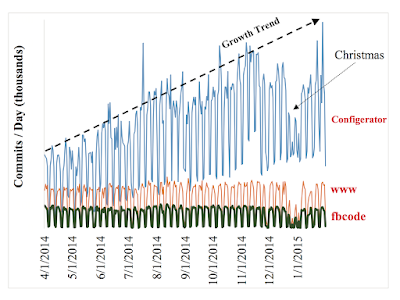
Move fast and break things That was Facebook's famous mantra for developers. Facebook believes in getting early feedback and iterating rapidly, so it releases software early and frequently: Three times a day for frontend code, three times a day for for backend code. I am amazed that Facebook is able to maintain such an agile deployment process at that scale. I have heard other software companies, even relatively young ones, develop problems with agility, even to the point that deploying a trivial app would take couple months due to reviews, filing tickets, routing, permissions, etc. Of course when deploying that frequently at that scale you need discipline and good processes in order to prevent chaos. In his F8 Developers conference in 2014, Zuckerberg announced the new Facebook motto "Move Fast With Stable Infra." I think the configerator tool discussed in this paper is a big part of the "Stable Infra". (By the way, why is it configerator but not configu...

Fool yourself

"The first principle is that you must not fool yourself --and you are the easiest person to fool."     ---Richard Feynman I agree with the second part. I am the easiest person to be fooled by myself, because I like to believe what is convenient, comfortable, less scary to me. For example, I am fooled to procrastinate, because I am scared of facing the task and not having a perfect complete product. Sometimes I am fooled to be overly optimistic, because I am scared of the alternative: failure and hassle. And sometimes I am fooled to be overly pessimistic, because I am scared of the long arduous fight to achieve something, so I say "No way, I won't be able to achieve it anyways". However, I like to propose a change to the first part of Feynman's quote. If it is so easy to fool yourself, you should exploit it: you should fool yourself in a beneficial manner to avoid fooling yourself in the usual/default harmful manner. For example, when you catch yourself...

Popular posts from this blog

Hints for Distributed Systems Design

The Agentic Self: Parallels Between AI and Self-Improvement

Learning about distributed systems: where to start?

5 Lessons at 50

Foundational distributed systems papers

Building a Database on S3

Cloudspecs: Cloud Hardware Evolution Through the Looking Glass

Aurora DSQL: Scalable, Multi-Region OLTP

TLA+ modeling tips

Supporting our AI overlords: Redesigning data systems to be Agent-first