Posts

Showing posts matching the search for tla teaching

Using TLA+ for teaching distributed systems

I am teaching CSE 4/586 Distributed Systems class  again this Fall (Fall 2014). This is the course I have most fun teaching. (I would like to think my students also feel that way :-) I teach the course with emphasis on reasoning about the correctness of distributed algorithms. Here are the topics I cover in sequence: Introduction, Syntax and semantics for distributed programs, predicate calculus Safety and progress properties Proof of program properties Time: logical clocks, State: distributed snapshots Mutual exclusion, Dining philosophers Consensus, Paxos Fault-tolerance, replication, rollback recovery, self-stabilization Programming support for distributed systems Data center computing and cloud computing  CAP theorem and NOSQL systems Distributed/WAN storage systems I put emphasis on reasoning about distributed algorithms because concurrency is very tricky; it truly humbles human brain. More than 3 actions in a distributed program and your intuitions will f...
Feedback from my distributed systems class

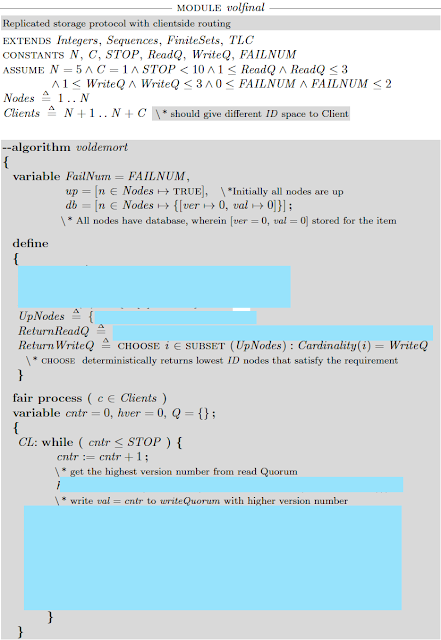
I am done with my distributed systems class this semester . At the end of the semester, I polled my students for feedback about the class. I was especially interested in hearing about their feedback on using TLA+ in the course and course projects, and using research paper reviewing for homework assignments. Of course, I didn't mention these when I solicited their feedback. I asked them to write a brief review for what they have learned in my distributed systems class this semester. I received overwhelmingly positive feedback. Below I share some of the comments about TLA+ and the paper review assignments. (I removed the flattering feedback about my teaching, while I enjoyed reading them.  I put a lot of effort in my teaching and I am happy when the students recognize how much I care.  That keeps me motivated. ) Feedback about using TLA+ I assigned two TLA+ projects. The first project was modeling Voldemort key-value store with client-side routing , and the second project ...

Beyond the Code: TLA+ and the Art of Abstraction

Image
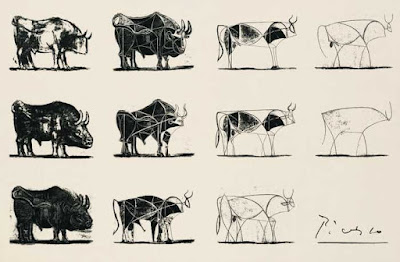
I have been teaching a TLA+ miniseries inside AWS. I just finished the 10th week, with a one hour seminar each week. I wanted to pen down my learnings from this experience. The art of abstraction Let's start with abstraction. Abstraction is a powerful tool for avoiding distraction. The etimology of the word abstract comes from Latin for cut and draw away. With abstraction, you slice out the protocol from a complex system, omit unnecessary details, and simplify a complex system into a useful model. For example, if you are interested in the consistency model of your distributed system, you can abstract away the mechanics of communication in the system when that is an unnecessary distraction. In his 2019 talk, Leslie Lamport said : Abstraction, abstraction, abstraction! That's how you win a Turing Award. Inside Amazon abstraction is also very valuable. We see skilled engineers look at large systems, slice out a protocol/subsystem, cut to the essence of it, and dive deep to make th...

Modeling the Dining Philosophers Algorithm in TLA+

Image
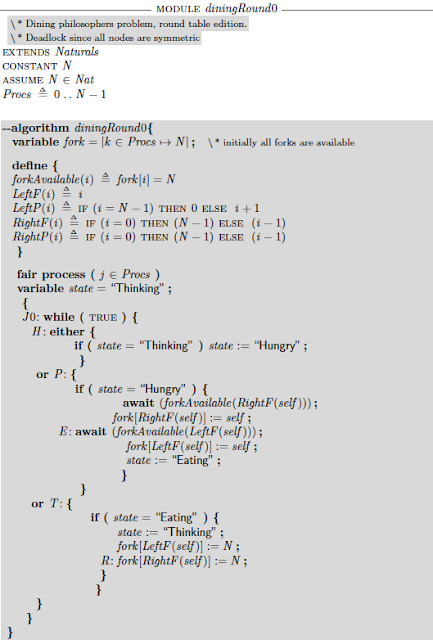
In this post I will provide a modeling of the dining philosophers algorithm in TLA+. If you have not heard about TLA+ before, take a look at my earlier posts on TLA+ to get some context.   Post1 and Post2 The dining philosophers problem is an instance/refinement of the mutual exclusion problem. The specification of the mutual exclusion problem dictates that when a node is in critical section, no other node in the system can be in the critical section. The dining philosopher relaxes this by taking into account the topology: When a node is in critical section, none of the neighbors of that node can be in critical section. Note that, this does not rule out two nodes to be in critical section simultaneously provided that they are not neighbors. In the original formulation of the dining philosophers problem by Dijkstra, there are 5 philosophers sitting around a table. Between each philosopher is a fork and, in order to eat a philosopher must hold both of the forks. (The spaghetti i...

Teaching Paxi

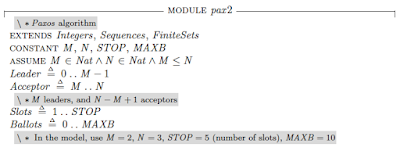
Paxos family of protocols (which I refer to as Paxi) is immensely useful for building distributed systems due to their excellent fault-tolerance properties. Many cloud computing services and distributed databases employ Paxi for state machine replication (SMR). Paxi preserve the safety of consensus problem (no two nodes commit different values for the same slot) even to the face of a fully asynchronous execution, crash faults, message losses, and network partitions. Paxi satisfy liveness of consensus problem (some value is eventually committed for the slot) when the system moves outside the realm of the coordinated attack and FLP impossibility results. Paxi are perennially misunderstood and their sophistication underrated. While there has been a lot of work on Paxi, we have been able to explore only a fraction of the algorithm design space. A striking evidence of this arrived in 2016, where we had a flexible quorum breakthrough after 30 years, which no one had anticipated. There ...

Cabbage, Goat, and Wolf Puzzle in TLA+

Image
Over the past couple of months, I have been harping on the value of TLA+ for teaching engineers the art of abstraction . It is important to emphasize that this is an art, not a science, and it is best learned through studying examples and practicing hands-on with modeling. TLA+ excels in providing rapid feedback on your modeling and designs, which facilitates this learning process significantly. Modeling the "cabbage, goat, and wolf" puzzle taught me that tackling real/physical-world scenarios is a great way to practice abstraction and design -- cutting out the clutter and focusing on the core challenge. How will you represent this world? What will be your actors, objects, and the relations between them? Will one approach result in a cleaner protocol model than another? Or, as I like to ask, does the protocol flow cleanly from the model? The puzzle description Here is the puzzle. A farmer with a wolf, a goat, and a cabbage must cross a river by boat. The boat can carry only t...

[Paper review] TaxDC: A Taxonomy of nondeterministic concurrency bugs in datacenter distributed systems

Image
This paper appeared in ASPLOS 2016 and the authors are Leesatapornwongsa, Lukman, Lu, and Gunawi. The paper provides a comprehensive study on real-world distributed concurrency bugs and is a good complement to the paper I reviewed before: "Why does cloud stop computing" . While the previous paper looked at all possible bugs that lead to service outages, this paper focuses only on distributed concurrency (DC) bugs. This type of bug happens to be my favorite kind of bug. I am fascinated with "failures", and with DC bugs doubly so. DC bugs are execution timing/ordering/scheduling related, they occur nondeterministically, and are extremely difficult to detect, diagnose, and fix in production systems. I love seeing those long traces of improbable DC bugs surface when I model check distributed algorithms in TLA+ . The experience keeps me humble. The paper presents analysis of 104 DC bugs from Cassandra, HBase, Hadoop MapReduce, and ZooKeeper. These bugs are categorize...

Modeling a Replicated Storage System in TLA+, Project 1

Image
Why a TLA+ project? The first project assignment in my distributed systems class this semester was modeling a replicated storage system in TLA+. Assigning a TLA+ project makes me a rarity among distributed systems professors. A common project would be a MapReduce programming assignment or a project to implement a simple distributed service (such as a key-value store) in Java. I think that a MapReduce deployment project does not teach much about distributed systems, because MapReduce is a very crude abstraction and hides all things distributed under the hood. Using MapReduce for the distributed systems class project would be like handing people a mechanics certification upon successful completion of a driving test. Implementing a simple distributed service, on the other hand, would teach students that indeed programming and debugging distributed systems is very hard. However, I would suspect that much of the hardship in that project would be due to accidental complexities of the i...

Modeling Paxos and Flexible Paxos in Pluscal and TLA+

Image
The first part of this post describes modeling Paxos in Pluscal. The second part shows how to modify that model to achieve a flexible quorum Paxos . The idea for flexible quorums was introduced in a paper in 2016 summer.  This simple and surprising result says "majority agreement is not required in Paxos and the sets of acceptors required to participate in agreement (known as   quorums) do not even need to intersect with each other" . Modeling Paxos in Pluscal While there are many examples of Paxos modeling in TLA+ available, I haven't found any Pluscal modeling of Paxos, except this one from Lamport , which helped me come up with my Pluscal model below. The problem with TLA+ is that it is too low-level (i.e., too declarative and math-like) for writing--and reading-- distributed algorithms. The PlusCal language provides a higher-level pseudocode, which is easier to follow. However, as you go through my Pluscal model below, you will find that it doesn't follow yo...

Popular posts from this blog

The Safest Job from AI may be Writing

The Two Abstractions of System Design: Hide or Reduce

The Agentic Self: Parallels Between AI and Self-Improvement

Learning about distributed systems: where to start?

Hints for Distributed Systems Design

Foundational distributed systems papers

Building a Database on S3

Cloudspecs: Cloud Hardware Evolution Through the Looking Glass

Specula: Scaling formal specifications for autonomous model checking of system code

What I'd do as a College Freshman in 2025