Posts

Showing posts with the label isolation levels

Analysing Snapshot Isolation

Image
This paper (PODC'2016) presents a clean and declarative treatment of Snapshot Isolation (SI) using dependency graphs. It builds on the foundation laid by prior work, including the SSI paper we reviewed recently , which had already identified that SI permits cycles with two adjacent anti-dependency (RW) edges, the so-called inConflict and outConflict edges. While the SSI work focused on algorithmic results and implementation, this paper focuses more on the theory (this is PODC after all) of defining a declarative dependency-graph-based model for SI. It strips away implementation details such as commit timestamps and lock management, and provides a purely symbolic framework. It also proves a soundness result (Theorem 10), and leverages the model for two practical static analyses: transaction chopping and robustness under isolation-level weakening. Soundness result and dependency graph model Let's begin with Theorem 10, which establishes both the soundness and completeness of the...

Transactional storage for geo-replicated systems

Image
This paper from SOSP 2011 describes a distributed storage system called Walter. Walter targets web applications that operate across multiple geographic sites, and it aims to balance consistency and latency in such systems by providing strong consistency within a site, and weaker consistency across sites. Parallel Snapshot Isolation (PSI) The paper introduces a new isolation property called Parallel Snapshot Isolation (PSI). PSI ensures consistent snapshots and transaction ordering within a site, causal ordering across sites, and prevention of write-write conflicts. PSI extends snapshot isolation (see Fig 3 for illustration of snapshot isolation, and here for an example of snapshot isolated database modeling ) by allowing different sites to have different commit orderings. For example, suppose site A executes transactions T1, T2 and site B executes transactions T3, T4. PSI allows site A to first incorporate just T1, T2 and later T3, T4, while site B first incorporates T3, T4 and later ...

A critique of ANSI SQL Isolation layers (Transaction Processing Book followup)

Image
This paper is from Sigmod 1995. As the title says, it critiques the ANSI SQL 92 standard (book) with respect to problems in isolation layer definitions. This is also a good follow up to t he Transaction Book chapter 7 where we reviewed the isolation layers . In fact, here Gray (with co-authors) gets a chance to amend the content in the Transaction Book with recent developments and better understanding/mapping of isolation layers to the degrees 0-4. Snapshot isolation (SI) finally makes its debut here in Gray's writing. Why so late? As we discussed earlier in the 80s the database keys were hot, and people rightly ignored optimistic concurrency control as it was not suitable for those workloads. Moreover, memory space was very scarce commodity, and multi-version (as in snapshot storage) was also off the table. With its increased adoption (with MySQL's use of SI around the corner) we see coverage of snapshot isolation in Gray's writing.  The paper is very well written, and is...

A snapshot isolated database modeling in TLA+

Image
While idly browsing tlaplus/Examples repository, I noticed TLA+ spec for a snapshot isolated Key-Value Store written by my friend Andrew Helwer . This is a centralized database. Each transaction makes a copy of the store, and OCC merges their copy back to store upon commit. I immediately wanted to write a PlusCal version of it and contribute back. My motivations were: Let's see how quickly I can write the PlusCal version. This way I can get practice converting TLA+ specs to PlusCal. (TLC automatically converts PlusCal to TLA+ spec, but the other way requires some judgement call.) The PlusCal version would make this spec easier to understand for modeling newbies. I can also add the client-centric isolation checking to this to provide a more concrete example of that immensely useful module. It would be cool to see the Serializability counterexample the model would throw. I was curious if the model checker will throw the classical write-skew counterexample. This would be a cool self...

Fast Serializable Multi-Version Concurrency Control for Main-Memory Database Systems

Image
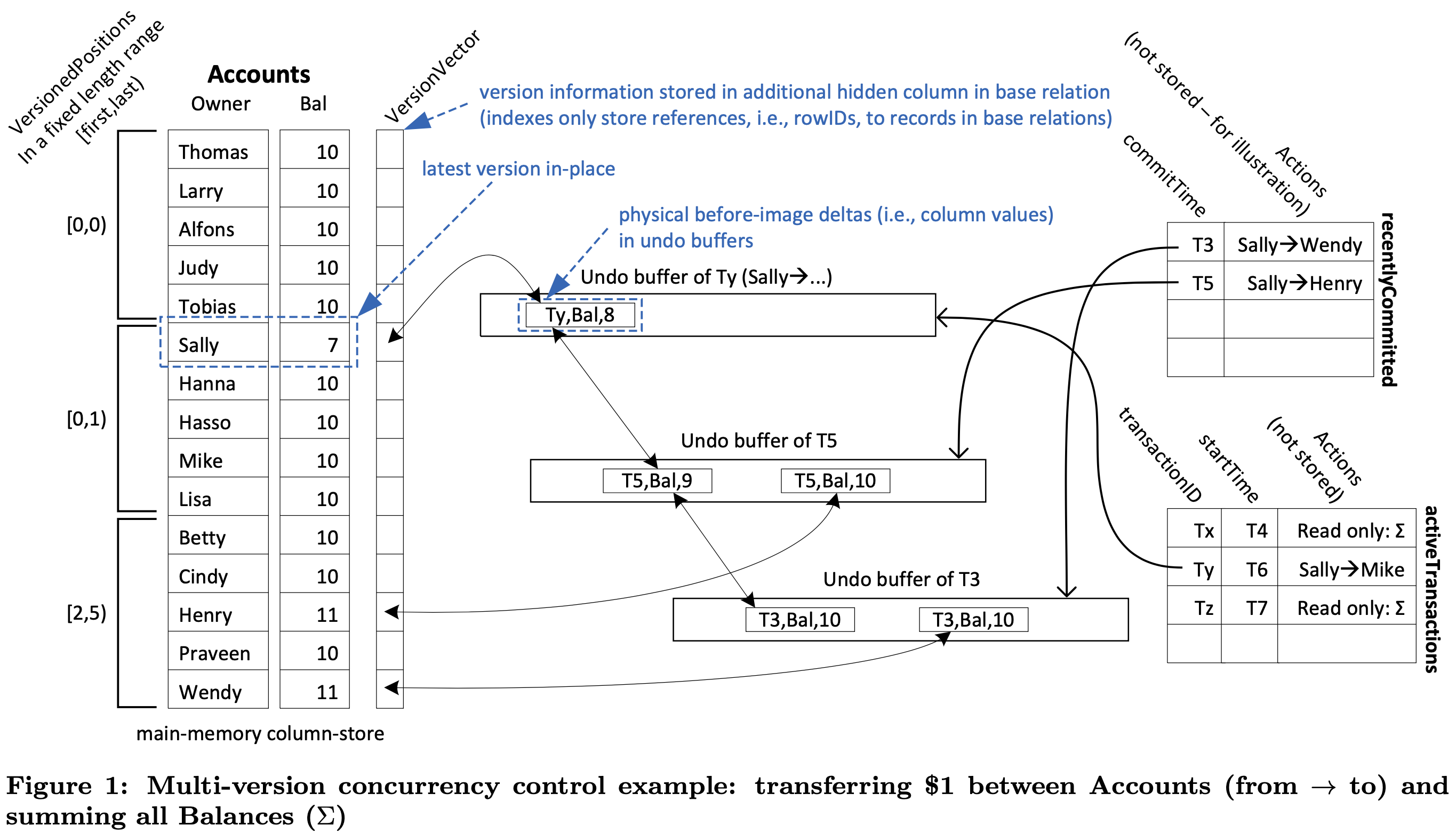
This paper from Sigmod 2015 describes the addition of Multi-Version Concurrency Control (MVCC) to the Hyper database, and discusses at length how they implement serializability efficiently with little overhead compared to snapshot isolation. Coming only two years later, this paper seems like a response/one-up-manship to the Hekaton paper . In the paper, you can see at many places statements like "in constrast to/ unlike/ as in/ Hekaton" phrase. In a way, that is the biggest compliment a paper can pay to another paper. Hyper is also an in-memory database as in Hekaton. The paper says that Hyper is like Hekaton in that, in order to preserve scan performance, new transactions are not allocated a separate place. The most uptodate version of the database is kept all in the same place. But, you can reach older versions of a record (that are still in use by active transactions) by working backwards from the record using the delta versions maintained. The biggest improvement in Hyp...

Popular posts from this blog

Hints for Distributed Systems Design

Chess invariants

The Agentic Self: Parallels Between AI and Self-Improvement

Learning about distributed systems: where to start?

5 Lessons at 50

Foundational distributed systems papers

Building a Database on S3

Cloudspecs: Cloud Hardware Evolution Through the Looking Glass

TLA+ modeling tips

Supporting our AI overlords: Redesigning data systems to be Agent-first