Posts

Showing posts with the label crdts

Transactional storage for geo-replicated systems

Image
This paper from SOSP 2011 describes a distributed storage system called Walter. Walter targets web applications that operate across multiple geographic sites, and it aims to balance consistency and latency in such systems by providing strong consistency within a site, and weaker consistency across sites. Parallel Snapshot Isolation (PSI) The paper introduces a new isolation property called Parallel Snapshot Isolation (PSI). PSI ensures consistent snapshots and transaction ordering within a site, causal ordering across sites, and prevention of write-write conflicts. PSI extends snapshot isolation (see Fig 3 for illustration of snapshot isolation, and here for an example of snapshot isolated database modeling ) by allowing different sites to have different commit orderings. For example, suppose site A executes transactions T1, T2 and site B executes transactions T3, T4. PSI allows site A to first incorporate just T1, T2 and later T3, T4, while site B first incorporates T3, T4 and later ...
Keep CALM and CRDT On

Image
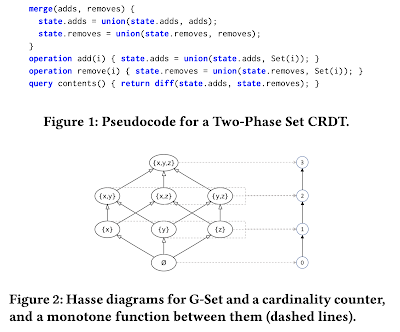
This paper is from VLDB'22. It focuses on the read/querying problem of conflict-free replicated data types (CRDTs). To solve this problem, it proposes extending CRDTs with a SQL API query model, applying the CALM theorem to identify which queries are safe to execute locally on any replica. The answer is of no surprise: monotonic queries can provide consistent observations without coordination. CRDTs To ensure replica consistency in distributed systems, a common method is to enforce strong consistency at the storage layer using traditional distributed coordination techniques such as consensus or transactions. However, for some applications this may create concerns about latency and availability (especially when a quorum is not readily available). Alternatively, developers can use weakly consistent storage models that don't require coordination, but they must ensure consistency at the application level. This is where CRDTs enter the picture, as they can provide a straightforward...

Popular posts from this blog

The Safest Job from AI may be Writing

The Agentic Self: Parallels Between AI and Self-Improvement

The Two Abstractions of System Design: Hide or Reduce

Learning about distributed systems: where to start?

Hints for Distributed Systems Design

Building a Database on S3

Foundational distributed systems papers

Cloudspecs: Cloud Hardware Evolution Through the Looking Glass

Specula: Scaling formal specifications for autonomous model checking of system code

What I'd do as a College Freshman in 2025