Posts

Showing posts with the label statistics

Review: Performance Modeling and Design of Computer Systems: Queueing Theory in Action

Image
Performance Modeling and Design of Computer Systems: Queueing Theory in Action , by Dr. Mor Harchol-Balter. Cross-posted with https://emptysqua.re/blog/review-queue-theory-book/ We are A. Jesse Jiryu Davis , Andrew Helwer , and Murat Demirbas , three enthusiasts of distributed systems and formal methods. We’re looking for rigorous ways to model the performance of distributed systems, and we hoped this book would point the way. We followed the author’s undergrad syllabus , although we were disappointed at its focus on single-threaded task queues. Most of our work is with multi-threaded servers, aka Processor-Sharing, so we added Chapter 10 section 2 (Aloha protocol) and Chapter 22 (only Jesse read it), skipped Chapter 29, and added Chapter 30. We met roughly every two weeks on Zoom, from December 2022 to August 2023. Between meetings we spent a few hours per week reading; we did many of the homework exercises at the beginning and none of them towards the end. Our Review...
Open Versus Closed: A Cautionary Tale

Image
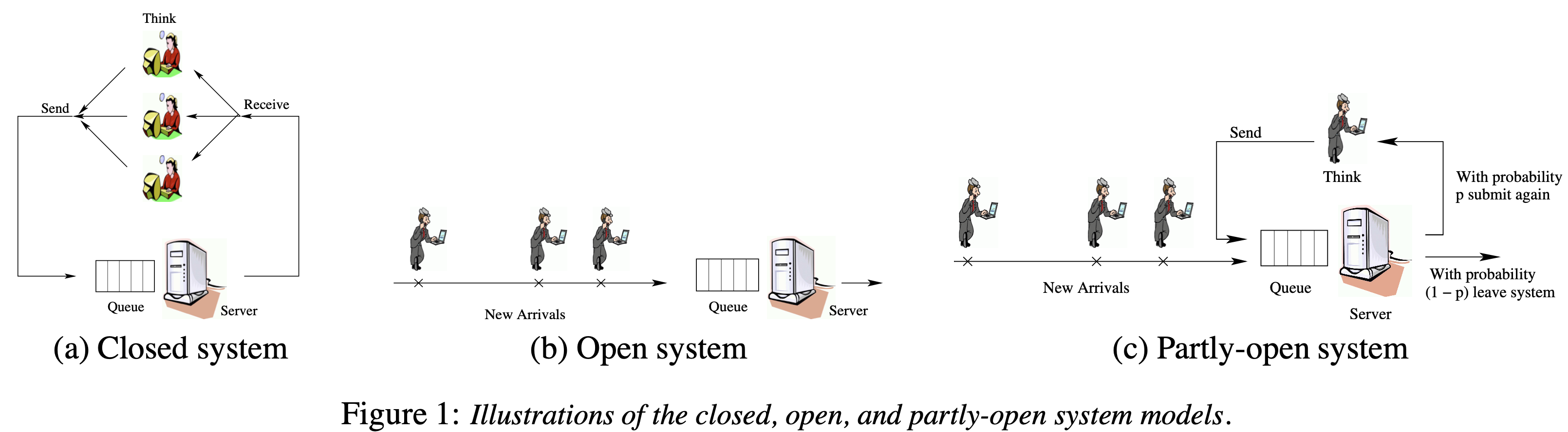
This paper appeared in NSDI'06 . It explores the behavior of open and closed system models. These two models differ in how they handle new job arrivals. In an open system model, new jobs arrive independently of job completions. In contrast, in a closed system model, new jobs are only triggered by job completions, followed by think time. The paper makes a basic but an important point that was missed by many people that were building workload generators and making system design decisions. In this sense this is a great demonstration of the thesis that "The function of academic writing is NOT to communicate your ideas, but to change the ideas of an existing community." The paper shows that while most workload generators model systems as closed systems, in reality the systems are closer to open systems, and conclusions drawn from closed model behavior of the systems do not translate to the performance of the systems in real-world settings.    Here is the gist of the idea. For ...

Checking statistical properties of protocols using TLA+

Image
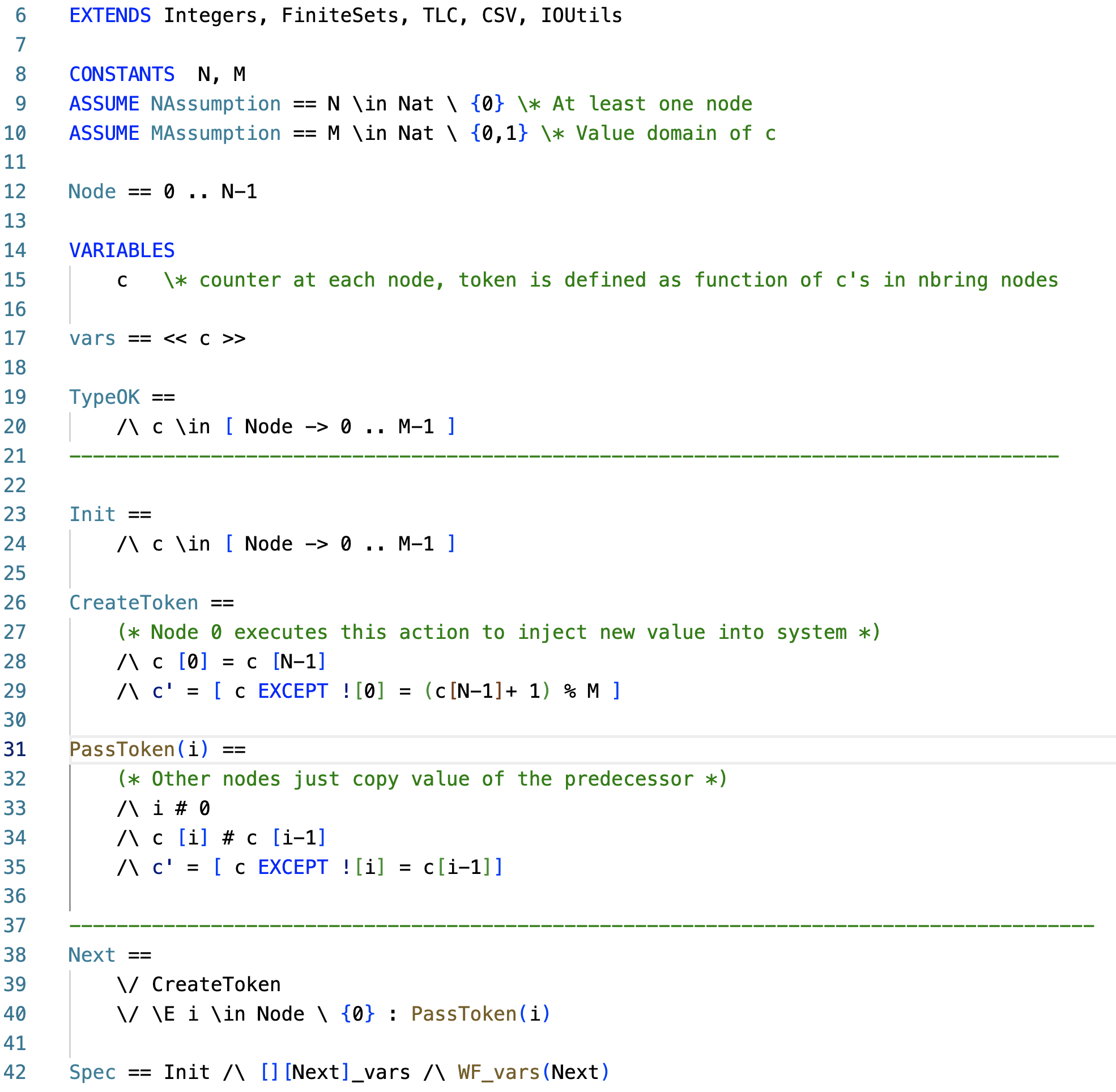
In my previous post, I mentioned how excited I was about Jack Vanlightly and Markus Kuppe's talk at TLA+ Conference. They showed a new mode (called "generate") added to the TLA+ checker to enable  obtaining statistical properties from the models. Here is how this works in a nutshell. Your TLA+ model/protocol produces a tree of runs, and, in the generate mode the TLA+ checker chooses these runs in a uniform manner. You also specify some state constraints, and when these are satisfied the TLA+ checker executes/evaluates your state constraint formula: you add the statistics logging as the side effect of this formula, and record information about the current run to a CSV file. This way, you can collect statistical hyper properties (abort rates, completion rounds, etc.) about the runs, in addition to checking it for correctness invariants. Later you can use Excel or Rscript to visualize the statistics collected and analyze the model behavior. Checking statistics is very usef...

Popular posts from this blog

Hints for Distributed Systems Design

The Agentic Self: Parallels Between AI and Self-Improvement

Learning about distributed systems: where to start?

5 Lessons at 50

Foundational distributed systems papers

Building a Database on S3

Cloudspecs: Cloud Hardware Evolution Through the Looking Glass

Specula: Scaling formal specifications for autonomous model checking of system code

Aurora DSQL: Scalable, Multi-Region OLTP

TLA+ modeling tips