Posts

The Rational Optimist: How Prosperity Evolves

This is a 2010 book by Matt Ridley. I had also read his 1993 book titled " The Red Queen: Sex and the Evolution of Human Nature. " Matt Ridley is a joy to read.  This book came 9 years before Steven Pinker's book about "Enlightenment Now" and already explained well how good we are having it in this modern age. ( Here is my earlier review of Pinker's "Enlightenment Now". ) In contrast to Pinker, who kept beating a dead horse for 500 pages, Ridley made his point quickly about how prosperous we are now and used the rest of the book to make a case about the root cause trait that led to this prosperity. Ridley argues that the reason Homo Sapiens prospered compared to any other species is because of the *innate human tendency to trade goods and services*. Of course Ridley is an expert on both economy and evolution, so he starts from millions of years ago with hominids, and manages to make a convincing case that trade, together with the specialization lin...

Mathematics for human flourishing (book review)

Image
Math is often seen as a cold reclusive discipline. This books talks about the beautiful and graceful side of math. It talks about the role of math in flourishing and achieving a fulfilled life . It talks about how math speaks not  just to the mind but also to the heart as well, and how it is possible to enjoy math, and do this collectively as flourishing communities.   Math got its ill reputation because of the way it is taught. I wrote several times about my gripes on this.   "The Bourbaki program was the extreme expression of the Cartesian style. It narrowed the scope of mathematics by excluding the beautiful flowers that Baconian travelers might collect by the wayside." The goals of introducing generality and rigor in the Bourbaki process are great but that should not (and does not) imply shunning the presentation of the thought-processes that led to these results. Our job is to communicate to other humans and the goal of formalizing things should be to make thin...

Ocean Vista: Gossip-Based Visibility Control for Speedy Geo-Distributed Transactions

Image
This paper occurred in VLDB'19 and is authored by Hua Fan and Wojciech Golab.  The paper is about providing strict serializability in geo-replicated databases. The technique it uses can be summarized as "geo-replicate-ahead transactions". First the transaction T is replicated to all the parties across the datacenters. The parties then check to see that the watermark rises above T to ensure that all transactions including and preceding T has been replicated successfully to all the parties. Then, the execution of T can be done asynchronously at each party. This should remind you of the SLOG paper :  SLOG uses a deterministic architecture to move most of this communication outside of conflict boundaries, enabling these transactions to be processed at high throughput. More specifically, SLOG relies on deterministic processing to avoid two phase commit. Once all parties agree to the plan, processing occurs (mostly) independently on each node, with the system relying on the pl...

Armada: Low-Effort Verification of High-Performance Concurrent Programs

Image
This paper appeared in PLDI 2020 and is authored by Jacob R. Lorch, Yixuan Chen, Manos Kapritsos, Bryan Parno, Shaz Qadeer, Upamanyu Sharma, James R. Wilcox, and Xueyuan Zhao. The paper presents the Armada framework for code-level verification of concurrent (multithreaded rather than distributed) programs. Armada is roughly a stepwise-refinement extended version of Dafny . So that is where I will start explaining. Dafny Dafny is an open source iterative compiled language for writing verified code. The code is verified with respect to the specifications the developer writes by adding high-level annotations alongside the code, such as ensures P and invariant P. At https://rise4fun.com/Dafny/tutorial you will find an interactive tutorial, that will get you up and running proving programs with Dafny. It is really fun, you should try this out now!  Dafny leverages Z3 for discharging proof obligations. Ok, so what is Z3? Z3 is a popular open source Satisfiability modulo theories (SMT)...

Designing Distributed Systems Using Approximate Synchrony in Data Center Networks

Image
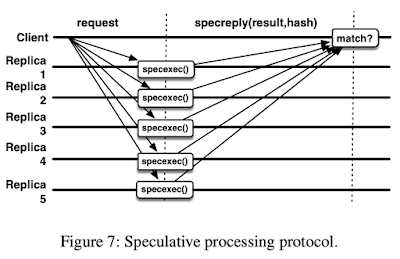
This paper is from Dan R. K. Ports Jialin Li Vincent Liu Naveen Kr. Sharma Arvind Krishnamurthy (University of Washington) and appeared in NSDI 2015. The previous week, in our Zoom Reading Group , we had read the "Scalable State Machine Replication" paper in our group. SSMR built on top of a "slow" atomic multicast (implemented with Multi-Ring Paxos) and imposed a total order for all messages before SMR.  This paper introduces SpecPaxos (Speculative Paxos), which also tries to impose an ordering of requests messages before SMR processing. SpecPaxos builds on a carefully constructed network to have most messages ordered correctly to start with and provides a way to deal with messages reorderings as needed. The relaxing of the ordering requirement allows Speculative Paxos to achieve good (average) latency and high throughput, and escape the heavy cost of atomic multicast implementation. (To be fair, SpecPaxos doesn't consider the problem of partitioning SMR and...

Scalable state machine replication

Image
This paper is by Carlos Eduardo Bezerra, Fernando Pedone, and Robbert van Renesse, and it appeared in DSN 2014.  This paper presents a non-Paxos non-consensus state machine replication (SMR) solution. When I see a non-Paxos solution to SMR, I always ask, "Ok, but where is Paxos hiding here?" It turns out, in this SMR solution, Paxos is hiding in the atomic multicast. The SMR protocol described in the paper assumes atomic multicast feed it. And atomic multicast is a problem equivalent to distributed consensus, and in the evaluation we see that they implement the atomic multicast service using MultiRing Paxos. "Atomic multicast ensures that (i) if a server delivers m, then all correct   servers deliver m (agreement); (ii) if a correct process multicasts m to groups, then all correct servers in every group deliver m (validity); and (iii) relation < is acyclic (order). The order property implies that if s and r deliver messages m and m′, then they deliver them in the sam...

Book review. Consider this: moments in my writing life after which everything was different (Chuck Palahniuk, 2020)

I had recently listened to Chuck Palahniuk in Tim Ferris's podcast. I got hooked immediately by Palahniuk's views on minimalism in writing . The man is right. The novelist has no business telling how the characters feel and how you should feel.  Literary minimalism is characterized by an economy with words and a focus on surface description. Minimalist writers eschew adverbs and prefer allowing context to dictate meaning. Readers are expected to take an active role in creating the story, to "choose sides" based on oblique hints and innuendo, rather than react to directions from the writer. https://en.wikipedia.org/wiki/Minimalism#Literary_minimalism It was clear that Palahniuk had thought a lot about how to choose words and how to give a rhythm to the story. So to learn more of his craft, I picked up his new book on writing: Consider This: Moments In My Writing Life After Which Everything Was Different. I loved it. I recommend it if you care about improving how you co...

Zoom, zoom, zoom

The new school year is on its way. My daughter is a kindergartener, my other daughter is a fourth grader, and my son is an eight grader. They will all be attending school as remote. It is going to be a challenging school year for all of us. The school offered a hybrid version of 2 days of in-person teaching followed by a day of remote teaching, and assignments. But we chose the all remote version. Our reasoning was that these schools will all be converting to remote in a month or two anyways, so why keep up the facade. A better strategy for the schools would be to keep it simple, and put all their preparation efforts for a fully online platform. I think most of the reason for putting up the facade is because of the pressure from the parents who are unable to accept this new reality.  For my little daughter we sure had imagined this year differently. We were thinking that she would be holding hands with her older sister, sharing seats on the school bus ride to school and back, and h...

My Distributed Systems Seminar's reading list for Fall 2020

For the Fall semester distributed systems seminar, we will discuss these papers: Bipartisan Paxos: A Family of Fast, Leaderless, Modular State Machine Replication Protocols eXtreme Modelling in Practice     Starling: A Scalable Query Engine on Cloud Function Services Lambada: Interactive Data Analytics on Cold Data using Serverless Cloud Infrastructure   Tiered Replication: A Cost-effective Alternative to Full Cluster Geo-replication   Scalable State-Machine Replication   Designing Distributed Systems Using Approximate Synchrony in Data Center Networks   Armada: Low-Effort Verification of High-Performance Concurrent Programs   Ocean Vista: Gossip-Based Visibility Control for Speedy Geo-Distributed Transactions   Consolidating Concurrency Control and Consensus for Commits under Conflicts    Tales of the Tail: Hardware, OS, and Application-level Sources of Tail Latency   Near-Optimal Latency Versus Cost Tradeoffs in Geo-Distributed St...

In the Plex: How Google Thinks, Works, and Shapes Our Lives (Steven Levy, 2011)

I read this book recently. Going into this, I knew I wouldn't learn many new/surprising things. After all, I have been following Google from outside since 1999. After I saw Google in action, I had switched to it immediately. I was quick to get on board with Gmail as well, and followed many Google services over the years. I have seen things.   As I anticipated, I didn't find many surprises in the book. But I liked the book nevertheless. It is always nice to read stuff from Steven Levy.  Steven Levy is one of my favorite authors. I have a dog-eared copy of the Hackers book he wrote. It was excellent writing. So much research went into each character in the book, and he made each character come alive. He also weaved the narration together artistically around a handful of themes and related new information/events back to these themes. He had put a lot of his interpretation and insight in to the facts/narrative, and I really enjoyed that.  This book is not as colorful. It has ...

Popular posts from this blog

Hints for Distributed Systems Design

The Agentic Self: Parallels Between AI and Self-Improvement

Learning about distributed systems: where to start?

5 Lessons at 50

Foundational distributed systems papers

Building a Database on S3

Cloudspecs: Cloud Hardware Evolution Through the Looking Glass

Aurora DSQL: Scalable, Multi-Region OLTP

TLA+ modeling tips

Supporting our AI overlords: Redesigning data systems to be Agent-first