Posts

Everything is broken

Last Wednesday, I attended one of the monthly meetings of the "Everything is Broken" meet up at Seattle. It turns out I selected a great meeting to attend, because both speakers, Charity Majors and Tammy Butow , were excellent. Here are some select quotes without context. Observability-driven development - Charity Majors Chaos engineering is testing code in production. "What if I told you: you could test both in and before production." Deploying code is not a binary switch; deploying code is a process of increasing your confidence in your code. "Microservices are hard!" as a caption for a figure comparing the LAMP stack 2005 versus the complexity of the Parse stack 2015. We are all distributed systems engineers and unknowns outnumber the knowns! Distributed systems have an infinite number of almost-impossible failures! Without observability you don't have chaos engineering, you have a chaos. Monitoring systems have not changed signi...
Debugging designs with TLA+

Image
This post talks about why you should model your systems and exhaustively test these models/designs with the TLA+ framework. In the first part, I will discuss why modeling your designs is important and beneficial, and in the second part I will explain why TLA+ is a very suitable framework for modeling, especially for distributed and concurrent systems. Modeling is important If you have worked on a large software system, you know that they are prone to corner cases , failed assumptions , race conditions , and cascading faults . There are many corner cases because there are many parameters, and these do interfere in unanticipated ways with each other. The corner cases violate your seemingly reasonable implicit assumptions about the system components and environment, e.g.,"1-hop is faster than 2-hops", "0-hop is faster than 1-hop", and "processes work with the same rate". There are abundant race conditions because today (with the rise of SOA, cloud, and ...

The last mile problem in trust

Blockchains are supposed to solve the trust problem. But blockchains attack only the easy part of the trust problem, and avoid the hard part. The easy part is to store the transactions in a tamper-resistant database. The hard part is to attest to physical world actions and state. The blockchain is a database technology and it does not attempt to attest to physical world actions/state. It solves the problem of tamper-proofing the state after it is added to the database. It doesn't attempt to validate/test/certify if the state is correct as it is added to the database. If humans create the state, there is inherently a trust problem: Were the lettuce bad before it was loaded to the trucks, or are the truck conditions to blame? Did the farmer or the trucker lie? If sensors create the state, this is still a very hard problem, but not because the sensors may have been tampered with ---that is a relatively easy problem to solve in hardware. The problem is hard because of the corner-ca...

Book review. Ignorance: How it drives science

I picked this up from my local library, because the title was interesting. I wrote about this earlier. Once you get a B.S., you think "you know everything". Once you get an M.S., you realize "you know nothing". Once you get a Ph.D., you realize that "yes, you know nothing, but that is not a problem, because nobody knows anything!" This turned out to be a nice read. The author, Stuart Firestein, has a very interesting background. He was working at a theater, and started a biology undergraduate at 30, and got his PhD at 40. Here are some tidbits from the book. Leibniz. page 38 The 17th-century German philosopher and mathematician Gottfried Leibniz, one of the inventors of calculus, had a lifelong project to construct a "basic alphabet of human thoughts" that would allow one to take combinations of simple thoughts and form any complex idea, just as a limited number of words can be combined endlessly to form any sentence -- including sentence...

TLA+ specification of the bounded staleness and strong consistency guarantees

Image
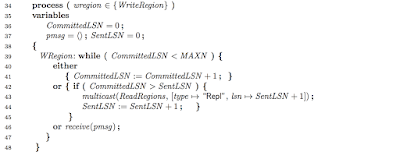
In my previous post , I had presented a TLA+ modeling of distributed data store that provides the consistent prefix property. In this post, I extend this model slightly to build bounded and strong consistency. In fact the strong consistency specification is achieved when we take the Delta on the bounded consistency as 1. The TLA+ (well, PlusCal to be more accurate) code for this model is available at https://www.dropbox.com/s/qvmhhgjf9iycaca/boundedstrongP.tla?dl=0 The system model As in the previous post, we assume there is a write region (with ID=1) and read regions (with IDs 2 through NumRegions). The write region performs the write and copies it to the read regions. There are FIFO communication channels between the write and read regions. WriteRegion == 1 ReadRegions == 2..NumRegions chan = [n \in 1..NumRegions |-> <<>>];  We use D to denote the Delta on the bounded staleness consistency. Bounded staleness ensures that read results are not too stale. ...

TLA+ specification of the consistent prefix guarantee

Image
We had covered consistency properties in the recent posts . Now to keep it more concrete and to give you a taste of TLA+ , I present a model of a distributed data store that provides the consistent prefix property. In my next post, I will extend this model slightly to present bounded and strong consistency properties. And, in the post after that, I will add a client model to show how this data store can be extended to provide session consistency.  The TLA+ (well, PlusCal to be more accurate) code for this model is available here.  The system model We assume there is a write region (with ID=1) and read regions (with IDs 2 through NumRegions). The write region performs the write and copies it to the read regions. There are FIFO communication channels between the write and read regions. WriteRegion == 1 ReadRegions == 2..NumRegions chan = [n \in 1..NumRegions |-> <<>>];  The write region actions The write region has 3 actions to perform: Comm...

Mind Your State for Your State of Mind

Image
This article by Pat Helland appeared at ACM Queue on July 2018. Pat is a self-confessed apostate . He is also a database philosopher; look at the title of his recent publications : Standing on distributed shoulders of giants, Life beyond distributed transactions, Immutability changes everything, Heisenberg was on the "write" track, consistently eventual, etc. This "mind your state for your state of mind" article looks at the history of interactions of applications and storage/databases, and charts their co-evolution as they move into the distributed and scalable world. The evolution of state, storage, and computing Storage has evolved from disks directly attached to your computer to shared appliances such as SANs (storage area networks) leading the way to storage clusters of commodity servers contained in a network. Computing evolved from a single-process on a single server, to multiple processes communicating on a single server, to RPCs (remote procedure c...

Logical index organization in Cosmos DB

Image
This post zooms into the logical indexing subsystem mentioned in my previous post on "Schema-Agnostic Indexing with Azure Cosmos DB".  With the advent of big data, we face a big data-integration problem. It is very hard to enforce a schema (structure/type system) on data, and irregularities and entropy is a fact of life. You will be better off if you accept this as a given, rather than pretend you are very organized, you can foresee all required fields in your application/database, and every branch of your organization will be disciplined enough to use the same format to collect/store data. A patch employed by relational databases is to add sparse new columns to accommodate for possibilities and to store a superset of the schemas. However, after you invoke an alter-table on a big data set, you realize this doesn't scale well, and start searching for schema-agnostic solutions. Achieving schema agnosticism As we discussed in the previous post, JSON provides a solut...

Replicated Data Consistency Explained Through Baseball

Image
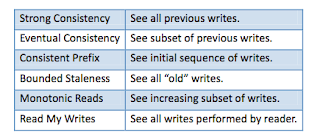
I had mentioned this report in my first overview post about my sabbatical at Cosmos DB . This is a 2011 technical report by Doug Terry , who was working at Microsoft Research at the time. The paper explains the consistency models through publishing of baseball scores via multiple channels. (Don't worry, you don't have to know baseball rules or scoring to follow the example; the example works as well for publishing of, say, basketball scores.) Many consistency models have been proposed for distributed and replicated systems. The reason for exploring different consistency models is that there are fundamental tradeoffs between consistency, performance, and availability. While seeing the latest written value for an object is desirable and reasonable to provide within a datacenter, offering strong consistency  for georeplicated services across continents results in lower performance and reduced availability for reads, writes, or both. On the opposite end of the spectrum, with ...

Popular posts from this blog

Hints for Distributed Systems Design

The Agentic Self: Parallels Between AI and Self-Improvement

Learning about distributed systems: where to start?

5 Lessons at 50

Foundational distributed systems papers

Building a Database on S3

Cloudspecs: Cloud Hardware Evolution Through the Looking Glass

Aurora DSQL: Scalable, Multi-Region OLTP

TLA+ modeling tips

Supporting our AI overlords: Redesigning data systems to be Agent-first