Posts

HPTS'17 day 1

This post is a continuation from yesterday's post. I cover only some of the talks, you may check the other talks from the HPTS agenda. Mind your state for your state of mind (Pat Helland -Salesforce) HPTS day 1 started with a keynote from Pat Helland. Pat Helland is a database veteran. I had covered some of his papers on this blog before. He writes insightful position papers with a unique style. The keynote provided an overview of trends in storage and computing and hit the high notes from his earlier position papers as well, and mentioned this table:                           | fast-reads | fast-writes | read-your-write linearizable       | no             | no              | yes            nonlinearizable | yes            | yes          ...

HPTS'17 day 0

Image
A couple weeks ago, I attended HPTS'17. As I wrote in my HTPS'15 posts ( day1 and day2 ), HPTS is an unconventional workshop. "Every two years, HPTS brings together a lively and opinionated group of participants to discuss and debate the pressing topics that affect today's systems and their design and implementation, especially where scalability is concerned. The workshop includes position paper presentations, panels, moderated discussions, and significant time for casual interaction. The only publications are slide decks by presenters who choose to post them." HPTS is by invitation only and keeps it under 100 participants. The workshop brings together experts from both industry and academia so that they can mix and interact. Although some people prefer to keep what happens at HPTS to stay at HPTS, I find it hard to not talk about HPTS. I learn a lot at HPTS and I want to share at least some of those. And this year I don't think there was any confidential t...

What does authentic mean?

Seth Godin defines authentic in relation to consistency.  Recently, he  defined it as "consistent emotional labor." We call a brand or a person authentic when they're consistent, when they act the same way whether or not someone is looking. Someone is authentic when their actions are in alignment with what they promise. Showing up as a pro. Keeping promises. Even when you don't feel like it. Especially when you don't. I agree with this definition. If I may refine it, I would define the authentic act/behavior as that which causes guilt/unrest, if you don't do it. If you don't act as your authentic self, you feel as if you shortchanged yourself, you feel guilt and pain. This doesn't mean that doing the authentic act is not painful. (After all if it is not painful, it is not worth doing. It is trivial.) Authentic means that if you don't do it, it is also painful because it causes guilt and unrest. At least if you act as your authentic se...

UB CSE 50 celebrations, Alumni Symposium

Image
The last couple of days we celebrated 50th anniversary of our department, CSE at University at Buffalo. We celebrated the anniversary with a technical conference and panels. Yesterday, I wrote about the Graduate Research Conference on Friday. Today, I am posting my notes on the Alumni Symposium that took place on Saturday.  Here is a link to the full program.  Keynote Speaker: Prof. Sung-Mo "Steve" Kang. “The 4th Industrial Revolution and Future of Nanoscience and Engineering”. Prof. Steve Kang got an MS from our department in 1972. He was Prof. Peter Scott's student. Steve talked about the era of the 4th industrial revolution: 1. steam engine (labor), 2. electricity (energy), 3. computing (knowledge), and 4. cyberphysical system (smart production / soft power). As part of this 4th era, Steve credits machine learning as important. He gave examples of alpha go vs Lee Sedol, a novel written by AI in Japan, the KAIST hubo roboto winning 2015 darpa robotic challenge,...

UB CSE 50 celebrations, The Graduate Research Conference

Over the last couple of days, we celebrated the 50th anniversary of our department, CSE at University at Buffalo. We celebrated the anniversary with a technical conference and panels, so it was an opportunity to learn new things for everyone. With the attendance of many prominent UB-CSE alumni, it has been a really amazing 2.5 days. Here is a link to the CSE 50 conference program. On Thursday evening, the event was kicked off with a reception and an undergraduate poster session. The thing that surprised me in this poster session was how quickly the PM2.5 sensors miniaturized. PM2.5 refers to atmospheric particulate matter (PM) that have a diameter less than 2.5 micrometers, which is about 3% the diameter of a human hair. PM2.5 is a traffic-related pollutant implicated in a wide variety of adverse health outcomes. I was involved in a NIH/NIEHS project for using smartphone-based time-activity data for air pollutant exposure estimation from 2010-12. At that time PM2.5 sensors were mini...

Paper Summary. Proteus: agile ML elasticity through tiered reliability in dynamic resource markets

Image
This paper proposes an elastic ML system, Proteus, that can add/remove transient workers on the fly for exploiting the transient availability of cheap but revocable resources in order to reduce costs and latency of computation. The paper appeared in Eurosys'17 and is authored by Aaron Harlap, Alexey Tumanov, Andrew Chung, Gregory R. Ganger, and Phillip B. Gibbons. Proteus has two components: AgileML and BidBrain. AgileML extends the parameter-server ML architecture to run on a dynamic mix of stable and transient machines, taking advantage of opportunistic availability of cheap but preemptible AWS Spot instances. BidBrain is the resource allocation component that decides when to acquire and drop transient resources by monitoring current market prices and bidding on new resources when their addition would increase work-per-dollar. Before delving into AgileML and BidBrain, let's first review the AWS Spot model. See Spot run AWS provides always available compute instances,...

Paper summary. Distributed Deep Neural Networks over the Cloud, the Edge, and End Devices

Image
This paper is by Surat Teerapittayanon, Bradley McDanel, and H.T. Kung at Harvard University and appeared in ICDCS'17.  The paper is about partitioning the DNN for inference between the edge and the cloud. There has been other work on edge-partitioning of DNNs, most recently the Neurosurgeon paper. The goal there was to figure out the most energy-efficient/fastest-response-time partitioning of a DNN model for inference between the edge and cloud device.  This paper adds a very nice twist to the problem. It adds an exit/output layer at the edge, so that if there is high-confidence in classification output the DNN replies early with the result, without going all the way to the cloud and processing the entire DNN for getting a result. In other words, samples can be classified and exited locally at the edge when the system is confident and offloaded to the cloud when additional processing is required. This early exit at the edge is achieved by jointly training a single DNN ...

Paper summary. Gaia: Geo-Distributed Machine Learning Approaching LAN Speeds

Image
This paper appeared in NSDI'17 and is authored by Kevin Hsieh, Aaron Harlap, Nandita Vijaykumar, Dimitris Konomis, Gregory R. Ganger,  Phillip B. Gibbons, and Onur Mutlu.  Motivation This paper proposes a framework to distribute an ML system across multiple datacenters, and train models at the same datacenter where the data is generated. This is useful because it avoids the need to move big data over wide-area networks (WANs), which can be slow (WAN bandwidth is about 15x less than LAN bandwidth), costly (AWS does not charge for inside datacenter communication but charges for WAN communication), and also prone to privacy or ownership concerns. Google's Federated Learning also considered similar motivations, and set out to reduce WAN communication. It worked as follows: 1) smartphones are sent the model by the master/datacenter parameter-server,  2) smartphones compute an updated model based on their local data over some number of iterations, 3) the updated models a...

Paper summary. OpenCL Caffe: Accelerating and enabling a cross platform machine learning framework

Image
This 2016 paper presents an OpenCL branch/port of the deep learning framework Caffe . More specifically, this branch replaces the CUDA-based backend of Caffe to an open standard OpenCL backend. The software was first located at https://github.com/amd/OpenCL-caffe , then  graduated to https://github.com/BVLC/caffe/tree/opencl . Once we develop a DNN model, we ideally like to be able to deploy it for different applications across multiple platforms (servers, NVDIA GPUs, AMD GPUs, ARM GPUs, or even over smartphones and tablets) with minimum developing efforts. Unfortunately, most of the deep learning frameworks (including Caffe) are integrated with CUDA libraries for running on NVIDIA GPUs, and that limits portability across multiple platforms. OpenCL helps for portability of heterogenous computing across platforms  since it is supported by a variety of commercial chip manufacturers: Altera, AMD, Apple, ARM Holdings, Creative Technology, IBM, Imagination Technologies, Intel,...

Retroscope: Retrospective Monitoring of Distributed Systems (part 2)

Image
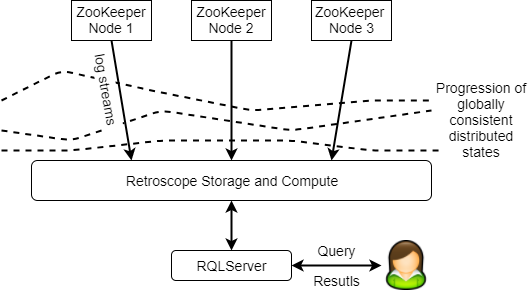
This post, part 2, focuses on monitoring distributed systems using Retroscope. This is a joint post with Aleksey Charapko . If you are unfamiliar with hybrid logical clocks and distributed snapshots, give part 1 a read first. Monitoring and debugging distributed applications is a grueling task. When you need to debug a distributed application, you will often be required to carefully examine the logs from different components of the application and try to figure out how these components interact with each other. Our monitoring solution, Retroscope, can help you with aligning/sorting these logs and searching/focusing on the interesting parts. In particular, Retroscope captures a progression of globally consistent distributed states of a system and allows you to examine these states and search for global predicates. Let’s say you are working on debugging ZooKeeper, a popular coordination service. Using Retroscope you can easily add instrumentation to the ZooKeeper nodes to log and ...

Web Data Management in RDF Age

Image
This was the keynote on ICDCS'17 Day 2, by Tamer Ozsu. Below are my notes from his talk. The slides for his presentation are available here. Querying web data presents challenges due to lack of a schema, its volatility, and its sheer scale. There have been several recent approaches to querying web data, including XML, JSON, and fusion tables. This talk is about another approach to maintaining and querying web data: RDF and SPARQL. This last one is the recommended way by W3C (World Wide Web Consortium) and is a building block for semantic web and Linked Open Data (LOD) . Here is a diagram denoting the LOD datasets and links between them as of 2014. Resource Description Framework (RDF) In RDF, everything is a uniquely named resource (URI). The ID for Jack Nicholson's resource is JN29704. Resources have defined attributes: y:JN29704 hasName = "Jack Nicholson", y:JN29704 BornOnDate = "1937-04-22". The relationships with other resources can be defined via ...

Gratitude

The other day I had taken my little daughter to the library. There was a lady tutoring his son. The boy was slightly over-active and argumentative. He was wearing a wool Buffalo hat. It was warm in the library, so that seemed out of place. It was also strange that the boy, who is around 7-8 years old, was not in school at this time of the day. But I can't put 2 and 2 together. I assumed that the lady is home-schooling the boy. Since I was interested about how home-schooling works (what works and what not), I asked her about it. (Although I am a shy introvert, I am not shy from asking people questions when I am curious about something. That is a little oddity I have.) She said she was not homeschooling, but her son missed a lot of classes, so she was trying to help him catch up. At that moment, I notice the thick book she was reading: "CANCER"! My heart sank. I tried to seem upbeat though. I asked the boy his name, Nicholas, and wished him best of luck with his studies...

Paper summary. Untangling Blockchain: A Data Processing View of Blockchain Systems

Image
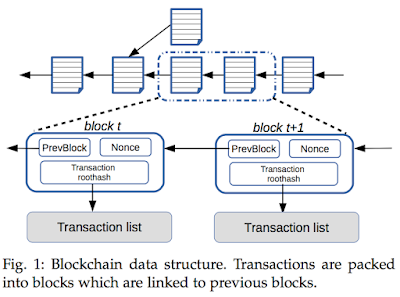
This is a recent paper submitted to arxiv (Aug 17, 2017).  The paper presents a hype-free, very accessible, yet technical  survey on blockchain. It takes a data-processing centric view of blockchain technology, treating  concurrency issues and efficiency of consensus as first class citizens in blockchain design. Approaching from that perspective, the paper  tries to forge a connection with blockchain technologies and distributed transaction processing systems. I think this perspective is promising for grounding the blockchain research better. When we connect a new area to an area with a large literature, we have opportunities to compare/contrast and perform efficient OODA loops . Thanks to this paper, I am finally getting excited about blockchains. I had a huge prejudice about blockchains based on the Proof-of-Work approach being used in BitCoin. Nick Szabo tried to defend this huge inefficiency, citing that it is necessary for attestation/decentralized/etc, but th...

Popular posts from this blog

Hints for Distributed Systems Design

The Agentic Self: Parallels Between AI and Self-Improvement

Learning about distributed systems: where to start?

5 Lessons at 50

Foundational distributed systems papers

Building a Database on S3

Cloudspecs: Cloud Hardware Evolution Through the Looking Glass

Aurora DSQL: Scalable, Multi-Region OLTP

TLA+ modeling tips

Supporting our AI overlords: Redesigning data systems to be Agent-first