Posts

Facebook's Mystery Machine: End-to-end Performance Analysis of Large-scale Internet Services
Image
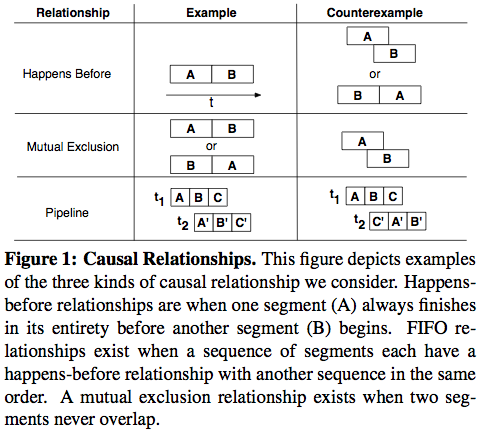
This paper appeared in OSDI'14, and is authored by Michael Chow, University of Michigan; David Meisner, Facebook, Inc.; Jason Flinn, University of Michigan; Daniel Peek, Facebook, Inc.; Thomas F. Wenisch, University of Michigan . The goal of this paper is very similar to that of Google Dapper (you can read my summary of Google Dapper here) . Both work try to figure out bottlenecks in performance in high fanout large-scale Internet services. Both work use similar methods, however this work (the mystery machine) tries to accomplish the task relying on less instrumentation than Google Dapper. The novelty of the mystery machine work is that it tries to infer the component call graph implicitly via mining the logs, where as Google Dapper instrumented each call in a meticulous manner and explicitly obtained the entire call graph. The motivation for this approach is that comprehensive instrumentation as in Google Dapper requires standardization....and I am quoting the rest from the pa...

Paper review: "Simple Testing Can Prevent Most Critical Failures: An Analysis of Production Failures in Distributed Data-Intensive Systems"

Image
This paper appeared in OSDI'14 and is written by Ding Yuan, Yu Luo, Xin Zhuang, Guilherme Renna Rodrigues, Xu Zhao, Yongle Zhang, Pranay U. Jain, and Michael Stumm, University of Toronto. While the title mentions "analysis of production failures", the paper is not concerned/interested in root cause analysis of failures, instead, the paper is preoccupied with problems in error handling that lead to failures. I enjoyed this paper a lot. The paper has interesting counterintuitive results. It opens to discussion the error handling issue, and particularly the Java exception handling. Digesting and interpreting the findings in the paper will require time. To contribute to this process, here is my take on the findings ---after a quick summary of the paper. The setup and terminology  The paper studied 198 randomly sampled user-reported failures of 5 opensource data-intensive distributed systems: Cassandra, HBase, Hadoop Distributed File System (HDFS), Hadoop MapReduce, an...

My crazy proposal for achieving lightweight distributed consensus

Distributed consensus is a hard problem. See some of my previous posts for discussion about impossibility results on distributed consensus. Paxos taught Perspectives on the CAP theorem Attacking Generals problem The reason distributed consensus is hard is because the parties involved don't have access to the same knowledge (the same point of view) of the system state.   Halpern's work on knowledge and common knowledge in distributed systems provides a useful framework to explain this.   Here is a summary of common knowledge paper by Halpern , and here is a nice talk on that paper. Of course, we have distributed consensus solutions, Paxos, ZooKeeper/ZAB, that ensure safety always and provide progress whenever the system conditions step outside the impossibility results territory (with respect to synchrony, channel reliability/reachability, and number of up nodes). But these solutions come with a performance cost, as they need serialization of all update requests from a ...

Eidetic systems

Image
This paper appeared in OSDI'14. The authors are all from University of Michigan: David Devecsery, Michael Chow, Xianzheng Dou, Jason Flinn, and Peter M. Chen. This paper presents a transformative systems work, in that it introduces a practical eidetic system implementation on a Linux computer/workstation. This paper is a tour de force: It undertakes a huge implementation effort to implement a very useful and novel eidetic memory/system service. The authors should be commended for their audaciousness. An eidetic computer system can recall any past state that existed on that computer, including all versions of all files, the memory and register state of processes, interprocess communication, and network input. An eidetic computer system can explain the lineage of each byte of current and past state. (This is related to the concept of data provenance, which I mention briefly at the end of my review.) Motivation One use case for an eidetic system is to track where/how erroneou...

Extracting more concurrency from Distributed Transactions

Image
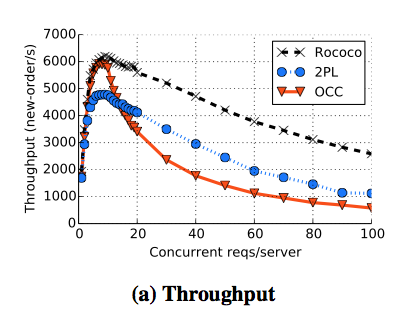
This paper appeared in OSDI'14. The authors are: Shuai Mu, Yang Cui, Yang Zhang, Wyatt Lloyd, Jinyang Li. The paper, presentation slides and video are accessible here. The paper proposes a concurrency control protocol for distributed transactions, and evaluates its performance comparing with two-phase locking (2PL) and optimistic concurrency control (OCC). The protocol The protocol introduced, ROCOCO (ReOrdering COnflicts for COncurrency) is targeted for extracting more concurrency under heavily contended workload than 2PL and OCC can handle. In fact, ROCOCO's improvements over OCC and 2PL comes after the peak throughput point of even ROCOCO. One of the questions after the OSDI presentation was about this. "That region where the system is thrashing is not a region you want to be. Why would you not employ admission control to refuse extra workload that pushes the system past peak performance?" ROCOCO assumes that a distributed transaction consists of a set of ...

My trick for coordinating Dropbox collaborations

There are high-tech solutions to managing the collaborative paper writing process, such as using version control systems like CVS or git. The downside to these systems is that when you are collaborating on a paper with a low-tech author, it is cumbersome to get them on board with these tools. Some of my collaborators have been from a non-CS background. And even some CS-background collaborators refuse to deal with cryptic version control commands and error messages. Dropbox provides a simple easy-to-use solution to sharing files which helps  teams to collaborate on projects, including collaborating on a paper. However, Dropbox does not have access control and cannot coordinate concurrent accesses to the same file by multiple writers. This causes overwritten/lost updates and frustrated collaborators. I have a low-tech solution to this problem. I have used this solution successfully with multiple collaborators over the last 2-3 years. Chances are that, you have also come up with t...

Salt: Combining ACID and BASE in a Distributed Database

Image
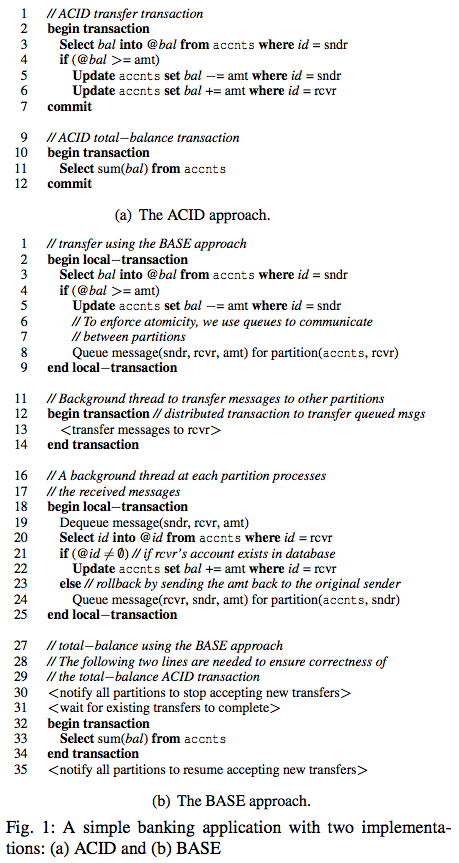
This paper appeared in OSDI'14. The authors are Chao Xie, Chunzhi Su, Manos Kapritsos, Yang Wang, Navid Yaghmazadeh, Lorenzo Alvisi, and Prince Mahajan, all from The University of Texas at Austin. Here you can watch a video of the OSDI presentation of the paper, and also find the presentation slides and the paper available as open access.  USENIX knows how to do conferences right. Dropping ACID ACID (Atomicity, Consistency, Isolation, Durability) approach provides ease-of-programming through its simple transaction abstraction, but loses on the performance. BASE (Basically-Available, Soft state, Eventually consistent) approach , popularized by the NoSQL systems, provides good performance (low-latency, high-throughput, and scalability), but loses on the ease-of-programming due to increased complexity of concurrent execution in distributed systems. This paper introduces Salt, which aims to find a best-of-both-worlds middle ground: to provide high performance like BASE with mode...

Book report: "Good Prose" and "How to write a lot"

Notes  from the "Good prose" This book is written by a journalist turned nonfiction author and his editor. This is a nice book, and a good read. "Quiet beginnings: You cannot make the reader love/trust you in the first sentence, but you can lose the reader with a grand proposition in the first sentence." "To write is to talk to strangers. Prepare the reader, tell everything reader needs to know to read on, but no more." "For a story to live, it is essential only that there be something important at stake, a problem that confronts the characters or reader. The unfolding of the problem and its resolutions are the real payoff." "Revelation transforms events into a story." "Don't mess with chronology unless you have a good reason." "On the topic of essays:  Essayists tend to argue with themselves. Who am I to write this? Who cares to read this? If I knew my own mind, I would not make essays, I would make de...

Paper summary: Perspectives on the CAP theorem

Image
This is a 2012 short paper by Seth Gilbert and Nancy Lynch that appeared in a special issue commemorating the 12th anniversary of the CAP theorem. Gilbert and Lynch get to write in this special issue because they were the ones to first publish a proof the CAP conjecture put forward by Eric Brewer in PODC 2000 keynote. In this paper, Gilbert and Lynch aim to situate the CAP theorem in the broader context of a family of results in distributed computing theory that shows impossibility of guaranteeing both safety  and liveness  in an unreliable  distributed system. The impossibility results surveyed in relation to CAP concern slightly different problems and slightly different fault models. While it is easy to confuse CAP with those results on a superficial look, on a closer inspection we see that the results are all distinct and none subsume CAP. The CAP problem  The CAP theorem does NOT consider the consensus problem, but considers an easier problem: the atomic ...

How to present your work

Presentation is a very important skill. Determining how to present and communicate your results in an effective manner is  as important as doing the research and getting those results. From the same material you can get a killer job talk or a bummed dissertation talk. Presentation skills can make the difference. Presentation is not a soft skill despite the common misconception among many technical people. It takes a lot of brains, analyzing, and synthesizing to produce a good presentation. You have to understand and internalize your content very well in order to present it clearly in the most engaging and compelling way. So if you fail to present your work clearly, that reflects poorly on you and your work. The audience will think "the work doesn't look significant or promising", or even worse "the presenter doesn't truly understand/internalize his work". The most essential requirement for a successful presentation is practice. I observe that our graduat...

Dijkstra's stabilizing token ring algorithm

Image
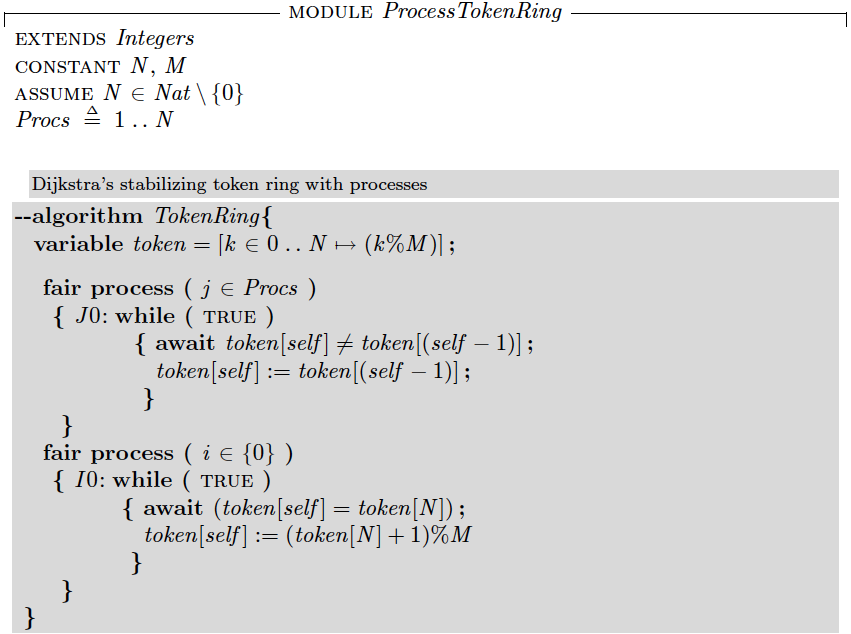
One of the classical algorithms I teach in my distributed systems class is Dijkstra's stabilizing token ring algorithm. This algorithm has started the self-stabilization field as a subfield of fault-tolerance. And, it still receives interest even after 40 years. There has been probably hundreds of self-stabilization papers that revisits Dijkstra's stabilizing token ring algorithm as part of a solution or as part of a case study. This algorithm never gets old for me as well. I still enjoy talking about this algorithm in class and thinking about it once in a while. I guess this is because it is a very elegant algorithm. Linked is Dijkstra's original paper introducing the algorithm. This paper also includes two variants of the stabilizing token ring algorithm, 3-state and 4-state token ring algorithms. Dijkstra would later do a followup writeup, titled, "A belated proof of self-stabilization" , where he gave a proof of stabilization for 3-state token ring progra...

My Distributed Systems Seminar reading list for Spring 2015

Below is the list of papers I plan to discuss in my distributed systems seminar this semester. If you have some suggestions on other good/recent papers to cover, please let me know in the comments. Perspectives on the CAP Theorem Consistency, availability, and convergence. Salt: combining ACID and BASE in a distributed database Extracting More Concurrency from Distributed Transactions Eidetic Systems Simple Testing Can Prevent Most Critical Failures: An Analysis of Production Failures in Distributed Data-Intensive Systems The Mystery Machine: End-to-end Performance Analysis of Large-scale Internet Services All File Systems Are Not Created Equal: On the Complexity of Crafting Crash-Consistent Applications GraphX: Graph Processing in a Distributed Dataflow Framework Architecture of a database system Arrakis: The Operating System is the Control Plane Fast Databases with Fast Durability and Recovery Through Multicore Parallelism Project Adam: Building an Efficient and Scala...

Popular posts from this blog

Writing as a thinking tool

The Man from the Future: Why Johnny Can't Stop Abstracting

The Safest Job from AI may be Writing

The Two Abstractions of System Design: Hide or Reduce

The Agentic Self: Parallels Between AI and Self-Improvement

In Search of a Compositional Theory of Self-Stabilization

Learning about distributed systems: where to start?

Building a Database on S3

Foundational distributed systems papers

What I'd do as a College Freshman in 2025