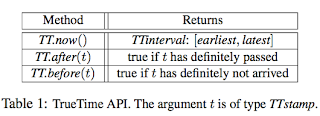
The Spanner paper by Google (appeared in OSDI'12) is cryptic and hard to understand. When I first read it, I thought I understood the main idea, and that the benefit of TrueTime was to enable lock-free read-only transactions in Spanner. Then, I slowly realized things didn't check; it was possible to achieve lock-free read-only transactions without TrueTime as well. I did another read, and thought for some time, and had a better understanding of how TrueTime benefits Spanner, and how to improve its shortcomings. I will first provide a summary of the Spanner work (borrowing sentences and figures from the Spanner paper), and then talk about what TrueTime is actually good for. In a nutshell Spanner is Google's scalable, multi-version, globally-distributed, and synchronously-replicated database. Spanner supports non-blocking reads in the past, lock-free read-only transactions, and atomic schema changes. In order to support externally-consistent distributed transactions a...