Posts

Online migration for geodistributed storage systems, Usenix ATC 2011

Image
This paper investigates the problem of migrating data between data centers. Data needs to be moved from one center to another based on the access patterns, for example, the user may have moved from East to West coast. The problem is complicated by the large size of data that needs to be moved, the requirement to perform the migration online without blocking access to any part of the data from anywhere, and finally that the data can be accessed/modified concurrently in different locations. To address this problem, the paper proposes an overlay abstraction. The goal of the abstraction is to implement migration as a service, so that the developer does not have to deal with the race conditions that may result while migrating data in ad hoc ways. The analogy of overlay is a sheet of transparencies. Remember the old days before powerpoint? The presenters used to print the slides on transparencies, and do animation by overlaying one transparency over another. The overlay idea is similar. ...

Refuse to Crash with Re-FUSE

Image
This paper appeared in Eurosys'10. This is a well written paper: the paper holds your hand, and takes you for a walk in the park. At each step of the path, you can easily predict what is coming next. I like this kind of easy-reading papers, compared to the cryptic or ambiguous papers which make you wander around or try to guess which paths to take through a jungle of junctions. The goal of this work is to provide support for restartable user-level filesystems. But, before I can tell you more about that, we first need to discuss user-filesystems. User-filesystems provides a way to add custom features (such as encryption, deduplication, access to databases, access to Amazon S3, etc.) on top of existing kernel-level filesystems. FUSE is a popular software that facilitates building user-filesystems on top of kernel-level filesystems. FUSE is available for Linux, FreeBSD, NetBSD, and MacOSX, and more than 200 userfilesystems have already been implemented using FUSE. GlusterFS, HDFS, Z...

Sabbatical help

My tenure at University at Bufffalo, SUNY has just become official after the President signed on it. Having completed my 6 years at UB, I am now eligible to spend a sabbatical year. I am planning to spend 6 months of my sabbatical in the industry/research-lab working on cloud computing challenges. If you have any suggestions/connections to make this happen, please send me an email.

Why are algorithms not scalable?

Recently, a colleague emailed me the following: Since you have been reading so much about clouds, CAP, and presumably lots of consensus things, you can answer better the question of algorithm scalability. How scalable are the popular algorithms? Can they do a reasonable job of consensus with 100,000 processes? Is this even a reasonable question? What are the fundamental problems, the algorithms or the lower level communication issues? These are actually the right kind of questions to ask probing for deeper CS concepts. Here are my preliminary answers to these questions. From what I read, consensus with 100K processes is really out of question. Paxos consensus was deployed on 5 nodes for GFS and similar systems: Zookeper, Megastore, etc. As another example Sinfonia's participant nodes in a transaction is also around limited to 5-10. So what is wrong with algorithms, why are they unscalable? I guess one obstacle against scalability is the "online" processing requirement...

On designing and deploying Internet scale services

This 2008 paper presents hard-earned lessons from James Hamilton 's experience over the last 20 years in high-scale data-centric software systems and internet-scale services. I liken this paper to "Elements of Style" for the domain of Internet scale services. Like the "Elements of Style" this paper is also not to be consumed at once, it is to be visited again and again every so often. There are three main overarching principles: expect failures, keep things simple, automate everything. We will see reflections of these three principles in several subareas pertaining to Internet-scale services below. Overall Application Design Low-cost administration correlates highly with how closely the development, test, and operations teams work together. Some of the operations-friendly basics that have the biggest impact on overall service design are as follows. /Design for failure/ Armando Fox had argued that the best way to test the failure path is never to shut the service...

Centrifuge: Integrated Lease Management and Partitioning for Cloud Services

Image
For performance reasons many large-scale sites (LinkedIn, Digg, Facebook, etc.) employ a pool of backend servers that operate purely on in-memory state. The frontend servers that forward the requests to the backend servers then should be very carefully implemented to ensure that they forward the requests to the correct backends. The frontend should ensure that the selected backend has the requested object in its memory and also possesses the lease to update the object. Unfortunately, things may change quickly at the backend; backend servers may fail, new ones may join, backend servers may start to cache different objects due to load-balancing requirements, and leases may exchange hands. All of these make the task of programming the frontend very challenging and frustrating. This work (from NSDI'10) proposes Centrifuge, a datacenter lease manager that addresses this problem. The Centrifuge system has been deployed as part of Microsoft live mesh service, a large scale commercial clo...

Smoke and Mirrors: Reflecting Files at a Geographically Remote Location Without Loss of Performance

Image
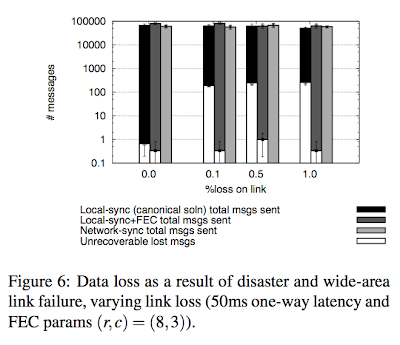
This paper from FAST'09 introduces smoke and mirrors filesystem (SMFS) which mirrors files at a geographically remote datacenter with negligible impact on performance. It turns out remote mirroring is a major problem for banking systems which keep off-site mirrors (employing dedicated high-speed 10-40Gbits optical links) to survive disasters. This paper is about disaster tolerance, not your everyday fault-tolerance. The fault model includes that the primary site may get destroyed, and some sporadic packet losses upto 1% may occur simultaneously as well, yet still no data should be lost. (Data is said to be lost if the client is acknowledged for the update but the corresponding update/data no longer exists in the system.) The primary site being destroyed may be a bit over-dramatization. An equivalent way to state the fault model would be that the paper just rules out a post~hoc correction (replay or manual correction). Here is how manual correction would work: if power outage occur...

Consistency analysis in Bloom: a CALM and collected approach

This work from CIDR11 aims to provide theoretical foundations for correctness under eventual consistency, and identifies "order independence" (independence of program execution from temporal nondeterminism) as a sufficient condition for eventual consistency. CALM (consistency and logical monotonicity) principle states that monotonic programs guarantee order independence, and hence, eventual consistency. A monotonic program is one where any true statement remains to be true as new axioms arrive. In contrast, in a non-monotonic program, new input can cause the earlier output to be revoked. A monotonic program guarantees eventual consistency, whereas non-monotonicity requires the use of coordination logic. To simplify the task of identifying monotonic and nonmonotonic program segments, this work proposes using program analysis in a declarative language, Bloom. In Bloom, monotonicity of a program is examined via simple syntactic checks. Selection, join, and projection operators ...

Life beyond Distributed Transactions: an Apostate's Opinion

Image
Pat Helland is one of the veterans of the database community. He worked on the Tandem Computers with Jim Gray. His tribute to Jim Gray , which gives a lot of insights into Jim Gray as a researcher, is worth reading again and again. This 2007 position paper from Pat Helland is about extreme scalability in cloud systems, and by its nature anti-transactional. Since Pat has been a strong advocate for transactions and global serializability for most of his career, the title is aptly named as an apostate's opinion. This paper is very relevant to the NoSQL movement . Pat introduces "entity and activities" abstractions as building primitives for extreme scalability cloud systems. He also talks about at length about the need to craft a good workflow/business-logic on top of these primitives. Entity and activities abstractions Entities are collections of named (keyed) data which may be atomically updated within the entity but never atomically updated across entities. An entity liv...

Tempest and Deutronomy reviews

I am 3 weeks behind in writing summaries for the papers we discuss in my seminar. In order to have some chance of catching up, I am skipping the summaries for Tempest and Deutronomy papers, and refer to student summaries for these two. Tempest: Soft state replication in the service tier (DSN'08) Deuteronomy: Transaction Support for Cloud Data (CIDR'11)

Megastore: Providing scalable, highly available storage for interactive services

Image
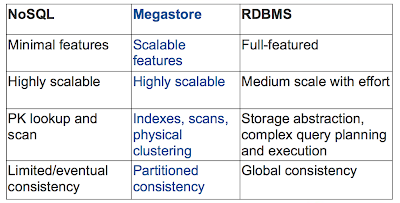
Google's Megastore is the structured data store supporting the Google Application Engine . Megastore handles more than 3 billion write and 20 billion read transactions daily and stores a petabyte of primary data across many global datacenters. Megastore tries to provide the convenience of using traditional RDBMS with the scalability of NOSQL: It is a scalable transactional indexed record manager (built on top of BigTable), providing full ACID semantics within partitions but lower consistency guarantees across partitions (aka, entity groups in Figure 1). To achieve these strict consistency requirements, Megastore employs a Paxos-based algorithm for synchronous replication across geographically distributed datacenters. I have some problems with Megastore, but I save them to the end of the review to explain Megastore first. Paxos Megastore uses Paxos , a proven, optimal, fault-tolerant consensus algorithm with no requirement for a distinguished master. (Paxos is hard to cover i...

Flexible, Wide-Area Storage for Distributed Systems with WheelFS

One of my students, Serafettin Tasci , wrote a good review of this paper, so I will save time by using his review below, instead of writing a review myself. In this paper the authors propose a storage system for wide-area distributed systems called WheelFS. The main contribution of WheelFS is its ability of adaptation to different types of applications with different consistency, replica placement or failure handling requirements. This ability is obtained via semantic cues that can be easily expressed in path names. For example to force the primary site of a folder john to be X, we can specify the cue “home/users/.Site=X/john”. This representation enables preserving of POSIX semantics and minor change in application software to use the cues. In WheelFS, there are 4 groups of semantic cues. Placement cues are used to arrange the location of primaries and replicas of a file or folder. Durability cues specify the number and usage of replicas. Consistency cues maintain a tradeoff between ...

Ceph: A Scalable, High-Performance Distributed File System

Image
Traditional client/server filesystems (NFS, AFS) have suffered from scalability problems due to their inherent centralization. In order to improve performance, modern filesystems have taken more decentralized approaches. These systems replaced dumb disks with intelligent object storage devices (OSDs)--which include CPU, NIC and cache-- and delegated low-level block allocation decisions to these OSDs. In these systems, clients typically interact with a metadata server (MDS) to perform metadata operations (open, rename), while communicating directly with OSDs to perform file I/O (reads and writes). This separation of roles improve overall scalability significantly. Yet, these systems still face scalability limitations due to little or no distribution of the metadata workload. Ceph is a distributed file system designed to address this issue. Ceph decouples data and metadata operations completely by eliminating file allocation tables and replacing them with generating functions (called CR...

Sinfonia: A New Paradigm for Building Scalable Distributed Systems

Image
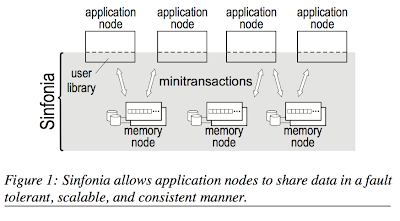
Sinfonia is an in-memory scalable service/infrastructure that aims to simplify the task of building scalable distributed systems. Sinfonia provides a lightweight "minitransaction" primitive that enables applications to atomically access and conditionally modify data at its multiple memory nodes. As the data model, Sinfonia provides a raw linear address space which is accessed directly by client libraries. Minitransactions In traditional transactions, a coordinator executes a transaction by asking participants to perform one or more participant-actions (such as retrieving or modifying data items), and at the end of the transaction, the coordinator decides and executes a two-phase commit. In the first phase, the coordinator asks all participants if they are ready to commit. If they all vote yes, in the second phase the coordinator tells them to commit; otherwise the coordinator tells them to abort. Sinfonia introduces the concept of minitransactions, by making the observation...

PetaShare: A reliable, efficient and transparent distributed storage management system

Image
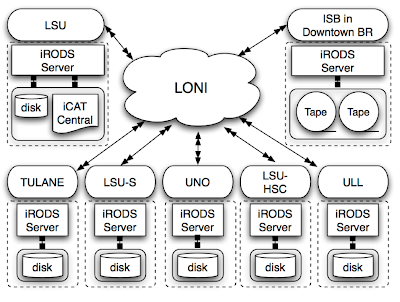
This paper by my colleague Tevfik Kosar (to appear soon) presents the design and implementation of a reliable and efficient distributed data storage system, PetaShare, which manages 450 Terabytes of disk storage and spans 7 campuses across the state of Louisiana. There are two main components in a distributed data management architecture: a data server which coordinates physical access (i.e. writing/reading data sets to/from disks) to the storage resources, and a metadata server which provides the global name space and metadata of the files. Metadata management is a challenging problem in widely distributed large-scale storage systems, and is the focus of this paper. Petashare architecture The back-end of PetaShare is based on iRODS . All system I/O calls made by an application are mapped to the relevant iRODS I/O calls. iRODS stores all the system information, as well as user-defined rules in centralized database, which is called iCAT. iCAT contains the information of the distributed...

Popular posts from this blog

Hints for Distributed Systems Design

The Agentic Self: Parallels Between AI and Self-Improvement

Learning about distributed systems: where to start?

5 Lessons at 50

Foundational distributed systems papers

Building a Database on S3

Cloudspecs: Cloud Hardware Evolution Through the Looking Glass

Aurora DSQL: Scalable, Multi-Region OLTP

TLA+ modeling tips

Supporting our AI overlords: Redesigning data systems to be Agent-first