Posts

Dynamo: Amazon's highly available key-value store

This paper, which appeared in SOSP'07, describes Dynamo, the underlying storage technology for several core services in Amazon's e-commerce platform. Dynamo is a NoSQL system and provides a single key-value store. The commonly accepted (yet still disputed) wisdom is that RDBMS are overkill for simple key-value stores and are unsuitable for large-scale multi datacenter systems. The goal in Dynamo is providing reliability at large scale. As the paper says in the introduction "The reliability and scalability of a system is dependent on how its application state is managed". This was a key lesson from the Ousterhout'90 paper: "The role of distributed state" . Dynamo is an optimistic replication system. According to the optimistic survey taxonomy , Dynamo is a multi-master (multiple coordinators can update the data) system that employs state transfer and asynchronous propagation of updates. Hence, Dynamo allows conflicting updates in to the system. Dynamo u...
Crowdsourced sensing and collaboration using Twitter

First, a brief prelude about my research interests. I started my PhD on distributed algorithms and self-stabilizing systems in 1998. But then in 2000, after my advisor received a DARPA grant on networked embedded sensor technologies, I have started working on wireless sensor networks. After 10 years of working on wireless sensor networks, I am now in the process of switching topics. I am doing a lot of reading on cloud computing. This is a topic I enjoy, and I think I can contribute here due to my background in distributed systems and theory. I am also doing a lot of reading on smartphones, as they provide a good alternative/complement to wireless sensor network systems. The main appeal of smartphones is that they have solved the market penetration problem, which the wireless sensor networks have been perpetually struggling with. The killer applications for smartphones are communication and offering a lightweight ubiquitous PC replacement. Smartphones are incidentally better sensors th...

VL2: A Scalable and Flexible Data Center Network

Image
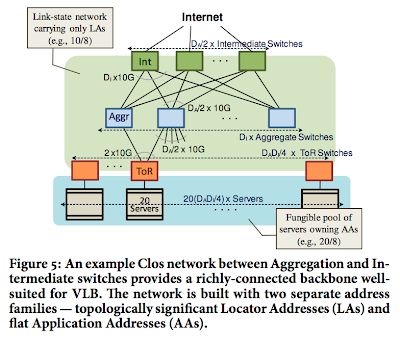
This paper is by MS Research and appeared in Sigcomm 2009. The paper investigates data center networking, the same problem as the Portland paper (which also appeared in Sigcomm 2009!). Naturally there are similarities in the approaches recommended by the two papers. The motivation for this paper is from a slightly different angle than the Portland paper. This paper puts more emphasis on the network capacity problem in the data centers. The paper argues that the network is the bottleneck of the computation, since the switches at the higher levels (i.e., aggregation and core switches) are oversubscribed heavily. Servers typically have 1:1 over-subscription to other servers in the same rack --that is, they can communicate at the full rate of their interfaces (e.g., 1 Gbps). However, up-links from top of the rack (ToR) switches are typically 1:20 oversubscribed (i.e., 1 Gbps of up-link for 20 servers), and paths through the highest layer of the tree can be 1:240 oversubscribed. The paper...

PortLand: A Scalable Fault-Tolerant Layer 2 Data Center Network Fabric

Image
Last week we covered the Portland paper by UC San Diego , which appeared at Sigcomm'09. This paper is well written and I really appreciate its clarity and simplicity. The motivation for the work is the need to scale at the data center networks (DCNs). Data centers today may have around 100K machines, with 32 virtual machines at each, which yield a total of 3 million hosts. Assuming one switch is required for every 25 physical hosts and accounting for interior nodes, the topology would consist of 8,000 switches. Current network protocols impose significant management overhead at this scale let alone supporting seamless VM migration across machines. For example, broadcasting ARPs and updates to every swithch is out of the question for such a network. The desiderata for the DCN is given as: R1. Any VM may migrate to any physical machine. Migrating VMs should not have to change their IP addresses as doing so will break pre-existing TCP connections and application-level state. R2. An ad...

Availability in Globally Distributed Storage Systems

Image
This paper by Google Research provides a report on the availability behavior of large cloud storage systems by studying up to 7K nodes at Google over a year. The paper does not propose any new protocols, but provides sufficiently accurate models of system behavior/performance based on the study. These models are important since they enable us to correctly design and optimize these multi layered systems for data availability. The work is divided into two parts. The first is the analysis of the component availability (disks, machines, racks), and the second is the analysis of the data availability, as inferred from the component availability results and design decisions of the distributed storage system. Preliminaries A storage node is defined as unavailable when it fails to respond positively to periodic health checking pings sent by the monitoring system. The paper does not investigate about network errors specifically; those are also swept under unavailability with software & h...

My iPhone 4 has a transparent screen

Image
I just took a picture of my palm, and set it as the wallpaper to give the transparency effect. The trick worked well on some unsuspecting friends.

Optimistic Replication

Image
This 2005 paper by Saito and Shapiro provides a comprehensive survey of the optimistic replication area and is a must-read for distributed services designers. Below, I am providing some snippets from the paper to give a brief overview. Data replication improves both availability and performance for distributed services. Availability is improved by allowing access to the data even when some of the replicas are unavailable. Performance improvements concern reduced latency (by enabling local access from replica instead of remote access) and increased throughput (by letting multiple computers serve the data). Pessimistic techniques block access to a replica unless it is provably up to date. Such pessimistic techniques perform well in local-area networks, in which latencies are small and failures uncommon, but is unsuitable for wide-area networks, because the Internet remains slow and unreliable. Moreover, pessimistic algorithms scale poorly, because its throughput and availability suf...

A presentation tip (brought to you by a weary audience)

A common and serious flaw I see in student presentations is that the presenter rushes through the first 5-10 slides. This is the worst thing to do in a presentation, these introduction slides to the problem and solution are the most important ones. If the presenter loses the audience in these beginning slides, this wastes the entire hour for the audience. In comparison, losing the audience in the middle of the presentation is less critical, less time is wasted, and the audience can even use this time to think about alternative solutions to the problem (which was presented clearly in the introduction). You would think this is common sense, but most of the students still commit this mistake. I guess the reason is since the presenter had read and understood the relatively easy introduction part of the paper, he thinks the audience can also understand and follow it with ease. And armed with the powerpoint slides, the presenter can finish the first 10 slides in less than 10 minutes in bulle...

The role of distributed state

This is a 1990 technical report by John Ousterhout, who has been a very influential and pioneer figure in systems research. I had written a summary of his log-structured file system (LFS) paper earlier in this blog. It seems like his ideas on LFS and RAMCloud are becoming important in cloud computing these days. Ousterhout is also the creator of TCL/TK, so he has a lot to say in programming languages for web applications domain as well. The miscellaneous articles on his non-academic homepage include a lot of wisdom from his experience in the software development industry, and are also worth reading carefully. This paper titled "Role of distributed state" describes the advantages and disadvantages of distributed state and suggests that the act of building a distributed system consists of making tradeoffs among various alternatives for managing the distributed state. Illustrating this point, the two case studies included in the paper, NFS and Sprite file systems, end up with ...

Paxos taught

In my previous posts I have alluded a couple of times to how I teach Paxos. Here I will explain how I go about teaching Paxos. These are the slides I use in class. (In my slides I reuse a lot of material from the lecture slides of Jeff Chase (Duke) . He shared his slides with me under the Creative Commons license, where I get to remix/change the contents with proper credit to him.) Paxos is a protocol for solving distributed consensus. The problem is easy to state. Consensus requires the following three properties. The first two are safety properties, the last one is a liveness property. Agreement: No two process can commit different decisions. Validity (Non-triviality): If all initial values are same, nodes must commit that value. Termination: Nodes commit eventually. I first start with a discussion of impossibility results in consensus. A major impossibility result is the coordinated attack (aka two generals) paradox . The result states that there is no determi...

Speculative Execution in a Distributed File System

Image
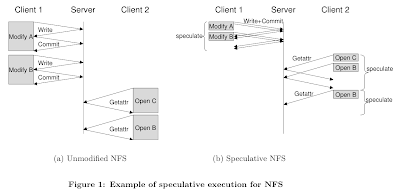
This SOSP'05 paper is about optimization techniques for client server distributed computing model, especially focusing on distributed file systems. In distributed filesystems, providing strong cash-consistency among concurrently editing clients require several synchronization messages to be exhanged between the clients and the server. Network delays, especially in wide area networks, make this unfeasibly slow. In fact AFS and NFS sacrifice consistency guarantees for speed, and provide weaker consistency guarantees such as close-to-open consistency where a client that opens the file see modifications by clients that have previously closed the file. Even these weaker consistency guarantees require synchronizing with the server and introduce latencies. Can distributed file systems be safe, consistent, yet fast? The paper states that it is possible to achieve this by using operating system support for lightweight checkpointing and speculative execution. The idea is simple. The main rea...

Live migration of virtual machines

This is a 2005 paper by the same group at Cambridge that developed the Xen virtualization system discussed in the previous post . This review will be short since it is only based on the notes I took while listening to the paper presentation in the seminar. Live virtual machine (VM) migration is the relocation of a VM from one machine to another while its applications continue to execute. The motivation for live migration is to perform load management across machines and even across data centers. Another motivation is fault-tolerance, if the original host needs to go down due to faults, maintenance, or power outage, migration can provide availability of the applications running on the hosted VMs. The challenges with live migration of VMs is to minimize the downtime and to provide a seamless relocation of the VM so the VM can continue to operate normally in its new address. One strawman for migrating the contents of VM memory is the stop-and-copy approach. This approach leads to a ...

Xen and the art of virtualization

Image
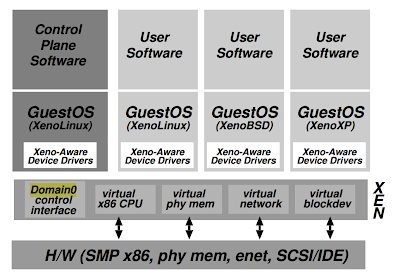
This week in the seminar class we discussed the Xen virtualization paper from SOSP 2003. Xen is the first open source virtualization solution, however, Vmware was already available in 2000 as a commercial solution for virtualization. A virtual machine (VM) is a software implementation of a machine (i.e. a computer) that executes instructions like a physical machine. The biggest benefit of virtualization is in server consolidation: enabling efficient usage of computer server resources in order to reduce the total number of servers that an organization requires. Thanks to the virtualization's ability to separate the OS and application from the hardware, it becomes possible to run multiple applications (in complete isolation from each other) on each server instead of just one application per server. This increases the utilization rate of servers and prevents the problem of "server sprawl", a situation in which multiple, under-utilized servers take up more space and resou...

Mencius: building efficient replicated state machines for Wide-Area-Networks (WANs)

I will write my short summary of the Mencius paper from OSDI08 here. Writing this helped me understand a couple subtle points better, so I hope it will also help others. Replicated state machines is a common approach for achieving fault-tolerance. State machine replication works by replicating the state and function across multiple servers (replicas) and using consensus to agree on the sequence of the commands the replicas execute. Assuming deterministic service, since all replicas execute the same sequence of commands, they all keep the same state, and strong consistency guarantees are provided to the face of server failures. Paxos is a fault-tolerant implementation of replicated state machines. Paxos has become hugely popular because it is the only formally proven protocol that works in the face of asynchronous model. Paxos preserves safety (no incorrect decisions are taken by replicas) to the face of violations of timing assumptions on the channels and servers. Paxos satisfies prog...

Future of powerpoint presentations

This Ted talk reminded me of a dream I had. In that dream, hundreds of soldiers are being shipped into a big empty convention center room, and they are being deployed into lines that are only a meter across from other enemy combatant soldiers. Between these two combatant lines there are some soil bags lined up, but the height of these bag blocks is only waist level. Everyone is so serious, this is war, so they take these deployment instructions very seriously. Nobody wants to make a mistake. After the deployment is finished, the commander is supposed to announce start, and soldiers are supposed to start firing at each other. I wake up before this happens. This is pure madness and terror. I felt disturbed by this very visual image for many days. But if you think about it, this was pretty much how WW1 and WW2 were in abstract. I think that deployment would make a really good performance art project. It is both abstract and concrete(visual) at the same time. It drives the point home. It ...

Popular posts from this blog

Hints for Distributed Systems Design

The Agentic Self: Parallels Between AI and Self-Improvement

Learning about distributed systems: where to start?

5 Lessons at 50

Foundational distributed systems papers

Building a Database on S3

Cloudspecs: Cloud Hardware Evolution Through the Looking Glass

Aurora DSQL: Scalable, Multi-Region OLTP

TLA+ modeling tips

Supporting our AI overlords: Redesigning data systems to be Agent-first