Posts

Showing posts matching the search for invariant-based

Paper review. An Empirical Study on Crash Recovery Bugs in Large-Scale Distributed Systems

Image
Crashes happen. In fact they occur so commonly that they are classified as anticipated faults. In a large cluster of several hundred machines, you will have one node crashing every couple of hours. Unfortunately, as this paper shows, we are still not very competent at handling crash failures. This paper from 2018 presents a comprehensive empirical study of 103 crash recovery  bugs from 4 popular open-source distributed systems: ZooKeeper, Hadoop MapReduce, Cassandra, and HBase. For all the studied bugs, they analyze their root causes, triggering conditions, bug impacts and fixing. Summary of the findings Crash recovery bugs are caused by five types of bug patterns: incorrect backup (17%) incorrect crash/reboot detection (18%) incorrect state identification (16%) incorrect state recovery (28%)  concurrency (21%) Almost all (97%) of crash recovery bugs involve no more than four nodes. This finding indicates that we can detect crash recovery bugs in a small set of...
Debugging designs with TLA+

Image
This post talks about why you should model your systems and exhaustively test these models/designs with the TLA+ framework. In the first part, I will discuss why modeling your designs is important and beneficial, and in the second part I will explain why TLA+ is a very suitable framework for modeling, especially for distributed and concurrent systems. Modeling is important If you have worked on a large software system, you know that they are prone to corner cases , failed assumptions , race conditions , and cascading faults . There are many corner cases because there are many parameters, and these do interfere in unanticipated ways with each other. The corner cases violate your seemingly reasonable implicit assumptions about the system components and environment, e.g.,"1-hop is faster than 2-hops", "0-hop is faster than 1-hop", and "processes work with the same rate". There are abundant race conditions because today (with the rise of SOA, cloud, and ...

Using TLA+ for teaching distributed systems

I am teaching CSE 4/586 Distributed Systems class  again this Fall (Fall 2014). This is the course I have most fun teaching. (I would like to think my students also feel that way :-) I teach the course with emphasis on reasoning about the correctness of distributed algorithms. Here are the topics I cover in sequence: Introduction, Syntax and semantics for distributed programs, predicate calculus Safety and progress properties Proof of program properties Time: logical clocks, State: distributed snapshots Mutual exclusion, Dining philosophers Consensus, Paxos Fault-tolerance, replication, rollback recovery, self-stabilization Programming support for distributed systems Data center computing and cloud computing  CAP theorem and NOSQL systems Distributed/WAN storage systems I put emphasis on reasoning about distributed algorithms because concurrency is very tricky; it truly humbles human brain. More than 3 actions in a distributed program and your intuitions will f...

Seeing is Believing: A Client-Centric Specification of Database Isolation

Image
This paper presents a new way to reason about transaction-isolation based on application-observable states, in lieu of prior history-based approaches. This approach maps more naturally to what applications can observe, and facilitates comparing isolation guarantees. It also frees isolation definitions from implementation-specific details (timestamps, replicas) and opens the way to find alternate implementations. The paper provides a dense but rewarding read. If you call history-based approaches as operational reasoning on transaction isolation semantics, you can think of the proposed state-based approach as opening the way for invariant-based reasoning for this. So there is a lot of potential to be realized for this work. The paper already illustrates some of these benefits: State-based modeling shows that several well-known guarantees, previously thought to be distinct, are in fact equivalent, and that many previously incomparable flavors of snapshot isolation can be organized in a c...

Hints for computer system design, ACM-OS'83

Image
My seminar on cloud computing systems has started today with two papers. Here is the summary of the first paper we covered in the seminar. Designing a computer system is very different from designing an algorithm: The external interface (that is, the requirement) is less precisely defined, more complex, and more subject to change. The system has much more internal structure, and hence many internal interfaces. The measure of success is much less clear. In this 1983 paper , Butler Lampson gives hints for computer system design based on his experience on building several systems in Xerox PARC labs. It is amazing how relevant and how fresh these hints are after 30 years of their publication. While these hints were not specifically targeting distributed systems design, several of these hints are applicable (and widely used) for cloud computing systems. Most of the text below is verbatim copied from the paper. I omitted about half of the hints, and details/justifications about the...

Modeling the DAO attack in PlusCal

Image
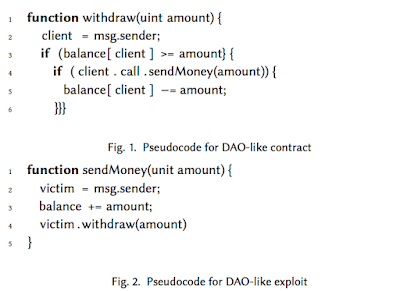
Maurice Herlihy's paper: "Blockchains from a distributed computing perspective" explains the DAO attack as follows: "Figure 1 shows a fragment of a DAO-like contract, illustrating a function that allows an investor to withdraw funds. First, the function extracts the client's address (Line 2), then checks whether the client has enough funds to cover the withdrawal (Line 3). If so, the funds are sent to the client through an external function call (Line 4), and if the transfer is successful, the client’s balance is decremented (Line 5).  This code is fatally  flawed. In June 2016, someone exploited this function to steal about $50 million funds from the DAO. As noted, the expression in Line 3 is a call to a function in the client's contract. Figure 2 shows the client's code. The client's contract immediately calls withdraw() again (Line 4). This re-entrant call again tests whether the client has enough funds to cover the withdrawal (Line 3), and b...

Best of Metadata in 2022

It is time to reflect back on the year. Here are some selected papers I covered in 2022. Production systems Amazon Aurora: Design Considerations + On Avoiding Distributed Consensus for I/Os, Commits, and Membership Changes Aurora provides a a high-throughput relational database on AWS cloud by decoupling the storage to a multi-tenant scale-out storage service. Each database instance acts as a SQL endpoint and supports query processing and transactions. Many database functions, such as redo logging, materialization of data blocks, garbage collection, and backup/restore, are offloaded to the storage nodes. Aurora performs replication among the storage nodes by pushing the redo log; this reduces networking traffic and enables fault-tolerant storage that heals without database involvement. Amazon DynamoDB: A Scalable, Predictably Performant, and Fully Managed NoSQL Database Service (USENIX ATC 2022) DynamoDB has massive scale; it powers Alexa, Amazon.com sites, and all Amazon fulfillment c...

TLA+ mental models

Image
In the age of LLMs, syntax is no longer the bottleneck for writing, reading, or learning TLA+. People are even getting value by generating TLA+ models and counterexamples directly from Google Docs descriptions of the algorithms. The accidental complexity of TLA+ (its syntax and tooling) is going away. But the intrinsic complexity remains: knowing where to start a model, what to ignore, and how to choose the right abstractions. This is modeling judgment, and it is the hardest skill to teach. Engineers are trained to think in code, control flow, and local state. TLA+ forces you into a different mode: mathematical, declarative, and global. You specify what must hold, not how to achieve it. Once you get comfortable with this shift, it changes how you think about systems, even away from the keyboard. In a companion post , I described TLA+ as a design accelerator based on lessons from 8 industry projects. Here I want to go deeper and articulate the mental models behind effective TLA+ use. Th...

Popular posts from this blog

The Safest Job from AI may be Writing

The Two Abstractions of System Design: Hide or Reduce

The Agentic Self: Parallels Between AI and Self-Improvement

Learning about distributed systems: where to start?

Hints for Distributed Systems Design

Building a Database on S3

Foundational distributed systems papers

Cloudspecs: Cloud Hardware Evolution Through the Looking Glass

Specula: Scaling formal specifications for autonomous model checking of system code

What I'd do as a College Freshman in 2025