Posts

Showing posts matching the search for consistency

The many faces of consistency

Image
This is a lovely paper (2016) from Marcos Aguilera and Doug Terry . It is an easy read. It manages to be technical and enlightening without involving analysis, derivation, or formulas. The paper talks about consistency. In distributed/networked systems (which includes pretty much any practical computer system today), data sharing and replication brings up a fundamental question:  What should happen if a client modifies some data items and simultaneously, or within a short time, another client reads or modifies the same items, possibly at a different replica? The answer depends on the context/application. Sometimes eventual consistency is what is desired (e.g., DNS), and sometimes you need strong consistency (e.g., reservations, accounting). The paper points out two different types of consistency, state consistency  and operation consistency , and focuses mainly on comparing/contrasting these two approaches. When I see the terms state versus operation consistency, witho...
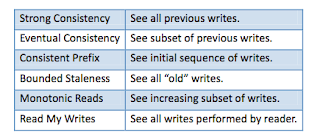
Replicated Data Consistency Explained Through Baseball

Image
I had mentioned this report in my first overview post about my sabbatical at Cosmos DB . This is a 2011 technical report by Doug Terry , who was working at Microsoft Research at the time. The paper explains the consistency models through publishing of baseball scores via multiple channels. (Don't worry, you don't have to know baseball rules or scoring to follow the example; the example works as well for publishing of, say, basketball scores.) Many consistency models have been proposed for distributed and replicated systems. The reason for exploring different consistency models is that there are fundamental tradeoffs between consistency, performance, and availability. While seeing the latest written value for an object is desirable and reasonable to provide within a datacenter, offering strong consistency  for georeplicated services across continents results in lower performance and reduced availability for reads, writes, or both. On the opposite end of the spectrum, with ...

Paper review: Measuring and Understanding Consistency at Facebook

Image
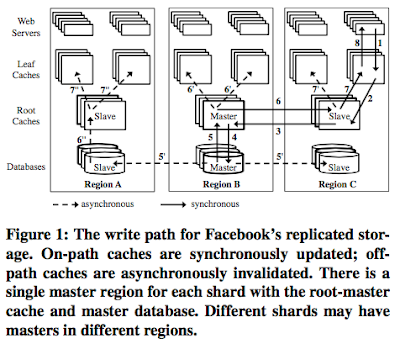
I have reviewed many Facebook papers in this blog before (see the links at the bottom for full list). Facebook papers are simple (in the good sense of the word) and interesting due to the huge scale of operation at Facebook. They are testaments of high scalability in practice. This one here is no different. This paper investigates the consistency of the Facebook TAO system. The TAO system is a replicated storage system for Facebook's social graph of billion vertices. In theory, TAO provides only eventual consistency. The interesting result in this paper is this: In practice, Facebook's TAO system is highly consistent, with only 5 inconsistency violations out of a million read requests! Facebook's TAO system TAO is basically 2-level memcached architecture backed by a database, as first discussed in NSDI'13 paper.  TAO architecture is given in Figure 1. As a prerequisite to TAO consistency discussion in the next section, it will be enough to review how TAO serves re...

Checking Causal Consistency of MongoDB

Image
This paper  declares the Jepsen testing of MongoDB for causal consistency a bit lacking in rigor, and goes on to test MongoDB against three variants of causal consistency (CC, CCv, and CM) under node failures, data movement, and network partitions. They also add TLA+ specifications of causal consistency and their checking algorithms, and verify them using the TLC model checker, and discuss how TLA+ specification can be related to Jepsen testing. This is a journal paper, so it is long. The writing could have been better. But it is apparent that a lot of effort went into the paper. One thing I didn't like in the paper was the wall-of-formalism around defining causal consistency in Section 2:Preliminaries. This was hard to follow. And I was upset about the use of operational definitions such as "bad patterns" for testing. Why couldn't they define this in a state-centric manner, as in the client-centric database isolation paper ? It turns out that Section 2 did not intr...

Paper review: Probabilistically Bounded Staleness for Practical Partial Quorums

Image
There is a fundamental trade-off between operation latency and data consistency in distributed database replication. The PBS paper (VLDB'12) examines this trade-off for partial quorum replicated data stores. Quorum systems We can categorize quorum systems into strict versus partial quorums. Strict quorum systems ensure strong consistency  by ensuring that read & write replica sets overlap: $R + W > N$. Here N is the total number of replicas in the quorum, R is the number of replicas that need to reply to a read query, and W is the number of replicas that need to reply to a write query. Employing partial quorums  can lower latency by requiring fewer replicas to respond, but R and W need not overlap: $R+W \leq N$. Such partial quorums offer eventual consistency . Here is a visual representation of an expanding quorum system. The coordinator forwards a write requests to all N replicas, and wait for W acknowledgements for responding back to the client for completi...

DDIA: Chp 5. Replication (Part 1)

Image
Chapter 5 of the Designing Data Intensive Applications (DDIA) book discusses strategies and challenges in replicating data across distributed systems. Replication is critical for ensuring data availability, fault tolerance, and scalability. One of the key challenges in replication is maintaining consistency across multiple replicas. Leader-based replication, the most common method, involves a single leader node accepting all writes, while follower nodes replicate the leader's changes. While single leader replication does not guarantee consistency readily (due to leader failover cornercases), it gives us a fighting chance. One primary advantage of leader-based replication is its simplicity: all write requests are serialized through the leader, ensuring a consistent order of operations. Followers receive a stream of changes (i.e., the replication log) from the leader and apply them in sequence, ensuring eventual consistency. However, replication lag, the delay between when a write i...

Popular posts from this blog

The Safest Job from AI may be Writing

The Two Abstractions of System Design: Hide or Reduce

The Agentic Self: Parallels Between AI and Self-Improvement

Learning about distributed systems: where to start?

Hints for Distributed Systems Design

Foundational distributed systems papers

Building a Database on S3

Cloudspecs: Cloud Hardware Evolution Through the Looking Glass

Specula: Scaling formal specifications for autonomous model checking of system code

What I'd do as a College Freshman in 2025