Posts

Tunable Consistency in MongoDB
Image
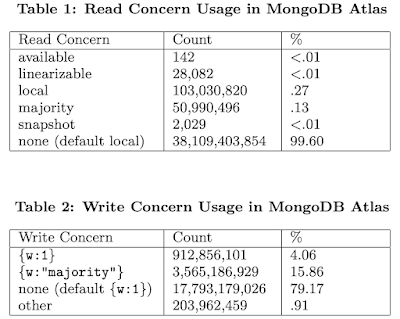
This paper appeared in VLDB 2019. It discusses the tunable consistency models in MongoDB and how MongoDB's speculative execution model and data rollback protocol enable this spectrum of consistency levels efficiently. Motivation Applications often tolerate short or infrequent periods of inconsistency, so it may not make sense for them to pay the high cost of ensuring strong consistency at all times. These types of trade-offs have been partially codified in the PACELC theorem . The Probabilistically Bounded Staleness work (and many followup work ) explored the trade-offs between operation latency and data consistency in distributed database replication and showcased their importance.  To provide users with a set of tunable consistency options, MongoDB exposes writeConcern and readConcern levels as parameters that can be set on each database operation. writeConcern specifies what durability guarantee a write must satisfy before being acknowledged to a client. Similarly, readConc...

Design and Analysis of a Logless Dynamic Reconfiguration Protocol

Image
This paper appeared in OPODIS'21 and describes dynamic reconfiguration in MongoDB. So, what is dynamic reconfiguration? The core Raft protocol implements state machine replication (SMR) using a static set of servers. ( Please read this to learn about how MongoDB adopted Raft for a pull-based SMR .) To ensure availability in the presence of faults, SMR systems must be able to dynamically (and safely) replace failed nodes with healthy ones. This is known as dynamic reconfiguration. MongoDB logless reconfiguration Since its inception, the MongoDB replication system has provided a custom, ad hoc, legacy protocol for dynamic reconfiguration of replicas. This legacy protocol managed configurations in a logless fashion, i.e., each server only stored its latest configuration. It decoupled reconfiguration processing from the main database operation log. The legacy protocol, however, was known to be unsafe in certain cases.  Revising that legacy protocol, this paper presents a redesigned saf...

Fault-Tolerant Replication with Pull-Based Consensus in MongoDB

Image
This paper, from NSDI 2021, presents the design and implementation of strongly consistent replication in MongoDB using a consensus protocol derived from Raft. Raft provides fault-tolerant state-machine-replication (SMR) over asynchronous networks. Raft (like most SMR protocols) uses push-based replication. But MongoDB uses pull-based replication scheme, so when integrating/invigorating MongoDB's SMR with Raft, this caused challenges. The paper focuses on examining and solving these challenges, and explaining the resulting MongoSMR protocol (my term, not the paper's).  The paper restricts itself to the strongest consistency level, linearizability, but it also talks about how serving weaker models interact/shape decisions made in MongoDB's replication protocol. The paper talks about extensions/optimizations of MongoDB SMR protocol, but I skip those for brevity. I also skip the evaluation section, and just focus on the core of the SMR protocol. Design Background Unlike conve...

Looking Back at Postgres

Image
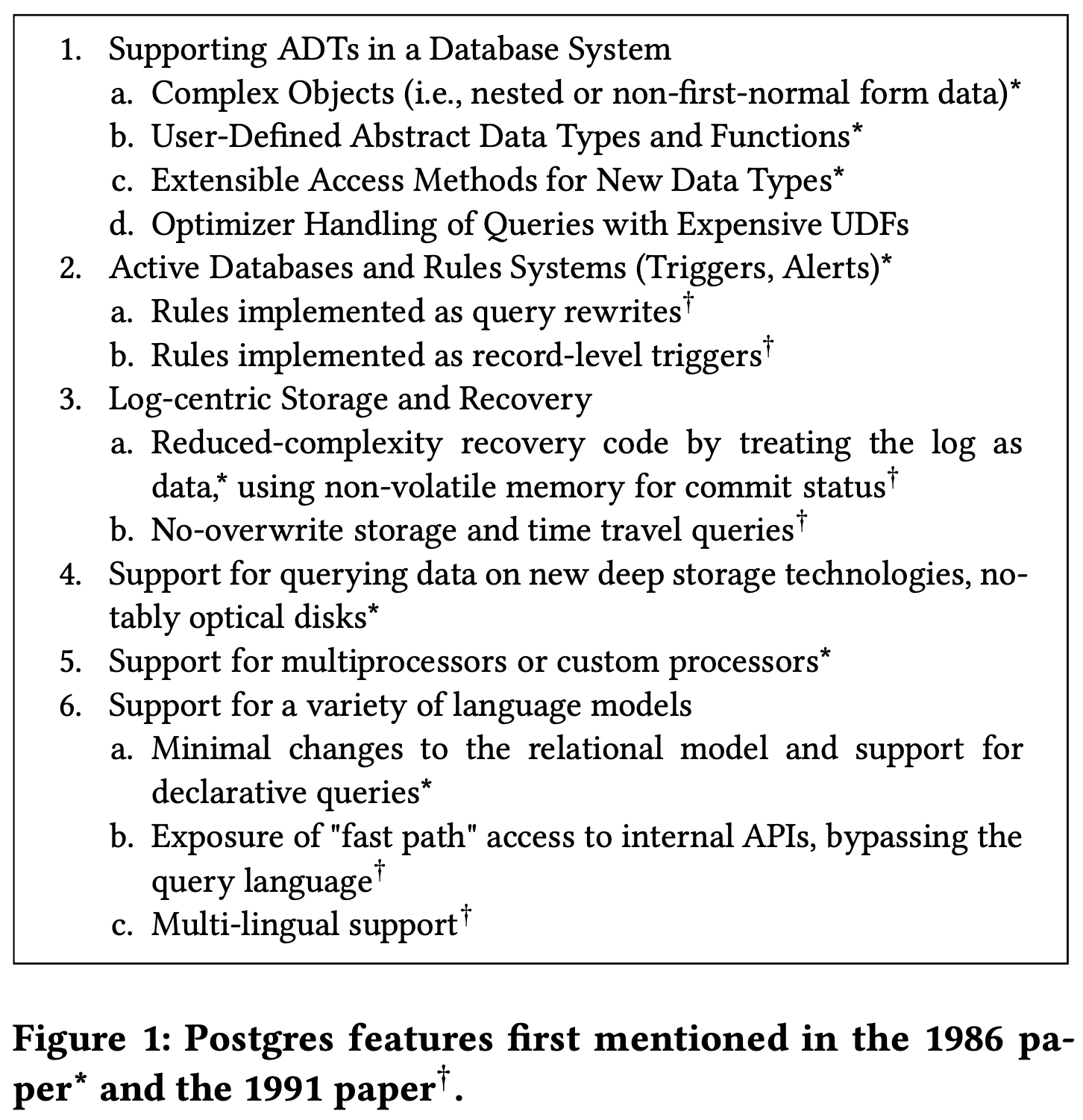
This is a 2019 article by Joe Hellerstein, the Jim Gray Professor of Computer Science at UC Berkeley. Last year at Sigmod, Joe was awarded the Ted Codd innovation award where he gave an awesome overview of his research agenda. This article, written to be included in Stonebraker’s Turing Award book, provides a retrospective on Postgres project, which Stonebraker led from the mid-1980’s to the mid-1990’s. I love this article a lot, because as I have written before, context is my crack : "The more context I know, the better I become able to locate something almost spatially, and the more I can make sense of it. Even reading the history and motivation for the subject can give my understanding a big boost." The entire paper is context, and it even has a section titled "Context", how cool is that? The footnotes on the article are also excellent! Very interesting gems there as well. Disclaimer: I use a lot of text from the article to summarize it. The features and the imp...

Scalable OLTP in the Cloud: What’s the BIG DEAL?

Image
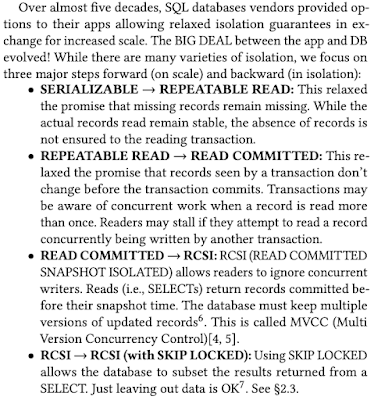
This paper is from Pat Helland, the apostate philosopher of database systems, overall a superb person, and a good friend of mine. The paper appeared this week at CIDR'24. (Check out the program for other interesting papers). The motivating question behind this work is: " What are the asymptotic limits to scale for cloud OLTP (OnLine Transaction Processing) systems? " Pat says that the CIDR 2023 paper "Is Scalable OLTP in the Cloud a Solved Problem?" prompted this question.  The answer to the question? Pat says that the answer lies in the joint responsibility of database and the application. If you know of Pat's work, which I have summarized several in this blog , you would know that Pat has been advocating along these lines before. But this paper provides a very crisp, specific, concrete answer. Read on for my summary of the paper. Disclaimer: This is a wisdom and technical information/detail packed 13-page paper, so I will try my best to summarize the sa...

Oblivious Paxos: Privacy-Preserving Consensus Over Secret-Shares

Image
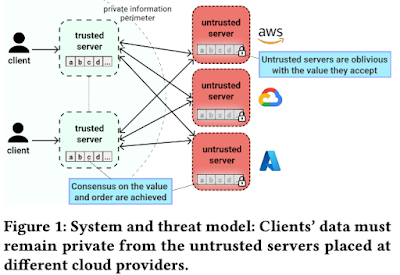
This paper appeared in SOCC'23. The paper presents a primary-backup secret-shared state machine (PBSSM) architecture and the associated consensus protocol, Oblivious Paxos (OPaxos). OPaxos enables privacy-preserving consensus by allowing acceptors to safely and consistently agree on a secret-shared value without untrusted acceptors knowing the value. OPaxos protocol overview OPaxos uses (t, n) threshold secret-sharing. This means generating n secret-shares from a single secret value such that it is possible to reconstruct the secret with just t shares. In order to make (t, n) threshold secret-sharing play well with Paxos, the protocol requires that the cardinality of the intersection of any phase1 quorum and phase2 quorum is larger than t.  This can be achieved by choosing the quorum size as (n+t)/2. More accurately,  one quorum (say phase1) would have cardinality as the ceiling of (n+t)/2, and the other quorum (phase2) would have cardinality as floor of this (n+t)/2. The ...

Dude, where's my Emacs?

It had been 3 years since I had to setup a new laptop. Past Murat had left me helpful instructions , but I got a bad surprise while configuring my Emacs setup. My beloved starter-kits, which worked smoothly under Emacs 27, stopped working under Emacs 29. I tried to fix the errors, but this proved futile due to my limited elisp/emacs skills.  I explored alternative starter-kits to configure Emacs. Doom emerged as the dominant choice, but it appeared large, bloated, and complex for my liking. I tried a couple small starter kits, but I faced other problems and was unable to integrate my customizations and get to a reasonable setup.  I am an Emacs user for 25 years, and I know a thing or two, but it seems everyone's now an Emacs pro. I don't get how people are able to accept and work with those complicated config files/directories. I started to speculate. Maybe the ordinary users left, leaving behind the proficient Emacs enthusiasts, who kept writing more and more intricate conf...

Popular posts from this blog

The Safest Job from AI may be Writing

The Two Abstractions of System Design: Hide or Reduce

The Agentic Self: Parallels Between AI and Self-Improvement

Learning about distributed systems: where to start?

Hints for Distributed Systems Design

Foundational distributed systems papers

Building a Database on S3

Cloudspecs: Cloud Hardware Evolution Through the Looking Glass

Specula: Scaling formal specifications for autonomous model checking of system code

What I'd do as a College Freshman in 2025