Posts

SIGMOD/PODS Day 2

Image
Yesterday I wrote about Day 1 , which was mostly PODS. Today the SIGMOD conference started and I had a fun packed day attending awesome talks.  Opening remarks The conference chairs, Sudipto Das and Ippokratis Pandis (both Amazonians), welcomed people. They said they were happy to get SIGMOD back to Seattle, the home of the clouds, after 25 years. They also noted that this is the first fully in-person SIGMOD conference post pandemic. The conference attracted 970 attendants! US based participants constituted 47% of the crowd, China 10%, Germany 8%. There were 660 submissions this year, which was up +20% from last year. There was a graph showing acceptance rates per topics, and I was to catch that transactions papers have more than 30% acceptance rate, and hardware papers more than 40%, both of which are above the average acceptance rate for the conference. They fed the keywords of the accepted papers to ChatGPT for fun, and got an abstract from ChatGPT. The title ChatGPT offered was...

SIGMOD/PODS Day 1

Image
This week I am attending the SIGMOD/PODS conference at Seattle . I am a bit out of my depth here, because I am a distributed systems person putting on a database hat. But so far, so good. I am happy to see that I am able to follow most talks well. I also enjoyed meeting and talking with many database people in coffee breaks and the receptions. Today, day 1, was the PODS conference. I thought PODS was like about storage systems, because you know, in US we see these PODS boxes that are used to pack/store and transport stuff. As I attended PODS talk after another and saw blocks of Greek symbols and formulas, it dawned on me to check what the acronym meant. Turns out PODS stands for "Symposium on Principles of Database Systems". Like its namesake "Principles of Distributed Computing (PODC)", PODS is also a theory conference. These two conferences use "principles" as a code word for theory, I guess. I don't see why that would be the case though, I like my p...

New directions in cloud programming

Image
This paper appeared in CIDR'21 . This paper is also on operationalizing CALM theorem, and is a good companion to the CALM-CRDT paper we covered yesterday. The paper starts by pointing out the challenges of cloud programmability. It says that most developers find it hard to harness the enormous potential of the cloud, and that the cloud has yet to provide a programming environment that exposes the inherent power of the platform. The paper then lays out an agenda for providing a new generation of cloud programming environment to programmers in an evolutionary fashion. I would like to start by challenging the claim that the cloud about not yet providing a noteworthy programming environment. I think there are many examples of successful cloud programming paradigms and frameworks that have emerged in the past decade, such as MapReduce, Resilient Distributed Datasets, Hadoop environment, Spark environment, real time data processing and streaming systems, distributed machine learning syst...

Keep CALM and CRDT On

Image
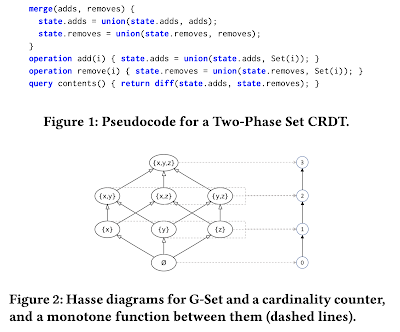
This paper is from VLDB'22. It focuses on the read/querying problem of conflict-free replicated data types (CRDTs). To solve this problem, it proposes extending CRDTs with a SQL API query model, applying the CALM theorem to identify which queries are safe to execute locally on any replica. The answer is of no surprise: monotonic queries can provide consistent observations without coordination. CRDTs To ensure replica consistency in distributed systems, a common method is to enforce strong consistency at the storage layer using traditional distributed coordination techniques such as consensus or transactions. However, for some applications this may create concerns about latency and availability (especially when a quorum is not readily available). Alternatively, developers can use weakly consistent storage models that don't require coordination, but they must ensure consistency at the application level. This is where CRDTs enter the picture, as they can provide a straightforward...

Open Versus Closed: A Cautionary Tale

Image
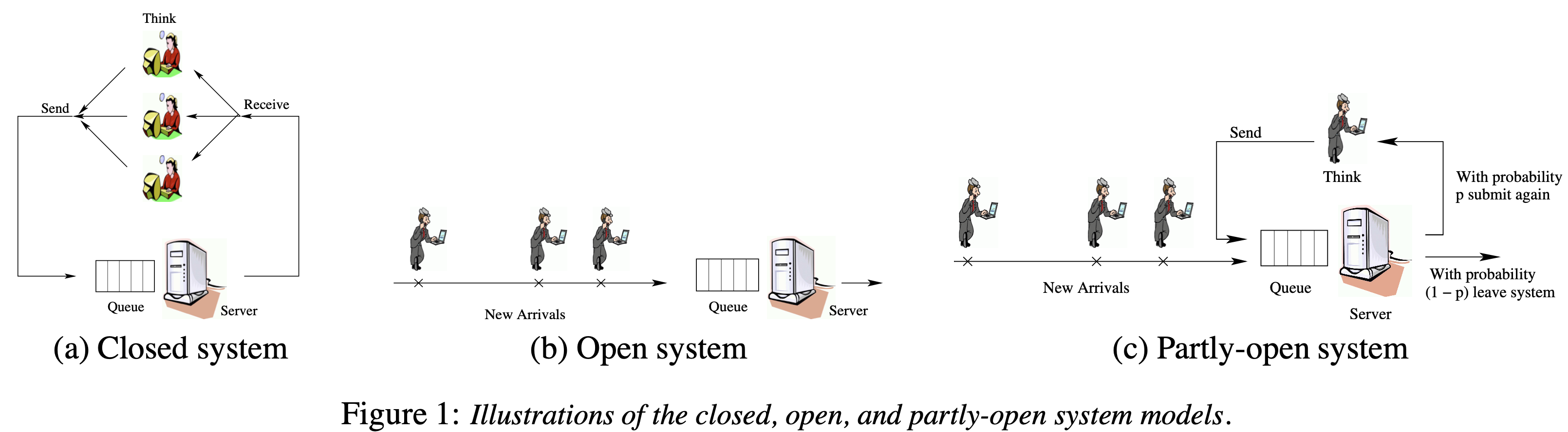
This paper appeared in NSDI'06 . It explores the behavior of open and closed system models. These two models differ in how they handle new job arrivals. In an open system model, new jobs arrive independently of job completions. In contrast, in a closed system model, new jobs are only triggered by job completions, followed by think time. The paper makes a basic but an important point that was missed by many people that were building workload generators and making system design decisions. In this sense this is a great demonstration of the thesis that "The function of academic writing is NOT to communicate your ideas, but to change the ideas of an existing community." The paper shows that while most workload generators model systems as closed systems, in reality the systems are closer to open systems, and conclusions drawn from closed model behavior of the systems do not translate to the performance of the systems in real-world settings.    Here is the gist of the idea. For ...

Empowering Azure Storage with RDMA

Image
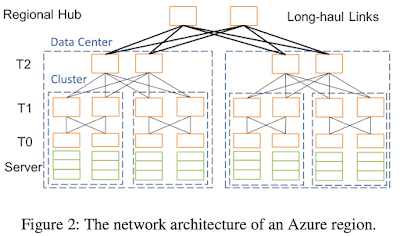
This paper appeared in Usenix'23 last week. The paper presents the experience of deploying across datacenter  (i.e., intra-region) Remote Direct Memory Access (RDMA) to support storage workloads in Azure. The paper reports that around 70% of traffic in Azure is RDMA and intra-region RDMA is supported in all Azure public regions. RDMA is a network technology that offloads the network stack to the network interface card (NIC) hardware. By allowing direct memory access from one computer to another without involving the OS or the CPU, RDMA helps achieve low latency, high throughput and near zero CPU overhead. This means that RDMA frees up CPU cores from processing networking packets, and allows Azure to sell these CPU cycles as customer virtual machines (VMs) or use for application processing. Although RDMA solutions have been around and being deployed at small scales for a decade now, the paper provides an experience report from a large production system, and talks about practical ch...

The end of a myth: Distributed transactions can scale

Image
This paper appeared in VLDB'17. The paper presents NAM-DB, a scalable distributed database system that uses RDMA (mostly 1-way RDMA) and a novel timestamp oracle to support snapshot isolation (SI) transactions. NAM stands for network-attached-memory architecture, which leverages RDMA to enable compute nodes talk directly to a pool of memory nodes. Remote direct memory access (RDMA) allows bypassing the CPU when transferring data from one machine to another. This helps relieve a major factor in scalability of distributed transactions: the CPU overhead of the TCP/IP stack. With so many messages to process, CPU may spend most of the time serializing/deserializing network messages, leaving little room for the actual work. We had seen this phenomena first hand when we were researching the performance bottlenecks of Paxos protocols. This paper reminds me of the "Is Scalable OLTP in the Cloud a Solved Problem? (CIDR 2023)" which we reviewed recently. The two papers share one ...

ARIES: A Transaction Recovery Method Supporting Fine-Granularity Locking and Partial Rollbacks

Image
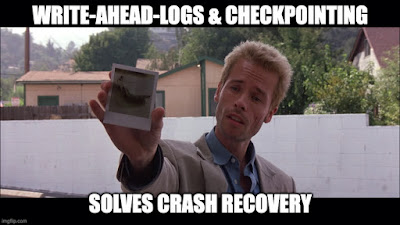
This paper is from IBM, 1992. This is a foundational paper in databases area. ARIES achieves long-running transaction recovery in a performant/nonblocking fashion. It is more complicated than simple (write-ahead-log) WAL-based per-action-recovery, as it needs to preserve the Atomicity and Durability properties for ACID transactions. Any transactional database worth its salt (including PostGres, Oracle, MySQL) implements recovery techniques based on the ARIES principles. "I have this condition... It's my memory." --From the movie Memento Background There is memory and there is disk (these days it is SSD, back in the old days it was a rotating hard disk). Memory is fast, but not persistent. Disk is durable, but slow. We want both fast and durable. We might execute and commit a transaction in-memory to achieve fast execution, but a committed transaction should also be durable. Flushing each transaction to the disk would add long I/O stalls before each commit. So it looks li...

Popular posts from this blog

The Safest Job from AI may be Writing

The Two Abstractions of System Design: Hide or Reduce

The Agentic Self: Parallels Between AI and Self-Improvement

In Search of a Compositional Theory of Self-Stabilization

Learning about distributed systems: where to start?

Hints for Distributed Systems Design

Foundational distributed systems papers

Building a Database on S3

Cloudspecs: Cloud Hardware Evolution Through the Looking Glass

Specula: Scaling formal specifications for autonomous model checking of system code