Posts

Paper summary. CORFU: A shared log design for flash clusters

Image
By: Mahesh Balakrishnan, Dahlia Malkhi, Vijayan Prabhakaran, Ted Wobber, Michael Wei, John D. Davis, Appeared in NSDI'2012 This paper applies VPaxos ideas (of using an auxiliary Paxos box for reconfiguration) and chain replication ideas in the context of Flash SSDs. The vision is that Corfu's novel client-centric design eliminates storage servers in favor of simple, efficient and inexpensive flash chips that attach directly to the network. The clients directly write to storage nodes, similar to what happens in Dynamo /Cassandra/ Voldemort replication, but linearizability is still guaranteed. Previously I had summarized the Tango paper, for maintaining distributed data structures over a shared log. Tango builds on the Corfu log abstraction. Corfu involves three main functions: A mapping function (maintained at the VPaxos box) from logical positions in the log to flash pages on the cluster of flash units A tail-finding mechanism (using a sequencer node) for finding t...
Dissecting performance bottlenecks of strongly-consistent replication protocols

Image
Dissecting performance bottlenecks of strongly-consistent replication protocols Ailidani Ailijiang, Aleksey Charapko, and Murat Demirbas. Hey, this is our paper! This appeared in Sigmod 2019 couple weeks back. This paper came out of the dissertation work of Ailidani Ailijiang . He has build the Paxi framework in Go, available on GitHub, to prototype any Paxos flavor quickly. His dissertation is called: "Strongly Consistent Coordination for Wide Area Networks".  Writing blog posts about one's own papers is harder than writing posts about others' papers. When you write a summary of your work, you want to include everything, and cannot detach yourself from specifics easily. I found that I neglected posting about many of our papers, even though it is important to provide brief and accessible summaries of these papers to enhance their reach. It is important to reach more people, because then we can see whether the paper can stand the test of time and push the state o...

Paxos jokes

Image
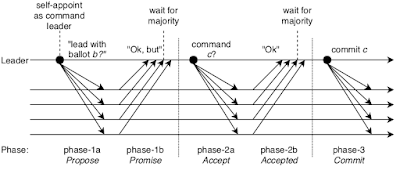
For some reason Aleksey finds any joke about Paxos hilarious, whereas Ailidani and I are indifferent to Paxos jokes. However, today out of nowhere I came up with some decent Paxos jokes, and shared them on Twitter.  In the evening I attended the USENIX ATC reception and shared these jokes with Benjamin Reed and Alexander Shraer of ZooKeeper  and ZooNet fame, and cracked them up. Here they are for perpetuity. It is a bad idea to explain jokes. But for pedantic purposes, and to get people interested in Paxos, I provide some explanations. Paxos jokes made simple... err.. moderately complex. I think the jokes get funnier if you read them in a Russian accent. So give that a try. Leader -  I tell you Paxos joke, if you accept me as leader. Quorum -  Ok comrade. Leader -  Here is joke! (*Transmits joke*) Quorum -  Oookay... Leader -  (*Laughs* hahaha). Now you laugh!! Quorum -  Hahaha, hahaha. The conversation corresponds to phase 1,...

Book review. Range: Why Generalists Triumph in a Specialized World

This is a very recent book, released on May 28, 2019. I got drawn to this book due to its interesting and controversial title: "Why Generalists Triumph in a Specialized World". The blurb about the book says: "If you take a closer look at the world's top performers, from professional athletes to Nobel laureates, you'll find that early specialization is the exception, not the rule. [David Epstein] discovered that in most fields--especially those that are complex and unpredictable--generalists, not specialists, are primed to excel. Generalists often find their path late, and they juggle many interests rather than focusing on one. They're also more creative, more agile, and able to make connections their more specialized peers can't spy from deep in their hyperfocused trenches. As experts silo themselves further while computers master more of the skills once reserved for highly focused humans, people who think broadly and embrace diverse experiences and per...

Is this consensus?

Image
The specification for consensus is as follows. The first two are safety properties, the last one a liveness property. Agreement : No two node can commit different decisions. Validity (Non-triviality) : If all initial values are same, nodes must commit that value. Termination : Nodes commit eventually. Below I talk about whether ABD or chain replication solve consensus, and whether it would be possible to implement state machine replication using them. Does ABD solve consensus? No, ABD does not solve consensus. I had written a summary of the ABD protocol in a 2012 post.  And I had talked about why ABD is not consensus in a 2015 post. Below is a short recap of that followed by a discussion of whether ABD can still be employed to solve the state machine replication problem. Consensus is prone to the FLP impossibility result, and it may lose progress under FLP conditions. In particular, for Paxos, if we can't determine whether the incumbent leader has failed in an asynch...

Book review. Loonshots: How to nurture the crazy ideas that win wars, cure diseases, and transform industries

Image
This book, by Safi Bahcall , is about how to nurture radical breakthroughs in science and technology. The book draws inspiration from the innovations Vannevar Bush made possible Office of Scientific Research and Development (OSRD), created in 1941, and the innovations Theodore N. Vail enabled at Bell. OSRD's portfolio of accomplishments is impressive indeed. The war against Nazis is won through superiority in the field of science . The bombers' microwave radar cut through darkness and fog to detect German U-Boats, and rendered them ineffective in a matter of weeks. The book compiles insights from the organizational principles Bush and Vail employed as Bush-Vail rules. The main concept here is of a dynamic equilibrium, where the organization maintains well-separated and equally strong loonshot and franchise groups (phase separation) continuously exchanging projects and ideas in both directions. Summary of the The Bush-Vail rules 1. Separate the phases separate you...

Paper summary. Cloud programming simplified: A Berkeley view on Serverless Computing

Image
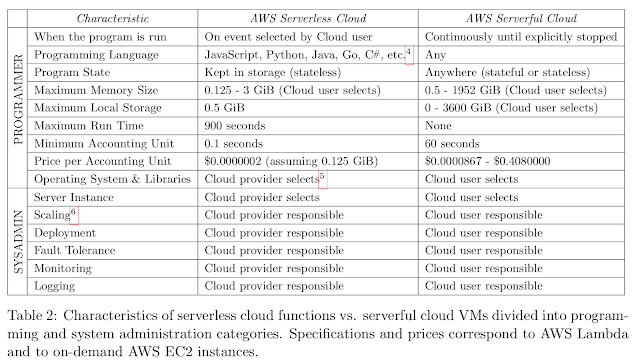
This position paper by UC Berkeley RISE lab is about serverless computing, its shortcomings, and its potential. It is easy reading, and is still useful even if you have a pretty good understanding about serverless computing due to some insights and forecasts in the paper. As you will read below, the paper provides a very strong endorsement for serverless computing. Instead of explaining the paper in my terms, I quote some of my highlights from the paper below, and at the end, in the MAD questions section, I discuss some of my thoughts on serverless computing. Introduction We believe the main reason for the success of low-level virtual machines was that in the early days of cloud computing users wanted to recreate the same computing environment in the cloud that they had on their local computers to simplify porting their workloads to the cloud. To set up your own environment in cloud (using virtual machines), you need to address these 8 issues. Redundancy for availability, ...

Popular posts from this blog

The Safest Job from AI may be Writing

The Two Abstractions of System Design: Hide or Reduce

The Agentic Self: Parallels Between AI and Self-Improvement

In Search of a Compositional Theory of Self-Stabilization

Learning about distributed systems: where to start?

Hints for Distributed Systems Design

Foundational distributed systems papers

Building a Database on S3

Cloudspecs: Cloud Hardware Evolution Through the Looking Glass

Specula: Scaling formal specifications for autonomous model checking of system code