Posts

Paper summary. Cloud programming simplified: A Berkeley view on Serverless Computing
Image
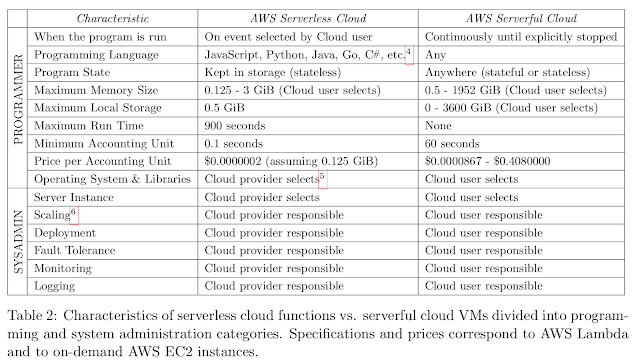
This position paper by UC Berkeley RISE lab is about serverless computing, its shortcomings, and its potential. It is easy reading, and is still useful even if you have a pretty good understanding about serverless computing due to some insights and forecasts in the paper. As you will read below, the paper provides a very strong endorsement for serverless computing. Instead of explaining the paper in my terms, I quote some of my highlights from the paper below, and at the end, in the MAD questions section, I discuss some of my thoughts on serverless computing. Introduction We believe the main reason for the success of low-level virtual machines was that in the early days of cloud computing users wanted to recreate the same computing environment in the cloud that they had on their local computers to simplify porting their workloads to the cloud. To set up your own environment in cloud (using virtual machines), you need to address these 8 issues. Redundancy for availability, ...

Paper summary. Scalable Consistency in Scatter

Image
Here is the pdf for the paper.  It is by Lisa Glendenning, Ivan Beschastnikh, Arvind Krishnamurthy, and Thomas Anderson, Department of Computer Science & Engineering University of Washington. This paper is about peer-to-peer (P2P) systems. But the paper is from 2011, way after the P2P hype had died. This makes the paper more interesting, because it had the opportunity to consider things in hindsight. The P2P corpse was cold, and Dynamo had looted the distributed hash tables (DHT) idea from P2P and applied it in the context of datacenter computing.  In return, this work liberates the Paxos coordination idea from the datacenter world and employs it in the P2P world. It replaces each node (or virtual node) in a P2P overlay ring with a Paxos group that consists of a number of nodes. Ok, what problem do Paxos groups solve in the P2P systems? In the presence of high churn, DHTs in P2P systems suffer from inconsistent routing state and inconsistent name space partitioni...

Book Notes. Steal Like an Artist: 10 Things Nobody Told You About Being Creative

Image
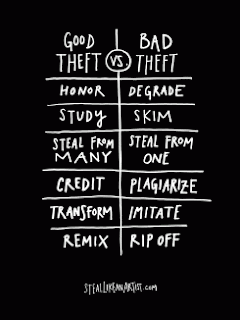
This book is by Austin Kleon, 2012. I had also wrote about his other book "Show Your Work! 10 Ways to Share Your Creativity and Get Discovered."  Here are the 10 things nobody told you about being creative: Steal like an artist. Don’t wait until you know who you are to get started. Write the book you want to read. Use your hands. Side projects and hobbies are important. The secret: do good work and share it with people. Geography is no longer our master. Be nice. (The world is a small town.) Be boring. (It’s the only way to get work done.) Creativity is subtraction. Kleon gave a short TEDX talk about the idea behind this book. The title is an homage to a quote attributed to Picasso: “ Good artists  borrow,  great artists  steal.” Picasso also said: "Art is theft." It’s not  just  where you take things from, it's where you take them to. Here are some parts I highlighted under Section 1: "steal like an artist." Every artist gets asked...

Book Notes. Creativity, Inc.: Overcoming the Unseen Forces That Stand in the Way of True Inspiration

This book is by Ed Catmull, cofounder of Pixar, with Amy Wallace, 2014. The book is about the cultivation and management of creativity: If Pixar is ever successful, will we do something stupid, too? Can paying careful attention to the missteps of others help us be more alert to our own? Or is there something about becoming a leader that makes you blind to the things that threaten the well-being of your enterprise?  I would devote myself to learning how to build not just a successful company but a sustainable creative culture. As I turned my attention from solving technical problems to engaging with the philosophy of sound management, I was excited once again. While reading the book, I was impressed by how many questions Ed kept asking. I thought I was asking a lot of questions , but Ed is really really into asking questions and using them to achieve focus. Here are some parts I highlighted from the book. From childhood to PhD Growing up in the 1950s, I had yearned to be ...

Azure Cosmos DB: Microsoft's Cloud-Born Globally Distributed Database

Image
It has been almost 9 months since I started my sabbatical work with the Microsoft Azure Cosmos DB team.  I knew what I signed up for then, and I knew it was overwhelming. It is hard not to get overwhelmed. Cosmos DB provides a global highly-available low-latency all-in-one database/storage/querying/analytics service to heavyweight demanding businesses. Cosmos DB is used ubiquitously within Microsoft systems/services, and is also one of the fastest-growing services used by Azure developers externally. It manages 100s of petabytes of indexed data, and serves 100s of trillions of requests every day from thousands of customers worldwide, and enables customers to build highly-responsive mission-critical applications. But I underestimated how much there is to learn about, and how long it would be to develop a good sense of the big picture. By "developing a good sense of the big picture", I mean learning/internalizing the territory myself, and, when looking at the terrain, bei...

Book Notes. Show Your Work! 10 Ways to Share Your Creativity and Get Discovered, by Austin Kleon

I recently read this book on Kindle. I really liked this short book, and in general, Austin Kleon's work. These are my notes, without context. A new way of operating But it’s not enough to be good. In order to be found, you have to be findable. I think there’s an easy way of putting your work out there and making it discoverable while you’re focused on getting really good at what you do. Almost all of the people I look up to and try to steal from today, regardless of their profession, have built sharing into their routine. These people aren’t schmoozing at cocktail parties; they’re too busy for that. They’re cranking away in their studios, their laboratories, or their cubicles, but instead of maintaining absolute secrecy and hoarding their work, they’re open about what they’re working on, and they’re consistently posting bits and pieces of their work, their ideas, and what they’re learning online. Instead of wasting their time “networking,” they’re taking advantage of the net...

Popular posts from this blog

The Safest Job from AI may be Writing

The Two Abstractions of System Design: Hide or Reduce

The Agentic Self: Parallels Between AI and Self-Improvement

In Search of a Compositional Theory of Self-Stabilization

Learning about distributed systems: where to start?

Hints for Distributed Systems Design

Foundational distributed systems papers

Building a Database on S3

Cloudspecs: Cloud Hardware Evolution Through the Looking Glass

Specula: Scaling formal specifications for autonomous model checking of system code