Posts

Book review. How to write a lot: A practical guide to productive academic writing

This book is by Paul J. Silvia, a psychology professor.  This book provides a great prescription to enable academics to write more. And let's be frank we all should be writing more. I give this little book to my graduate students so they get a healthy perspective on writing, an integral part of a researcher's job description, before they develop bad habits and PTSD from bad experiences with writing. The book prescribes simple straightforward solutions to the writing woes. It has a no BS, let's get to business attitude. It gives some practical writing style advice as well, but if you need more help on developing a good writing/composition style, you should also look into other books, such as "Elements of Style", and on "Writing Well". Here are some selected pieces from the book. I recommend the book to all struggling academic writers. On finding time to write (page 12) You have a teaching schedule, and you never miss it. If you think that writin...

Paper summary. Step by Step Towards Creating a Safe Smart Contract: Lessons and Insights from a Cryptocurrency Lab

Image
This paper , on our seminar reading list, was our first real intro to the "smartcontracts", so we liked that the paper was written to be very accessible. A smart contract is a program that is executed by all miners and its outputs incorporated to the blockchain. A contract consists of program code, a storage file, and an account balance. The program code of a contract is fixed when the contract is created, and cannot be changed. The contract's code is executed whenever it receives a message from a user or from another contract. While executing its code, the contract may read from or write to its storage file. The contract's storage file is stored on the public blockchain. A contract can also receive money into its account balance, and send money to other contracts or users. A contract's entire state is visible to the public. Ethereum uses the concept of "gas" (bought by currency) to discourage over-consumption of resources. During the execution o...

Book review. Crypto: How the code rebels beat the government---saving privacy in the digital age.

In graduate school, I had read "Hackers: Heroes of the Computer Revolution" from Steven Levy and enjoyed it a lot. (I still keep the dog eared paper copy with affection.) So, I should have read Steven Levy's Crypto book a long time ago. But for some reason, I didn't...even though I was aware of the book. I guess that was due to a stupid quirk of mine; I had some aversion to the security/cryptography research. I don't know why. Maybe it was because I had sat through a couple of bad security/cryptography talks ( a similar aversion happened to me after a bad networking course ). Another reason, I regret to admit, may be that I had some distributed systems snobbery going on that time. I was so into the distributed systems/algorithms area that I was quick to label AI, security, and this, and that as uninteresting or useless *to me*. I wish I could have been more open minded. I am sure reading this book then would have changed my outlook toward security and cryptograp...

Notes from USENIX NSDI Days 2 & 3

Before talking about Days 2 & 3, here are my notes from NSDI day 1 if you are interested. Again all of the papers mentioned (and omitted) below are accessible publicly at the NSDI web page . Enjoy! NSDI day 2  Day 2 had the following sessions: web and video performance isolation and scaling congestion control cloud Here are the papers I took detailed notes on. I ordered them by how interesting I found them. Towards Battery-Free HD Video Streaming This paper is by Saman Naderiparizi, Mehrdad Hessar, Vamsi Talla, Shyamnath Gollakota, and Joshua R Smith, University of Washington. This work was mind blowing for me. This is a strong group that has developed the Wisp motes before, but even then the presented battery-free video streaming sensors was very impressive and the talk included a live demo of them. So here is the deal. The goal of this work is to design sticker form factor, battery-free cameras. But that is crazy right? Video streaming is power hungry...

Notes from USENIX NSDI 18 First Day

I have been attending USENIX NSDI, one of the premier conferences on networking, at Seattle, WA. Here are some notes from the first day, Monday, April 9. Pre-session announcements NSDI has 40 papers accepted out of 255 papers. There was a mention of 1000 reviews done for the conference. That is a lot of reviews by very highly qualified people. It is a shame those reviews are not shared openly, those reviews could be really useful for the community to learn from, and providing them may also expose if there were any sub-par reviews. There is a movement for open review process, and I hope it catches on at a wider scale. The best paper is awarded to " NetChain: Scale-Free Sub-RTT Coordination " by  Xin Jin, Johns Hopkins University; Xiaozhou Li, Barefoot Networks; Haoyu Zhang, Princeton University; Nate Foster, Cornell University; Jeongkeun Lee, Barefoot Networks; Robert Soulé, Università della Svizzera italiana; Changhoon Kim, Barefoot Networks; Ion Stoica, UC Berkeley. ...

The Stellar Consensus Protocol: A Federated Model for Internet-level Consensus

Image
Last week in our seminar we discussed the Stellar consensus paper. The paper is long, 32 pages. It looks like the paper is written the way the protocol is conceived and reasoned about. First comes a section on the federated Byzantine agreement (FBA) model, which talks about quorum slices and the quorums that result from them. The next section talks about the requirements for quorum intersections, and defines the dispensable sets with associated theorems. Then comes the federated voting section, with subsections titled:  Voting with open membership, Blocking sets, Accepting statements, Accepting is not enough, Statement confirmation, and Liveness and neutralization. On page 19, the Stellar Consensus Protocol (SCP) section starts, with more definitions and the proofs intertwined with the protocol description. At this point, the reader is already overwhelmed, trying to maintain in his mind theories about how the previous 19 pages might connect back to this protocol, and is confront...

Book review: Last lecture by Randy Pausch

Image
Of course you have watched the late Prof. Randy Pausch's last lecture. If for some reason you haven't, please right that wrong now. I recently read the book "Last Lecture" by Randy Pausch. I got the book from my local library, yes, a physical library building. They still exist, and they are a great resource. It is a short book, and I have a very brief review. The book does not repeat the "last lecture" presentation. It tells mostly disjoint and complementary story, and it gets into more personal stuff. I learned several more interesting anectodes about Randy in this book. It is of course a very heartbreaking story. The book is a "memento mori". It makes you think about "What would you want to be known for?" and "How would you prioritize your life if you had 5 years left?" I am still thinking about those long after I returned the book to the library. I am currently reading about "Crypto: How the Code Rebels B...

Master your tools

Image
Couple months ago, a friend sent me this article about "Speed learner Max Deutsch challenging chess grandmaster Magnus Carlsen".  My friend called the story a life-hack story, and remarked that this is the "Silicon Valley bro" frame of mind in action: "Nobody deserves any respect because I am so confident and valley savvy I could naturally write an app and do it better". This was my reply on the article. This is a very nice illustration of a hack versus expert: Expert had years of battle-scar, and internalized everything. Hacks/shortcuts are going to take you only to where the expert's domain starts. Also another take away is, we humans are dumb. We don't have anything to be proud of about our mental prowess. I make so many stupid mistakes every week, it is frustrating. It is a shame we can't get much smarter on the spot. But in the offline mode (doing research/thinking by writing), I think we can do better. We can only make up for the sho...

Replying to why decentralization matters

Last month Chris Dixon published "Why decentralization matters" . I felt it was one-sided and lacked solid arguments. I picked up some populist vibes as well. "There go my people. I must find out where they are going, so I can lead them." --Alexandre Auguste Ledru-Rollin At that time, I had jotted down my criticisms to some of the paragraphs in that article in my draft posts folder. Then I saw Todd Hoff's (from High Scalability fame) brief write up about the article . It captures nicely my reactions to the article. So I will start with Todd's response and cover only the remaining parts of my criticisms in the rest of this post. "Nerds always dream of decentralization, I certainly do, but every real world force aligns on the side of centralization. We still have NAT with IPv6! Ironically, the reason given why decentralization will win is exactly why it won't: "Decentralized networks can win the third era of the internet for the same reas...

Blockchain applications in Supply Chain Management

Image
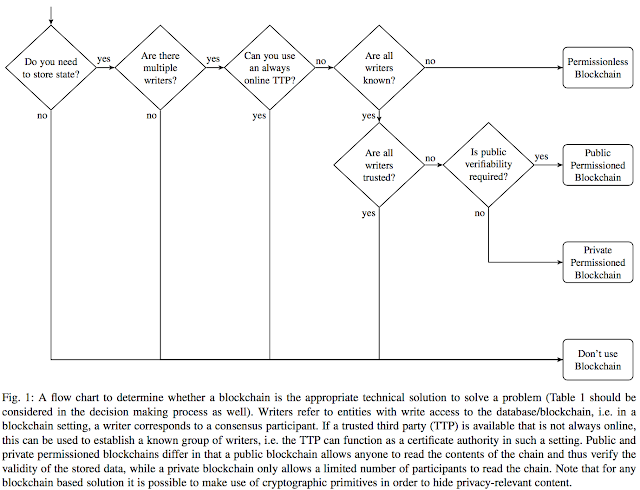
Here is the whitepaper that started this  post, which is admittedly outside my domain of expertise. Also here is some discussion we had on this on Twitter.  The white paper includes quotes like "7 in 10 consumer industry executives expect to have a blockchain production network in 3 years" and "Blockchains are expected to greatly reduce nine frictions. Including: inaccessible marketplaces, restrictive regulations, institutional inertia, invisible threats, imperfect information, inaccessible information." Man, if that last statement is true, the companies should just employ blockchain and fire their CEO's and management teams as they are no longer needed. Blockchain is a miracle worker indeed. It enters inaccessible marketplaces, it loosens restrictive regulations, eliminates institutional inertia, makes visible the invisible threats (watchout ninjas), corrects/curates the imperfect information, and makes all information accessible. I know that I tend to g...

Popular posts from this blog

The Safest Job from AI may be Writing

The Two Abstractions of System Design: Hide or Reduce

The Agentic Self: Parallels Between AI and Self-Improvement

In Search of a Compositional Theory of Self-Stabilization

Learning about distributed systems: where to start?

Hints for Distributed Systems Design

Foundational distributed systems papers

Building a Database on S3

Cloudspecs: Cloud Hardware Evolution Through the Looking Glass

Specula: Scaling formal specifications for autonomous model checking of system code