Posts

Paper Summary. Proteus: agile ML elasticity through tiered reliability in dynamic resource markets

Image
This paper proposes an elastic ML system, Proteus, that can add/remove transient workers on the fly for exploiting the transient availability of cheap but revocable resources in order to reduce costs and latency of computation. The paper appeared in Eurosys'17 and is authored by Aaron Harlap, Alexey Tumanov, Andrew Chung, Gregory R. Ganger, and Phillip B. Gibbons. Proteus has two components: AgileML and BidBrain. AgileML extends the parameter-server ML architecture to run on a dynamic mix of stable and transient machines, taking advantage of opportunistic availability of cheap but preemptible AWS Spot instances. BidBrain is the resource allocation component that decides when to acquire and drop transient resources by monitoring current market prices and bidding on new resources when their addition would increase work-per-dollar. Before delving into AgileML and BidBrain, let's first review the AWS Spot model. See Spot run AWS provides always available compute instances,...

Paper summary. Distributed Deep Neural Networks over the Cloud, the Edge, and End Devices

Image
This paper is by Surat Teerapittayanon, Bradley McDanel, and H.T. Kung at Harvard University and appeared in ICDCS'17.  The paper is about partitioning the DNN for inference between the edge and the cloud. There has been other work on edge-partitioning of DNNs, most recently the Neurosurgeon paper. The goal there was to figure out the most energy-efficient/fastest-response-time partitioning of a DNN model for inference between the edge and cloud device.  This paper adds a very nice twist to the problem. It adds an exit/output layer at the edge, so that if there is high-confidence in classification output the DNN replies early with the result, without going all the way to the cloud and processing the entire DNN for getting a result. In other words, samples can be classified and exited locally at the edge when the system is confident and offloaded to the cloud when additional processing is required. This early exit at the edge is achieved by jointly training a single DNN ...

Paper summary. Gaia: Geo-Distributed Machine Learning Approaching LAN Speeds

Image
This paper appeared in NSDI'17 and is authored by Kevin Hsieh, Aaron Harlap, Nandita Vijaykumar, Dimitris Konomis, Gregory R. Ganger,  Phillip B. Gibbons, and Onur Mutlu.  Motivation This paper proposes a framework to distribute an ML system across multiple datacenters, and train models at the same datacenter where the data is generated. This is useful because it avoids the need to move big data over wide-area networks (WANs), which can be slow (WAN bandwidth is about 15x less than LAN bandwidth), costly (AWS does not charge for inside datacenter communication but charges for WAN communication), and also prone to privacy or ownership concerns. Google's Federated Learning also considered similar motivations, and set out to reduce WAN communication. It worked as follows: 1) smartphones are sent the model by the master/datacenter parameter-server,  2) smartphones compute an updated model based on their local data over some number of iterations, 3) the updated models a...

Paper summary. OpenCL Caffe: Accelerating and enabling a cross platform machine learning framework

Image
This 2016 paper presents an OpenCL branch/port of the deep learning framework Caffe . More specifically, this branch replaces the CUDA-based backend of Caffe to an open standard OpenCL backend. The software was first located at https://github.com/amd/OpenCL-caffe , then  graduated to https://github.com/BVLC/caffe/tree/opencl . Once we develop a DNN model, we ideally like to be able to deploy it for different applications across multiple platforms (servers, NVDIA GPUs, AMD GPUs, ARM GPUs, or even over smartphones and tablets) with minimum developing efforts. Unfortunately, most of the deep learning frameworks (including Caffe) are integrated with CUDA libraries for running on NVIDIA GPUs, and that limits portability across multiple platforms. OpenCL helps for portability of heterogenous computing across platforms  since it is supported by a variety of commercial chip manufacturers: Altera, AMD, Apple, ARM Holdings, Creative Technology, IBM, Imagination Technologies, Intel,...

Retroscope: Retrospective Monitoring of Distributed Systems (part 2)

Image
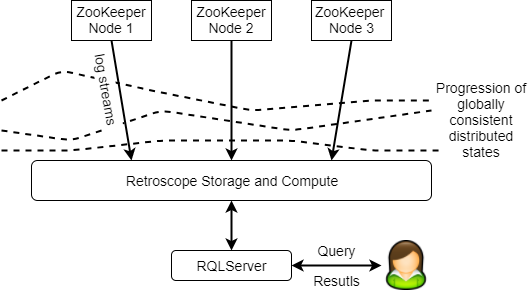
This post, part 2, focuses on monitoring distributed systems using Retroscope. This is a joint post with Aleksey Charapko . If you are unfamiliar with hybrid logical clocks and distributed snapshots, give part 1 a read first. Monitoring and debugging distributed applications is a grueling task. When you need to debug a distributed application, you will often be required to carefully examine the logs from different components of the application and try to figure out how these components interact with each other. Our monitoring solution, Retroscope, can help you with aligning/sorting these logs and searching/focusing on the interesting parts. In particular, Retroscope captures a progression of globally consistent distributed states of a system and allows you to examine these states and search for global predicates. Let’s say you are working on debugging ZooKeeper, a popular coordination service. Using Retroscope you can easily add instrumentation to the ZooKeeper nodes to log and ...

Web Data Management in RDF Age

Image
This was the keynote on ICDCS'17 Day 2, by Tamer Ozsu. Below are my notes from his talk. The slides for his presentation are available here. Querying web data presents challenges due to lack of a schema, its volatility, and its sheer scale. There have been several recent approaches to querying web data, including XML, JSON, and fusion tables. This talk is about another approach to maintaining and querying web data: RDF and SPARQL. This last one is the recommended way by W3C (World Wide Web Consortium) and is a building block for semantic web and Linked Open Data (LOD) . Here is a diagram denoting the LOD datasets and links between them as of 2014. Resource Description Framework (RDF) In RDF, everything is a uniquely named resource (URI). The ID for Jack Nicholson's resource is JN29704. Resources have defined attributes: y:JN29704 hasName = "Jack Nicholson", y:JN29704 BornOnDate = "1937-04-22". The relationships with other resources can be defined via ...

Gratitude

The other day I had taken my little daughter to the library. There was a lady tutoring his son. The boy was slightly over-active and argumentative. He was wearing a wool Buffalo hat. It was warm in the library, so that seemed out of place. It was also strange that the boy, who is around 7-8 years old, was not in school at this time of the day. But I can't put 2 and 2 together. I assumed that the lady is home-schooling the boy. Since I was interested about how home-schooling works (what works and what not), I asked her about it. (Although I am a shy introvert, I am not shy from asking people questions when I am curious about something. That is a little oddity I have.) She said she was not homeschooling, but her son missed a lot of classes, so she was trying to help him catch up. At that moment, I notice the thick book she was reading: "CANCER"! My heart sank. I tried to seem upbeat though. I asked the boy his name, Nicholas, and wished him best of luck with his studies...

Paper summary. Untangling Blockchain: A Data Processing View of Blockchain Systems

Image
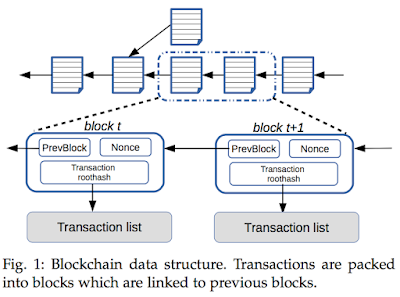
This is a recent paper submitted to arxiv (Aug 17, 2017).  The paper presents a hype-free, very accessible, yet technical  survey on blockchain. It takes a data-processing centric view of blockchain technology, treating  concurrency issues and efficiency of consensus as first class citizens in blockchain design. Approaching from that perspective, the paper  tries to forge a connection with blockchain technologies and distributed transaction processing systems. I think this perspective is promising for grounding the blockchain research better. When we connect a new area to an area with a large literature, we have opportunities to compare/contrast and perform efficient OODA loops . Thanks to this paper, I am finally getting excited about blockchains. I had a huge prejudice about blockchains based on the Proof-of-Work approach being used in BitCoin. Nick Szabo tried to defend this huge inefficiency, citing that it is necessary for attestation/decentralized/etc, but th...

Retrospective Lightweight Distributed Snapshots Using Loosely Synchronized Clocks

Image
This is a summary of our recent work that appeared at ICDCS 2017 . The tool we developed, Retroscope (available on GitHub), enables unplanned retrospective consistent global snapshots for distributed systems. Many distributed systems would benefit from the ability to take unplanned snapshots of the past. Let's say Alice notices alarms going off for her distributed system deployment at 4:05pm. If she could roll-back to the state of the distributed system at 4:00pm, and roll forward step by step to figure out what caused the problems, she may be able to remedy the problem. The ability to take retrospective snapshots requires each node to maintain a log of state changes and then to collate/align these logs to construct a consistent cut at a given time. However, clock uncertainty/skew among nodes is dangerous and can lead to taking an inconsistent snapshot. For example, the cut at 4:00pm in this figure using NTP is inconsistent, because event F is included in the cut, but causally...

Paper summary: Performance clarity as a first-class design principle (HOTOS'17)

Image
This paper appeared in HOTOS'17 and is by Kay Ousterhout, Christopher Canel, Max Wolffe, Sylvia Ratnasamy, and Scott Shenker. (The team is at UC Berkeley Christopher is now at CMU.) The paper argues that performance clarity is as important a design goal as performance or scalability. Performance clarity means ease of understanding where bottlenecks lie in a deployment and the performance implications of various system changes. The motivation for giving priority to performance clarity arises from the performance opaqaness of distributed systems we have, and how hard it is to configure/tune them to optimize performance. In current distributed data processing systems, a small change in hardware or software configurations may cause disproportional impact on performance. An earlier paper, Ernest, showed that selecting an appropriate cloud instance type could improve performance by 1.9× without increasing cost. And when things run slowly in a deployment, it is hard to determine whe...

Dhalion: self-regulating stream processing in Heron (VLDB'17)

Image
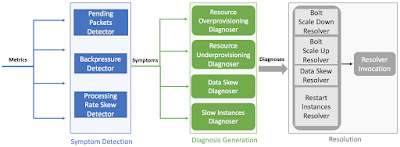
This paper appeared in VLDB'17 , and is by Avrilia Floratou (Microsoft), Ashvin Agrawal (Microsoft), Bill Graham (Twitter), Sriram Rao (Microsoft), and Karthik Ramasamy (Streamlio).   Dhalion aims to further reduce the complexity of configuring and managing Heron streaming applications. It provides a self-tuning/self-correcting extension to Heron to monitor, diagnose, and correct problems with the deployment. (Dhalion is named after a mythical bird with interesting healing capabilities. ) It turns out there are only 4-5 category of things that can (is likely to) go wrong in a Heron deployment. ( I had summarized Heron earlier here. ) The detectors and diagnosers in Dhalion check for them. The resolver as a result tries one of these corresponding 4-5 correction actions. And the effectiveness of the correctors are then rated. Yes, you heard it right, instead of guaranteed-to-work correctors, Dhalion rates the correctors' effectiveness and decides what to try next. "Af...

Cloud fault-tolerance

Image
I had submitted this paper to SSS'17. But it got rejected. So I made it a technical report and am sharing it here. While the paper is titled "Does the cloud need stabilizing?", it is relevant to the more general cloud fault-tolerance topic. I think we wrote the paper clearly. Maybe too clearly. Here is the link to our paper :  https://www.cse.buffalo.edu//tech-reports/2017-02.pdf (Ideally I would have liked to expand on Section 4. I think that is what we will work on now.) Below is an excerpt from the introduction of our paper, if you want to skim that before downloading the pdf. ------------------------------------------------------------------------- The last decade has witnessed rapid proliferation of cloud computing. Internet-scale webservices have been developed providing search services over billions of webpages (such as Google and Bing), and providing social network applications to billions of users (such as Facebook and Twitter). While even the smallest ...

Popular posts from this blog

The Safest Job from AI may be Writing

The Two Abstractions of System Design: Hide or Reduce

The Agentic Self: Parallels Between AI and Self-Improvement

In Search of a Compositional Theory of Self-Stabilization

Learning about distributed systems: where to start?

Hints for Distributed Systems Design

Foundational distributed systems papers

Building a Database on S3

Cloudspecs: Cloud Hardware Evolution Through the Looking Glass

Specula: Scaling formal specifications for autonomous model checking of system code