Posts

Dijkstra's stabilizing token ring algorithm
Image
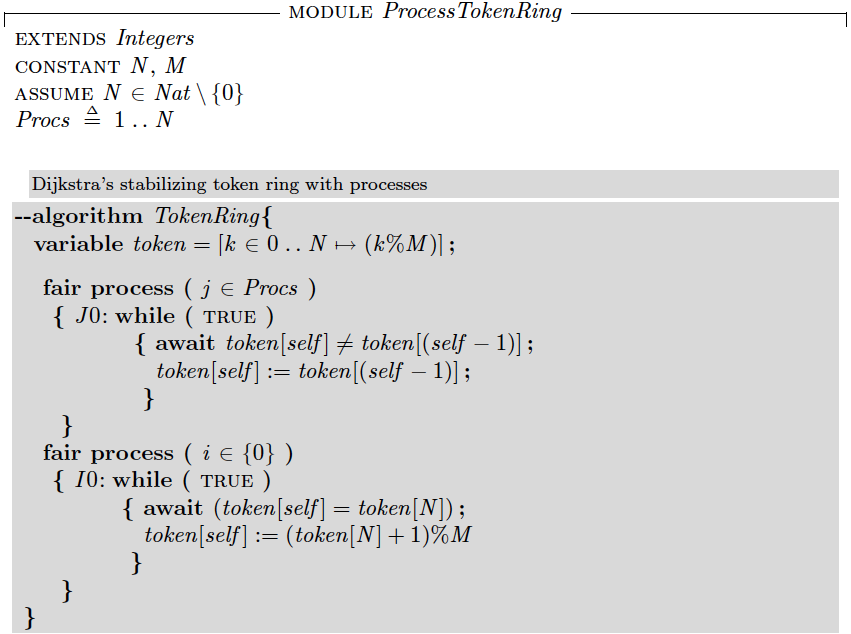
One of the classical algorithms I teach in my distributed systems class is Dijkstra's stabilizing token ring algorithm. This algorithm has started the self-stabilization field as a subfield of fault-tolerance. And, it still receives interest even after 40 years. There has been probably hundreds of self-stabilization papers that revisits Dijkstra's stabilizing token ring algorithm as part of a solution or as part of a case study. This algorithm never gets old for me as well. I still enjoy talking about this algorithm in class and thinking about it once in a while. I guess this is because it is a very elegant algorithm. Linked is Dijkstra's original paper introducing the algorithm. This paper also includes two variants of the stabilizing token ring algorithm, 3-state and 4-state token ring algorithms. Dijkstra would later do a followup writeup, titled, "A belated proof of self-stabilization" , where he gave a proof of stabilization for 3-state token ring progra...

My Distributed Systems Seminar reading list for Spring 2015

Below is the list of papers I plan to discuss in my distributed systems seminar this semester. If you have some suggestions on other good/recent papers to cover, please let me know in the comments. Perspectives on the CAP Theorem Consistency, availability, and convergence. Salt: combining ACID and BASE in a distributed database Extracting More Concurrency from Distributed Transactions Eidetic Systems Simple Testing Can Prevent Most Critical Failures: An Analysis of Production Failures in Distributed Data-Intensive Systems The Mystery Machine: End-to-end Performance Analysis of Large-scale Internet Services All File Systems Are Not Created Equal: On the Complexity of Crafting Crash-Consistent Applications GraphX: Graph Processing in a Distributed Dataflow Framework Architecture of a database system Arrakis: The Operating System is the Control Plane Fast Databases with Fast Durability and Recovery Through Multicore Parallelism Project Adam: Building an Efficient and Scala...

My experience with using TLA+ in distributed systems class

Image
I used TLA+ in my distributed system class in Fall 2014. ( To learn the backstory on this, read my pre-semester TLA+ post. ) In short, I loved the experience and I am hooked. Integrating TLA+ to the class gave students a way to get a hands-on experience in algorithms design and correctness verification. Even for a sophisticated algorithm, such as Paxos, I can refer the students to TLA+ to practice and play with the algorithm, so they can internalize what is going on. Throughout the semester as I had more chance to work with TLA+, I started growing a library of TLA+ modeling of distributed algorithms. Next time I teach the class, I hope to provide the students with a TLA+ model of each algorithm I cover in the class. The student feedback was also positive. The students liked TLA+ since it gave them a way to experiment and supported them in reasoning about the algorithms. Several students complained of the learning curve. They wanted me to cover TLA+ in more detail in the class. (The...

Google Cloud Messaging (GCM): An evaluation

Image
I had written about our work on building a crowdsourced superplayer for the "Who wants to be a millionaire (WWTBAM)" quiz show earlier. In that work we developed an Android app that enabled the app users in Turkey to participate in WWTBAM in real time as the show was airing on TV. When a question was read by the show host, my PhD students typed the question and the multiple-choice options, which were transmitted via Google Cloud Messaging (GCM) to the app users. App users played the game, and enjoyed competing with other app users, and we got a chance to collect precious data about MCQA dynamics in crowdsourcing. Our app was downloaded 300K+ times, and at the peak of its popularity 20K participants played the game simultaneously. We used GCM to send the questions to the participants because we wanted to keep the app simple. GCM is the default push messaging solution for the Android platform and is maintained by Google as a free service with no quotas. GCM allows app develo...

Paper Summary: Granola, Low overhead distributed transaction coordination

Image
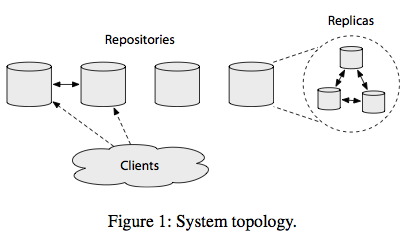
This paper is by Cowling and Liskov, and it appeared at Usenix ATC'12.  Most closely related papers to this paper are the Sinfonia and Calvin papers. So, it may be helpful to also read the summaries of those papers from the links above to familiarize yourself with them. This paper looks at coordination of 1-round transactions, which are different from general transactions that involve multi-round interaction with the client. 1-round transactions execute at the participant nodes, with no communication with other nodes except for at most a single commit/abort vote. Figure 1 shows the system architecture. The clients are the transaction managers for these 1-round transactions. They initiate transactions and evaluate the commit/conflict/abort decisions returned for the transactions. The repositories communicate with one another (for at most a single commit/abort vote) to coordinate transactions. There are 2 types of transactions in Granola: coordinated ones, and uncoordinat...

Paper Summary: Calvin, Distributed transactions for database systems

Calvin is a transaction scheduling and replication management layer for distributed storage systems. By first writing transaction requests to a durable, replicated log, and then using a concurrency control mechanism that emulates a deterministic serial execution of the log's transaction requests, Calvin supports strongly consistent replication and fully ACID distributed transactions, and manages to incur lower inter-partition transaction coordination costs than traditional distributed database systems. Calvin emphasizes modularity. The holy trinity in Calvin is: log, scheduler, executor. When a client submits a transaction request to Calvin, this is immediately appended to a durable log, before any actual execution begins. Calvin's scheduling mechanism then processes this request log, deciding when each transaction should be executed in a way that maintains an invariant slightly stronger than serializable isolation: Transaction execution may be parallelized but must be equiva...

Paper Summary: Coordination Avoidance in Database Systems

Image
Serializing transactions is sufficient for correctness, but it is not necessary for all operations of all applications. The downside of serialization is that it kills scalability and is overkill in many cases. This paper (which will appear in VLDB'15) has the following insight: Given knowledge of application transactions and correctness criteria (i.e., invariants), it is possible to avoid this over-coordination of serializability and execute some transactions without coordination while still preserving those correctness criteria (invariants). In particular the authors propose the concept of "invariant confluence" to relax the use of serialization for some operations of a coordination-requiring application. By operating on application-level invariants over database states (e.g., integrity constraints), the invariant confluence analysis provides a necessary and sufficient condition for safe, coordination-free execution. When programmers specify application invariants,...

Clock-SI: Snapshot Isolation for Partitioned Data Stores Using Loosely Synchronized Clocks

Image
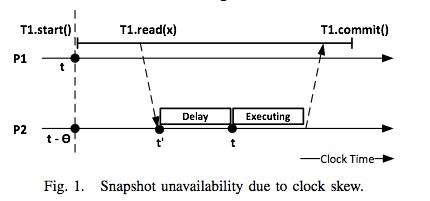
This paper appeared in SRDS 2013, and is concerned with the snapshot isolation problem for distributed databases/data stores. What is snapshot isolation (SI)? (I took these definitions almost verbatim from the paper.) SI is a multiversion concurrency control scheme with 3 properties: 1) Each transaction reads from a consistent snapshot, taken at the start of the transaction and identified by a snapshot timestamp. A snapshot is consistent if it includes all writes of transactions committed before the snapshot timestamp, and if it does not include any writes of aborted transactions or transactions committed after the snapshot timestamp. 2) Update transactions commit in a total order. Every commit produces a new database snapshot, identified by the commit timestamp. 3) An update transaction aborts if it introduces a write-write conflict with a concurrent committed transaction. Transaction T1 is concurrent with committed update transaction T2, if T1 took its snapshot before T2 comm...

Facebook's software architecture

Image
I had summarized/discussed a couple papers ( Haystack , Memcache caching ) about Facebook's architecture before. Facebook uses simple architecture that gets things done. Papers from Facebook are refreshingly simple, and I like reading these papers. Two more Facebook papers appeared recently, and I briefly summarize them below. TAO: Facebook's distributed data store for the social graph (ATC'13) A single Facebook page may aggregate and filter 100s of items from the social graph. Since Facebook presents each user with customized content (which needs to be filtered with privacy checks) an efficient, highly available, and scalable graph data store is needed to serve this dynamic read-heavy workload. Before Tao, Facebook's web servers directly accessed MySql to read or write the social graph, aggressively using memcache as a look aside cache (as it was explained in this paper) . The Tao data store implements a graph abstraction directly. This allows Tao to avoid...

Paper Summary: A self-configurable geo-replicated cloud storage system

Image
This paper is a followup work to the Pileus work, which I had covered here . Pileus aimed to help developers find a suitable consistency/latency combination for their application deployment. In Pileus, the configuration of primary and secondary nodes is assumed to be fixed (some storage nodes are designated as primary nodes, which hold the master data, while others are secondary nodes). The developer uses an SLA to state ranked preferences for latency and consistency of the reads that would make most sense for the application, and using this SLA, Pileus provides dynamic tuning of the performance of the application by deciding which read to forward to which replica/master. This paper introduces a followup system, called Tuba, where the configuration is not fixed, and can be changed on the fly. Tuba extends Pileus to address the problem of finding an optimal configuration of primary and secondary replicas that maximizes the overall utility and minimizes the cost for the application. ...

Consistent snapshot analogies

Image
Last week I taught distributed snapshot in my CSE 586: Distributed Systems class. While I teach snapshot, I invariably find myself longing for analogies to provide some intuition about this concept. The global state captured by a distributed snapshot ( say using Lamport/Chandy marker algorithm ) does not correspond to the "state of the system at initiation of the snapshot". Furthermore, it also may not correspond to a "state of the system from initiation to current state during this computation". This is because while the snapshot taking is progressing in the system, the underlying system computation is also proceeding and changing the state of the system progressively. (Distributed snapshot is not allowed to stop/freeze underlying system computation as that reduces availability.) For those curious about the question, "what good is a snapshot then?": The snapshot captures a reachable state from initiation state, and from the snapshot state the current st...

Paper Summary: High-availability distributed logging with BookKeeper

Image
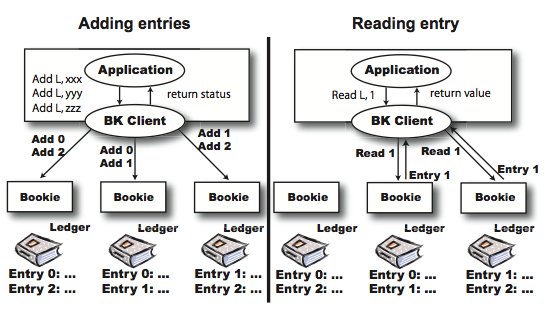
This paper is brought to you by the Yahoo Research group that developed the ZooKeeper, and it appeared in LADIS'12 . BookKeeper targets the logging problem. More specifically, the distributed logging problem where high-availability is important and where many distributed clients are interested in reading the logs. Most current applications log to the local disk, but this constitutes a single point of failure (SPOF) and betrays high-availability. A hasty remedy is to write to an NFS partition to store log files remotely. But now the NFS server becomes the SPOF. (We can of course replicate the NSF server, but the performance would suffer.) Another solution is to use NetApp filers that implement RAID. This costs money, and still does not completely solve SPOF. BookKeeper provides a no-SPOF efficient data store  for serving a large number of concurrent single-writer, multiple-reader logs. It stripes log entries across servers, leading to higher throughput. BookKeeper is opensour...

Popular posts from this blog

The Safest Job from AI may be Writing

The Two Abstractions of System Design: Hide or Reduce

The Agentic Self: Parallels Between AI and Self-Improvement

In Search of a Compositional Theory of Self-Stabilization

Learning about distributed systems: where to start?

Hints for Distributed Systems Design

Foundational distributed systems papers

Building a Database on S3

Cloudspecs: Cloud Hardware Evolution Through the Looking Glass

Specula: Scaling formal specifications for autonomous model checking of system code