Posts

Lessons from giant-scale services

This is a 2001 paper by Eric Brewer summarizing the lessons he learned from designing and developing giant-scale internet services ( see Inktomi ) between 1995-2001. This paper does not mention the CAP theorem at all! This is very surpising given that CAP theorem is what Brewer is famous to most people in the internet services domain. (CAP theorem is very famous and has been very influential for the design of Internet services and cloud computing systems. CAP theorem was first mentioned in publication in 1998 paper , and then presented in PODC'00 keynote by Brewer. See these two posts for a detailed treatment of the CAP theorem.) Instead this paper is all about DQ principle as a design guideline for internet services. The paper mentions Harvest and Yield which may be seen as finer granularity versions of Consistency and Availability respectively, and may connect back to the CAP theorem. I discuss that connection at the end. DQ principle In the web services model, clie...

Hints for computer system design, ACM-OS'83

Image
My seminar on cloud computing systems has started today with two papers. Here is the summary of the first paper we covered in the seminar. Designing a computer system is very different from designing an algorithm: The external interface (that is, the requirement) is less precisely defined, more complex, and more subject to change. The system has much more internal structure, and hence many internal interfaces. The measure of success is much less clear. In this 1983 paper , Butler Lampson gives hints for computer system design based on his experience on building several systems in Xerox PARC labs. It is amazing how relevant and how fresh these hints are after 30 years of their publication. While these hints were not specifically targeting distributed systems design, several of these hints are applicable (and widely used) for cloud computing systems. Most of the text below is verbatim copied from the paper. I omitted about half of the hints, and details/justifications about the...

Crash-only software, HOTOS'03

Here is the summary for the second paper we covered in the first class of our seminar. The paper has a provocative title, and in fact there is a wikipedia entry on this title : "Crash-only software refers to computer programs that handle failures by simply restarting, without attempting any sophisticated recovery. Correctly written components of crash-only software can microreboot to a known-good state without the help of a user. Since failure-handling and normal startup use the same methods, this can increase the chance that bugs in failure-handling code will be noticed..." (We had previously seen this observation in the last section of Ousterhout's "The role of distributed state" paper .) Motivation Since crashes are unavoidable, software must be at least as well prepared for a crash as it is for a clean shutdown. But then --in the spirit of Occam's Razor-- if software is crash-safe, why support additional, non-crash mechanisms for shutting down? A frequ...

My Spring'11 Seminar on Cloud Computing

I am offering a seminar on Cloud Computing this semester. Below is the list of papers I plan to discuss in the seminar. I have also put up a course webpage here . If you have some suggestions on other good/recent papers to cover, please let me know in the comments. (My colleague, Tevfik Kosar , who joined the department this semester, is also offering a seminar on Data Intensive Scientific Discovery . He will be posting his reading list soon, in the meanwhile, here is a link to his 2006 seminar reading list . ) WEEK 1 Hint for Computer System Design, ACM OS'83 [Systems] Crash-Only Software, HotOS 2003 [Systems] WEEK 2 The role of distributed state, 1991 [Filesystems] Harvest, Yield, and Scalable Tolerant Systems, HOTOS'99 [Architectures] WEEK 3 Serverless network filesystems, ACM ToCS'96 [Filesystems] A History of the Virtual Synchrony Replication Model, Replication'10 [Replication] WEEK 4 SEDA: An Architecture for Highly Concurrent Server Applications, SOSP...

CRDTs: Consistency without concurrency control

Image
This paper appeared in ACM SIGOPS Operating Systems Review in April 2010. One of the authors on this paper is Marc Shapiro. We have previously discussed the "optimistic replication" survey by Shapiro here . (If you haven't read that survey, you should take a moment now to fill this gap. I'll wait.) This paper is also related to optimistic replication. Recall that there are two approaches to replication due to the CAP theorem . One approach insists on maintaining a strong consistency among replicas and requires consensus for serializing all updates on the replicas. Unfortunately this approach does not scale beyond a small cluster. The alternative, optimistic replication, ensures scalability by giving up consistency guarantees, however in the absence of consistency, application programmers are faced with overwhelming complexity. Yes, for some applications eventual consistency may suffice, but even there "complexity and consensus are hiding under a different guis...

Case for RAMClouds: Scalable High-Performance Storage Entirely in DRAM

Image
I wrote about Ousterhout's "The Role of Distributed State" work before. This review is for his recent work on RAMClouds, which appeared in SIGOPS Operating Systems Review . This paper makes a case for keeping all the data in the RAM over distributed nodes in a datacenter. "A RAMCloud is not a cache like memcached and data is not stored on an I/O device, as with flash memory: DRAM is the permanent home for data." Obviously, storing everything in RAM would yield a very high-throughput (the paper mentions 100-1000x) and very low-latency (again the paper mentions 100-1000x) system compared to disk-based systems. However, the primary reason the authors are excited about RAMCloud is the following: "RAMCloud will simplify the development of large-scale Web applications by eliminating many of the scalability issues that sap developer productivity today." The motivation for RAMCloud is to provide a general-purpose storage system that scales far beyond existing...

Finding a Needle in Haystack: Facebook's Photo Storage

Image
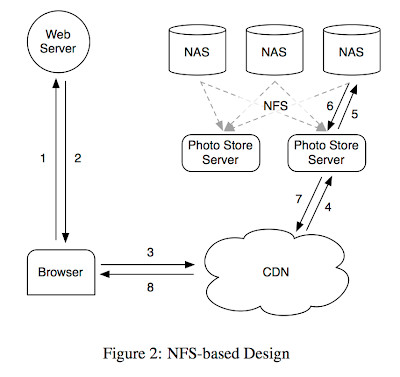
This paper appeared in OSDI'10. The title "Finding a needle in Haystack" is a bit over-dramatization :-) Finding a needle in Haystack becomes straightforward if you can memorize the location of each needle in the haystack. And that is exactly what Facebook Haystack system does. Haystack is an object store for sharing photos on Facebook where data is written once, read often, never modified, and rarely deleted. Haystack storage system was designed because traditional filesystems perform poorly under the Facebook workload. While using network attached storage (NAS) appliance mounted over NFS, several disk operations were necessary to read a single photo: one (or typically more) to translate the filename to an inode number, another to read the inode from disk, and a final one to read the file itself. While insignificant on a small scale, multiplied over billions of photos and petabytes of data, accessing metadata becomes the throughput bottleneck. Haystack aims to...

Boxwood: Abstractions as the foundation for storage infrastructure

Image
This paper is by Microsoft Research, and appeared in OSDI'04. This review will mostly be a stream of conciousness, because I have not yet understood all of the paper and cannot put it in context as much as I would like to. While reading in to the Boxwood paper, I started to notice how similar this is getting to the GFS problem and GFS approach . Boxwood appeared at OSDI'04, and GFS appeared at SOSP'03. Boxwood refers to GFS but does not compare or contrast itself with GFS. Maybe the reason is in 2004 the Boxwood authors could not see the similarities. This could be because, as I mentioned in my GFS review , the GFS paper did not talk about the Paxos replication of the master chunk-manager in the 2003 paper; that came a couple years later in the Chubby and Paxos-made-live papers. When citing GFS, the Boxwood authors only state that GFS "will be layered over the facilities of Boxwood". But, that is impractical as it would be duplicating a lot of the services; GFS ...

Popular posts from this blog

The Safest Job from AI may be Writing

The Two Abstractions of System Design: Hide or Reduce

The Agentic Self: Parallels Between AI and Self-Improvement

In Search of a Compositional Theory of Self-Stabilization

Learning about distributed systems: where to start?

Hints for Distributed Systems Design

Foundational distributed systems papers

Building a Database on S3

Cloudspecs: Cloud Hardware Evolution Through the Looking Glass

Specula: Scaling formal specifications for autonomous model checking of system code