Posts

Paxos taught

In my previous posts I have alluded a couple of times to how I teach Paxos. Here I will explain how I go about teaching Paxos. These are the slides I use in class. (In my slides I reuse a lot of material from the lecture slides of Jeff Chase (Duke) . He shared his slides with me under the Creative Commons license, where I get to remix/change the contents with proper credit to him.) Paxos is a protocol for solving distributed consensus. The problem is easy to state. Consensus requires the following three properties. The first two are safety properties, the last one is a liveness property. Agreement: No two process can commit different decisions. Validity (Non-triviality): If all initial values are same, nodes must commit that value. Termination: Nodes commit eventually. I first start with a discussion of impossibility results in consensus. A major impossibility result is the coordinated attack (aka two generals) paradox . The result states that there is no determi...
Speculative Execution in a Distributed File System

Image
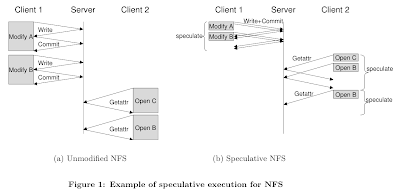
This SOSP'05 paper is about optimization techniques for client server distributed computing model, especially focusing on distributed file systems. In distributed filesystems, providing strong cash-consistency among concurrently editing clients require several synchronization messages to be exhanged between the clients and the server. Network delays, especially in wide area networks, make this unfeasibly slow. In fact AFS and NFS sacrifice consistency guarantees for speed, and provide weaker consistency guarantees such as close-to-open consistency where a client that opens the file see modifications by clients that have previously closed the file. Even these weaker consistency guarantees require synchronizing with the server and introduce latencies. Can distributed file systems be safe, consistent, yet fast? The paper states that it is possible to achieve this by using operating system support for lightweight checkpointing and speculative execution. The idea is simple. The main rea...

Live migration of virtual machines

This is a 2005 paper by the same group at Cambridge that developed the Xen virtualization system discussed in the previous post . This review will be short since it is only based on the notes I took while listening to the paper presentation in the seminar. Live virtual machine (VM) migration is the relocation of a VM from one machine to another while its applications continue to execute. The motivation for live migration is to perform load management across machines and even across data centers. Another motivation is fault-tolerance, if the original host needs to go down due to faults, maintenance, or power outage, migration can provide availability of the applications running on the hosted VMs. The challenges with live migration of VMs is to minimize the downtime and to provide a seamless relocation of the VM so the VM can continue to operate normally in its new address. One strawman for migrating the contents of VM memory is the stop-and-copy approach. This approach leads to a ...

Xen and the art of virtualization

Image
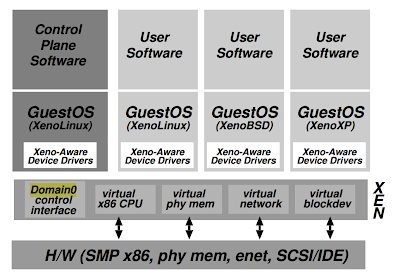
This week in the seminar class we discussed the Xen virtualization paper from SOSP 2003. Xen is the first open source virtualization solution, however, Vmware was already available in 2000 as a commercial solution for virtualization. A virtual machine (VM) is a software implementation of a machine (i.e. a computer) that executes instructions like a physical machine. The biggest benefit of virtualization is in server consolidation: enabling efficient usage of computer server resources in order to reduce the total number of servers that an organization requires. Thanks to the virtualization's ability to separate the OS and application from the hardware, it becomes possible to run multiple applications (in complete isolation from each other) on each server instead of just one application per server. This increases the utilization rate of servers and prevents the problem of "server sprawl", a situation in which multiple, under-utilized servers take up more space and resou...

Mencius: building efficient replicated state machines for Wide-Area-Networks (WANs)

I will write my short summary of the Mencius paper from OSDI08 here. Writing this helped me understand a couple subtle points better, so I hope it will also help others. Replicated state machines is a common approach for achieving fault-tolerance. State machine replication works by replicating the state and function across multiple servers (replicas) and using consensus to agree on the sequence of the commands the replicas execute. Assuming deterministic service, since all replicas execute the same sequence of commands, they all keep the same state, and strong consistency guarantees are provided to the face of server failures. Paxos is a fault-tolerant implementation of replicated state machines. Paxos has become hugely popular because it is the only formally proven protocol that works in the face of asynchronous model. Paxos preserves safety (no incorrect decisions are taken by replicas) to the face of violations of timing assumptions on the channels and servers. Paxos satisfies prog...

Future of powerpoint presentations

This Ted talk reminded me of a dream I had. In that dream, hundreds of soldiers are being shipped into a big empty convention center room, and they are being deployed into lines that are only a meter across from other enemy combatant soldiers. Between these two combatant lines there are some soil bags lined up, but the height of these bag blocks is only waist level. Everyone is so serious, this is war, so they take these deployment instructions very seriously. Nobody wants to make a mistake. After the deployment is finished, the commander is supposed to announce start, and soldiers are supposed to start firing at each other. I wake up before this happens. This is pure madness and terror. I felt disturbed by this very visual image for many days. But if you think about it, this was pretty much how WW1 and WW2 were in abstract. I think that deployment would make a really good performance art project. It is both abstract and concrete(visual) at the same time. It drives the point home. It ...

Rethinking Enterprise Network Control

This post will cover three closely related papers together: Rethinking Enterprise Network Control NOX: Towards an Operating System for Networks OpenFlow: Enabling Innovation in Campus Networks These papers are all about simplifying the job of the network administrators, that is, that of monitoring and enforcing policies over a large network. Existing approaches for network administration are hard to implement and maintain. One of these approaches is using middleboxes at network chokepoints (e.g., firewalls). Another is adding functionality to networks (e.g., using diagnostic tools, controls for VLANs, access-control lists, filters). These papers advocate the use of an omniscient central controller to simplify the implementation and enforcing of policies and simplifying network equipment. The papers argue that despite its centralized nature, the controller has good scalability in this approach. The three objectives of this approach are: 1) Network should be governed by policies declar...

The Chubby Lock Service for Loosely-Coupled Distributed Systems, Burrows, OSDI 2006

I didn't read this paper before class, because I thought I had read it earlier. It turns out I hadn't and I was confusing it with the "Paxos Made Live" PODC 2007 paper. I realized this only towards the middle of the class :-) The "Paxos Made Live" paper focused on the Paxos consensus implementation that makes the state replication and availability work in Chubby. In contrast, this Chubby Lock Service paper focuses only on the lock service part and is very client-centric. It is the need and uses cases of the clients (i.e., the programmers in Google) that has dictated the design of the service and the interfaces, and even the presentation of the paper. Chubby serves course grain locks rather than fine-grained locks to keep the load light. The paper mentions that the primary goal is to provide reliability/availability and thruput/storage are secondary goals. Chubby uses Paxos for consistent state replication among the five machines in the Chubby cell. The det...

The Google File System, Ghemawat et al., SOSP 2003

Image
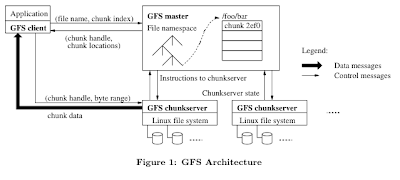
The motivation for the GFS arised because the traditional filesystems didn't fit the bill for Google's use cases: Firstly, failures are continual (i.e., always happening) since Google has thousands of machines. Secondly, multi-GB files are common in Google due to mapreduce jobs. (Though, the paper does not mention mapreduce at all, the mapreduce paper appeared the next year in 2004.) And finally, again due to mapreduce, in Google's use cases file access is read/append mostly, random writes are very rare. (For mapreduce jobs, it was more important to have a high sustained bandwidth than low latency atomic appends.) The GFS architecture is very simple (to the credit of the designers). Clients talk to a single master to get a handle on the chunk to read/write, and then using the handle clients pull/push the data to the chunkservers. Chunks are replicated over (by default) three chunkservers, one of which is designated as a primary replica by the master. So the master in fact ...

The Design and Implementation of a Log-Structured File System

by Rosenblum, Mendel and Ousterhout, John K. SOSP 1991. PDF link for the paper The motivation for the log-structured filesystem (LFS) are threefold. 1) Traditional file systems (say UNIX FAST filesystem) perform poorly for write. FAST requires 6 writes to create a new one block file. 2) Main memory caching capacity is increasing, which takes care of reads, so the workloads to disks are dominated by writes. And this is bad, see above. 3) There is a large gap between random and sequential i/o performance. Random is dominated by seeking time (which is very costly), whereas you avoid the seek time with sequential i/o. The LFS idea is simple: focus on write performance and utilize sequential bandwidth of disks. Here is how it works. LFS buffers all writes into a segment in main memory. (Even though the writes may be for different files, they are appended into the segment.) When the segment is full, LFS writes the segment to unused place on disk sequentially again. Since LFS writes sequentia...

Pig Latin: A Not-So-Foreign Language for Data Processing

I will be honest, I haven't read the week-3 papers. But this does not stop me from writing a short summary of the Pig Latin paper based on the notes I took during its class discussion. So I apologize if there is a mistake in my review. (The second week-3 paper was the Dryad: Distributed Data-Parallel Programs from Sequential Building Blocks. Unfortunately we had little time to discuss this paper, and I also had to leave early. So no review for that paper. I didn't understand much, so I will just paraphrase from its abstract "A Dryad application combines computational vertices with communication channels to form a dataflow graph. Dryad runs the application by executing the vertices of this graph on a set of available computers, communicating as appropriate through files, TCP pipes, and shared-memory FIFOs.") Pig Latin: A Not-So-Foreign Language for Data Processing Christopher Olston, Benjamin Reed, Utkarsh Srivastava, Ravi Kumar, Andrew Tomkins (Yahoo Research) Pig Lat...

MapReduce Online

I am running behind my blogging the seminar. Here are some short notes on the papers we have been discussing in the Data Center Computing seminar. The " MapReduce Online" paper by "Tyson Condie, Neil Conway, Peter Alvaro, Joseph M. Hellerstein, Khaled Elmeleegy and Russell Sears" was a reading assignment for the first week, but we didn't have the time to discuss it. This paper is written very simple and provides a clean discussion of Hadoop's inner workings that I felt I should write about the paper just for this reason. The paper presents a modified Hadoop mapreduce framework that allows data to be pipelined between operators, and supports online aggregation, which allows users to see "early returns" from a job as it is being computed. In Hadoop, a downstream worker is blocked until the previous worker process the entire data and make it available in entirety. In contrast, pipelining delivers data to downstream operators more promptly. Not only t...

Twitter, open the firehose!

Twitter has 30 millions of users just in US. The users tweet about everything that interest or bother them. These tweets are public and over 50 million tweets are added to this pool everyday. It is no surprise that data mining researchers have been swarming to Twitter data to use it for mining public opinion and trends. Data mining researchers have a problem, though. In this year's KDD conference (arguably the top conference on data mining), the researchers were unanimously vocal about the difficulties of acquiring the data they need from Twitter. The researchers need to learn Twitter API and other networking tools to acquire the data. And Twitter imposes a strict and very low-quota on the data it serves per IP. Of course Twitter does this to ensure that their system is not overwhelmed by these third party requests and can continue to serve its users. To get access to more data there is a lengthy process of whitelisting from Twitter. But, I guess, Twitter is unlikely to whitelist...

Intermediate storage support for mapreduce for improved fault-tolerance

The second paper we discussed in the first week of the data center computing seminar is Steve Ko 's work on improving fault-tolerance in mapreduce jobs. The notes below are just the edited version of the notes I took during Steve's presentation, so mistakes and omissions are most probably mine. Making Cloud-Intermediate-Data Fault-Tolerant Steven Y. Ko, Imranul Hoque, Brian Cho, and Indranil Gupta Proceedings of the ACM Symposium on Cloud Computing 2010 (SOCC), 2010 Problem: Yes, mapreduce is fault-tolerant in the sense that the master will reassign a failed map or reduce task to another worker to get the job done. But, this approach to fault-tolerance introduces latency to the jobs. Steve's experiments showed that 1 failure in 20 machines led to 33% increase in runtime in a single mapreduce task. We have a worse problem in our hands when we consider mapreduce job chains. A worker failure in the middle of the chain necessitates a cascaded re-execution till the top of the ch...

MapReduce: Simplified Data Processing on Large Clusters

Steve Ko joined our department this semester from UIUC by way of Princeton. He is offering a seminar course on data center computing . I am sitting in his seminar to catch-up on these topics. I thought I might as well write some posts about the papers we discuss in that seminar. The first post is on the "MapReduce: Simplefied Data Processing on Large Clusters , J. Dean et al., OSDI 2004" paper. Several companies use mapreduce. Mapreduce helps companies process large data. Mapreduce is popular because it provides a simple abstraction for parallelizing, and hide the meticuluous tasks involved in parallelizing in the datacenter under the hood. Mapreduce has been inspired by the map reduce operations in Lisp. (map square '(1 2 3 4)) output is (1 4 9 16) (reduce + '(1 4 9 16)) output is 30 because of (+ 16 (+ 9 (+ 4 1))) Google noticed that they keep doing tasks that follow the same pattern: they individually process web pages (map), and then gather-reprocess-fuse (redu...

Popular posts from this blog

The Safest Job from AI may be Writing

The Two Abstractions of System Design: Hide or Reduce

The Agentic Self: Parallels Between AI and Self-Improvement

In Search of a Compositional Theory of Self-Stabilization

Learning about distributed systems: where to start?

Hints for Distributed Systems Design

Foundational distributed systems papers

Building a Database on S3

Cloudspecs: Cloud Hardware Evolution Through the Looking Glass

Specula: Scaling formal specifications for autonomous model checking of system code